Build or buy is the number one question enterprise ecommerce organizations ask when evaluating AI for shopping and support. Most get the analysis wrong because they skip the research that matters. They compare the visible cost of a platform subscription against the visible cost of developer salaries and call it a day. That comparison misses the hidden costs on both sides: the integration debt of building, the configuration limits of buying, the opportunity cost of delayed deployment, and the maintenance burden that compounds quietly for years.
This guide gives you a structured decision framework across five dimensions so you can make smart build vs. buy decisions based on your specific situation, resources, and strategic priorities.
Dimension 1: Time to Value
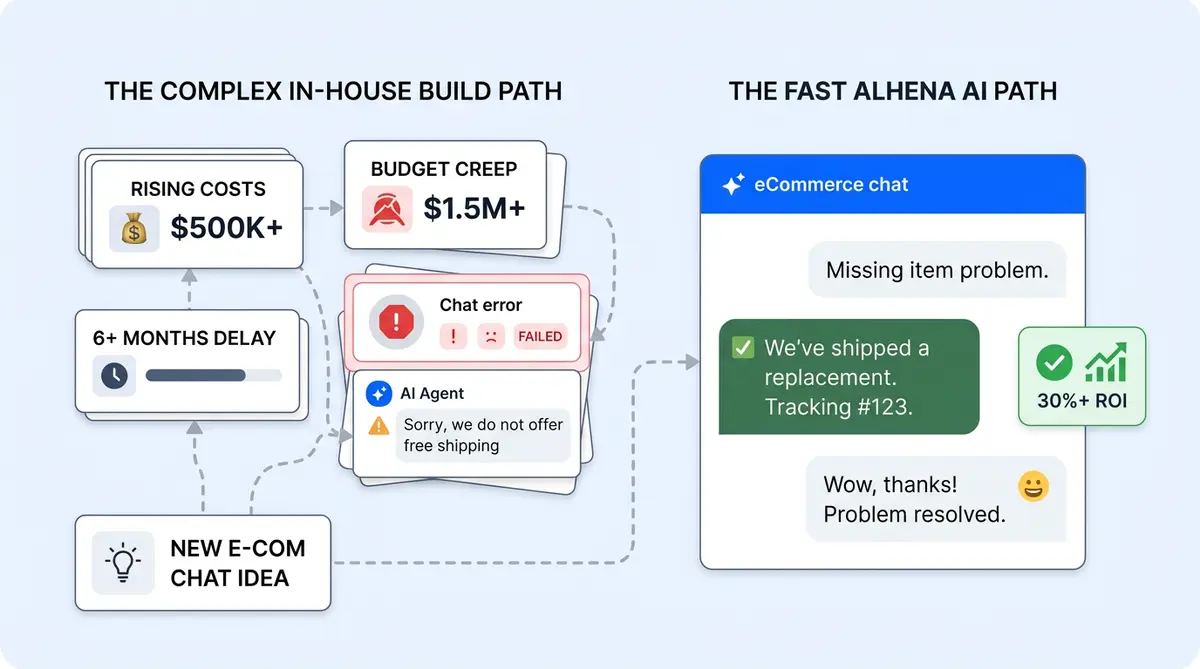
Building an in-house AI chatbot for ecommerce typically requires 6 to 12 months for a minimum viable deployment. That timeline covers generative AI model selection, prompt engineering, RAG pipeline construction, product catalog integration, hallucination prevention, helpdesk connection, QA testing, and user acceptance. Each step depends on the one before it, so delays cascade.
A purpose-built ecommerce AI platform deploys in days to weeks, accelerating adoption because these components are pre-built and pre-integrated. Alhena AI, for example, goes live in under 48 hours with no developer resources required.
For organizations in competitive markets or approaching peak seasons, the 6 to 12 month gap represents lost revenue you could accelerate that compounds every month the AI is not live. If your AI shopping assistant could lift conversion rates by even 1% (and the data from brands already using one suggests the lift is significantly higher), every month of delay has a real dollar cost. Tatcha saw 3x conversion rates and 11.4% of total site revenue flowing through their AI assistant. That's revenue a 12-month build cycle would have left on the table for an entire year.
Dimension 2: Engineering Cost and Talent
In-house AI requires ML engineers ($150K to $250K+ annually per head), prompt engineers, data engineers to maintain the product data pipeline, and ongoing DevOps for infrastructure. A mid-size ecommerce brand typically needs 2 to 4 dedicated engineers for the first year (at 2025 salary benchmarks), putting the all-in cost at $500K to $1M+ before the system handles a single customer conversation.
Platform adoption requires zero to one technical resources for integration and configuration. The math favors building only when you have existing AI engineering talent with spare capacity, which most ecommerce organizations simply do not have. Your engineers are already stretched across site performance, checkout optimization, and platform migrations.
There's also a retention risk that rarely makes the spreadsheet. AI engineers are among the most in-demand roles in tech today. If your lead ML engineer leaves midway through the build, the project stalls. Institutional knowledge walks out the door. With a platform, that single point of failure doesn't exist because the vendor's entire engineering team maintains the system.
Dimension 3: Ecommerce-Specific Complexity
The gap between a working chatbot and a commerce-ready AI chatbot is enormous. A general-purpose generative AI wrapper can answer basic questions. Commerce-ready AI requires all of the following working together:
- Real-time catalog integration with inventory and pricing updates, so the AI never recommends an out-of-stock item or quotes a stale price
- Order management system connectivity for tracking, returns, and refunds through Alhena's Order Management Agent
- Hallucination prevention grounded in verified product data, not general LLM knowledge
- Revenue attribution connecting conversations to purchases, so you can measure ROI from day one
- Omnichannel deployment across web chat, email, Instagram DMs, and WhatsApp
- Helpdesk integration for seamless human escalation through tools like Zendesk, Gorgias, or Freshdesk
Building each of these capabilities from scratch adds months to your timeline. AI platforms that have solved them across hundreds of brands offer them as configuration, not development. Alhena's native integrations with Shopify, WooCommerce, and Salesforce Commerce Cloud mean the catalog, order, and inventory data flows are already built.
Dimension 4: Maintenance and Improvement Burden
In-house AI requires ongoing retraining as products, policies, and promotions change. A brand with 5,000+ SKUs and seasonal rotations faces significant maintenance overhead. The AI degrades every time the catalog changes if someone does not manually update the training data. New product launches, price adjustments, discontinued items, updated return policies: each one is a potential source of outdated answers that frustrate shoppers today of outdated or wrong answers.
Self-improving platforms handle this automatically. Alhena's continuous learning architecture uses incremental training, auto-generated FAQs, and conversation analysis to get sharper with every interaction, without engineering intervention. The AI identifies gaps in your knowledge base, flags unanswered questions for your team, and updates its understanding as your catalog evolves.
Manawa experienced this firsthand: response time dropped from 40 minutes to under one minute, with 80% of inquiries fully automated. Crocus hit an 86% deflection rate at 84% CSAT. These results didn't require a team of engineers maintaining the system. The platform improved on its own.
Dimension 5: Competitive Differentiation
This is the one dimension where building can win. If your brand's AI needs to do something fundamentally unique that no platform supports (a proprietary recommendation algorithm, a deeply custom workflow that is core to your competitive advantage), building may be justified.
But for 90%+ of ecommerce brands, the differentiator is not the AI architecture itself. It's how you configure, train, and deploy AI against your specific catalog, brand voice, and customer base. A well-configured platform delivers that differentiation without the engineering overhead.
Consider what actually sets your brand apart in the eyes of a shopper. It's your products, your brand story, your curation, and your customer experience. Not whether your AI runs on a custom RAG pipeline or a managed one. Alhena's vertical AI agents (Fit Analyzer, Skin Analyzer, Outfit Builder) deliver category-specific intelligence for fashion, beauty, and lifestyle brands that no single in-house organization could build and maintain across multiple verticals simultaneously. Victoria Beckham drove a 20% AOV increase using this kind of pre-built vertical intelligence.
The Decision Matrix: Build, Buy, or Hybrid
Build if: you have existing AI engineering talent with spare capacity, a 12+ month timeline before you need results, a $500K+ annual budget dedicated to AI engineering, and a genuinely unique use case that no solution on the market addresses. This path makes sense for roughly 5 to 10% of ecommerce brands, typically those with in-house tech teams numbering in the hundreds.
Buy if: you need results in weeks not months. Your AI use cases are shopping assistance, support automation, and conversion optimization, which cover 90%+ of ecommerce needs. You don't have dedicated ML engineering headcount. And you want to focus internal resources on merchandising, marketing, and growth and innovation instead of AI infrastructure. This is the strategically smart path for the vast majority of ecommerce brands.
Hybrid if: you want to build proprietary recommendation logic or a custom scoring model but run it alongside a platform that handles the commerce plumbing. Catalog integration, agentic checkout, helpdesk routing, and omnichannel deployment stay on the platform side. Your custom logic plugs in through APIs. Alhena's Agent Assist supports exactly this model, letting your team build what's unique while the platform handles what's standard.
Why Alhena AI Collapses the Strongest Arguments for Building
The honest case for building in-house usually rests on five arguments: speed of customization, integration depth, accuracy control, learning over time, and analytics ownership. Alhena AI addresses each one directly:
- 48-hour deployment collapses the time-to-value gap that normally justifies a build timeline
- Native integrations with Shopify, WooCommerce, Salesforce Commerce Cloud, Gorgias, Zendesk, Freshdesk, and Kustomer remove months of integration engineering
- Hallucination-free architecture with built-in watchdog systems would take in-house staff 3 to 6 months to develop and validate
- Self-improving learning from every conversation removes the retraining burden that burns engineering hours month after month
- Revenue analytics connect conversations to purchases from day one, without building a custom attribution pipeline
Puffy reached 90% CSAT while automating 63% of inquiries. That's the kind of outcome that typically takes in-house engineers a full year to approach, delivered through a platform in weeks.
Key Takeaways
- The build vs. buy decision is really a capital allocation question. Every dollar and engineer-hour spent building AI infrastructure a platform already provides is a dollar not spent on the products, brand, and customer experiences that differentiate your business.
- Time to value is the most underestimated dimension today. A 6 to 12 month build cycle means 6 to 12 months of lost AI-driven revenue.
- Ecommerce-specific complexity (catalog sync, order management, hallucination prevention, omnichannel, attribution) makes a generic chatbot build far harder than it appears.
- Building only wins on competitive differentiation, and only when your use case is genuinely unique. For 90%+ of brands, it's not.
- The brands winning with AI in ecommerce are not the ones with the most custom code. They're the ones that deployed fastest, optimized soonest, and focused engineering on what only they can build.
Ready to see how the buy path works for your brand? Book a demo with Alhena AI or start for free with 25 conversations. Use our ROI calculator to model the revenue impact before you commit. Do your research first.
Frequently Asked Questions
How long does it take to build an AI shopping assistant in-house versus buying a platform like Alhena AI?
Building an in-house AI shopping assistant typically takes 6 to 12 months covering LLM selection, RAG pipeline construction, catalog integration, hallucination prevention, and helpdesk connectivity. Alhena AI deploys in under 48 hours with pre-built integrations for Shopify, WooCommerce, Salesforce Commerce Cloud, and major helpdesks, collapsing the time-to-value gap from months to days.
What are the hidden costs of building ecommerce AI in-house that most teams miss?
Beyond engineer salaries ($150K to $250K+ per ML engineer), hidden costs include data pipeline maintenance as your catalog changes, retraining the model for new products and promotions, hallucination prevention engineering, integration upkeep across your tech stack, and talent retention risk. Alhena AI's self-improving architecture and native commerce integrations eliminate these ongoing burdens, letting your team focus on growth instead of AI infrastructure.
When should an ecommerce brand build AI in-house instead of buying a platform?
Building makes sense when you have existing AI engineering talent with spare capacity, a 12+ month timeline, a $500K+ annual AI budget, and a genuinely unique use case no platform addresses. For the 90%+ of brands whose needs center on shopping assistance, support automation, and conversion optimization, a purpose-built platform like Alhena AI delivers results faster at a fraction of the cost.
Can a purchased AI platform match the customization of an in-house build for ecommerce?
Modern ecommerce AI platforms offer deep customization through APIs, configurable workflows, and vertical AI agents. Alhena AI provides category-specific intelligence (Fit Analyzer, Skin Analyzer, Outfit Builder) alongside Agent Assist for human-AI collaboration and custom business rules. The hybrid model lets you build proprietary logic while the platform handles catalog sync, checkout, omnichannel deployment, and revenue attribution.
How does Alhena AI prevent hallucinations without requiring in-house engineering?
Alhena AI uses a hallucination-free architecture with built-in watchdog systems that ground every response in your verified product data, order records, and policy documents. If the answer is not in your catalog, the AI says so instead of guessing. Building equivalent accuracy safeguards in-house typically requires 3 to 6 months of dedicated engineering and ongoing monitoring that Alhena handles automatically.