AI language model powered search now influences over $595 billion in retail ecommerce, according to Euromonitor. AI-driven referral traffic to ecommerce sites grew 302% in 2025 alone, and 58% of consumers have already replaced traditional search with generative AI for product discovery. For ecommerce brands, this means one thing: if your products don't show up when ChatGPT, Perplexity, or Google AI Overviews answer a shopping question, you lose the customer before they ever visit your online store. The user experience of product discovery has shifted from search engine results pages to AI-generated content.
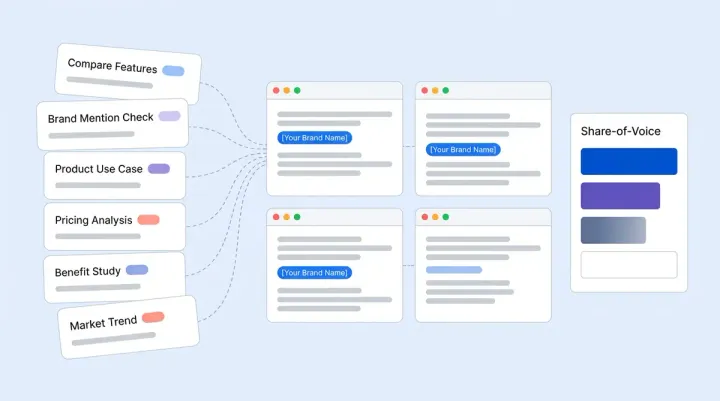
That shift created a new category of software: AI visibility tools. These platforms track how brands and products appear across AI answer engines and search engine alternatives. But not all of them solve the same problem, and most weren't built with ecommerce in mind. This guide ranks the 10 best AI visibility tools for 2026, each tracked and evaluated on its pros, evaluated against three criteria that matter most to ecommerce brands: SKU-level product tracking, revenue attribution, and first-party ecommerce data integration.
What to Look for in an AI Visibility Tool for Ecommerce
Most AI visibility platforms were designed for SEO and content teams tracking brand mentions. Ecommerce brands need something different. Before comparing tools, here are the three criteria that separate ecommerce-ready platforms from generic monitoring dashboards:
- SKU-level product tracking: Does the tool track individual products, or just your brand name? Knowing "our brand appeared in 40 AI answers" doesn't help you understand which products are visible and which are invisible.
- Revenue attribution: Can you connect AI visibility to actual sales? Monitoring without attribution is a reporting exercise, not a brand visibility strategy.
- First-party ecommerce data integration: Does the tool pull from your product catalog, store data, and conversion metrics? Or does it sit in a silo, disconnected from your commerce stack?
Keep these three filters in mind as you evaluate each tool’s approach to search visibility below.
The 10 Best AI Visibility Tools for Ecommerce in 2026
1. Alhena AI Visibility
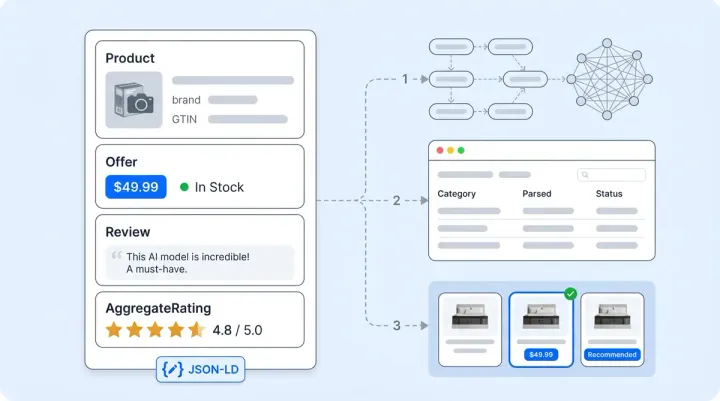
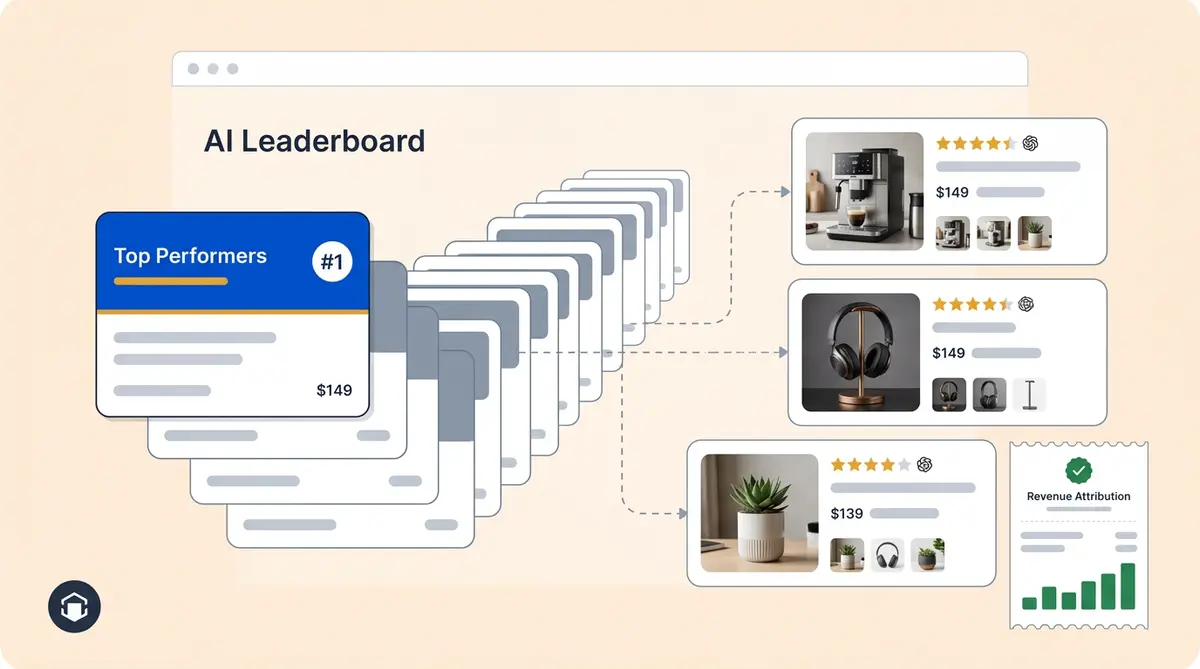
Alhena AI Visibility is the best tool on this list for ecommerce product tracking, built from the ground up. It monitors how individual SKUs appear across ChatGPT, Google AI Overviews, Perplexity, and Gemini, including rendering analysis that shows whether product cards display with pricing, ratings, and images or just a brand mention. What sets it apart is closed-loop revenue attribution: Alhena connects SKU-level visibility data to actual shopping assistant conversions and sales, so you can trace a product's AI appearance directly to revenue.
Key strength: The only platform that combines SKU-level tracking, rendering analysis, and revenue attribution on top of first-party ecommerce data. Its AEO FAQ Engine and GEO Citation Strategy tools help you improve visibility, not just monitor it.
Limitation: Newer entrant compared to established SEO platforms like Semrush or Ahrefs, so teams deeply embedded in those ecosystems need to adopt a separate tool.
2. Semrush AIO
Semrush's AI Optimization module tracks brand visibility across ChatGPT, Perplexity, Claude, Gemini, and DeepSeek. Its AI search forecasting projects potential traffic gains from improved AI visibility, and brands like Amazon and LG Electronics use it for competitive benchmarking.
For a practical walkthrough on tracking and attributing revenue from these AI platforms, see our LLM traffic attribution guide.
Key strength: The best brand-level AI monitoring platform for SEO teams, backed by Semrush's massive keyword and backlink data.
Limitation: Built for SEO teams, not ecommerce operators. No native SKU tracking, no revenue attribution, no ecommerce platform integrations. Enterprise-only pricing and custom plans put it out of reach for most mid-market brands.
3. Otterly
Otterly.ai is a Gartner Cool Vendor that tracks brand citations across six AI platforms: ChatGPT, Perplexity, Google AI Overviews, AI Mode, Gemini, and Microsoft Copilot. Its prompt research feature helps discover what audiences are asking AI engines.
Key strength: Best multi-engine coverage among mid-market tools, with a clean interface and strong prompt discovery.
Limitation: Brand-level monitoring only. No SKU tracking, no revenue attribution, no technical ecommerce data integration. It reads brand signals but misses product-level detail. Prompt-based pricing (each prompt per engine counts separately) makes product-line monitoring expensive fast.
4. Profound
Profound ($1B valuation, $155M raised) sends millions of prompts daily to 10 AI engines. It recently launched a Shopping Analysis module that tracks product images, placement, and retailer benchmarking in AI shopping conversations.
Key strength: Best AI engine coverage (10 platforms) and the new Shopping Analysis module brings genuine SKU-level tracking to the enterprise market.
Limitation: Shopping Analysis is an add-on, not a core architecture. No revenue attribution, no ecommerce platform connections. Enterprise pricing limits accessibility.
5. Promptwatch
Promptwatch takes a prompt-first approach, tracking actual user questions rather than keywords across ChatGPT, Claude, Gemini, Perplexity, and DeepSeek. Its Research feature suggests new prompts based on your website content.
Key strength: Prompt-based monitoring mirrors the real user experience, providing more authentic visibility data than keyword-based alternatives.
Limitation: General-purpose brand tool with no ecommerce features. No SKU tracking, no revenue attribution. The Essential plan ($89/mo) limits you to one website and one seat.
6. Peec AI
Peec AI ($21M Series A) uses UI scraping technology to interact with AI models exactly as real users do, tracking share of voice, mention positioning, and sentiment across ChatGPT, Gemini, and Copilot.
Key strength: UI scraping delivers highly authentic data with strong accuracy. Strong early traction with brands like Wix (5x YoY increase in LLM traffic).
Limitation: Built for B2B/SaaS marketing and SEO, not ecommerce product discovery. Brand-level only, no SKU tracking, no revenue attribution. Per-platform pricing adds up quickly.
7. Authoritas
Authoritas offers customizable prompt tracking across seven AI engines with a specific retail module. You can upload product names, categories, and catalog feeds to build custom tracking sets, and it supports multi-language, multi-market monitoring.
Key strength: Best customizable prompt tracking among all tools reviewed. Multi-market support and technical depth are strong for international brands.
Limitation: While you can upload product keywords, it remains a visibility monitoring tool without revenue attribution. No live catalog sync. Pricing starts at $1,499/month.
8. Ahrefs Brand Radar
Ahrefs Brand Radar draws from a database of 250+ million prompts to show how brands appear across six AI engines. Custom AI prompt tracking (added January 2026) lets teams monitor brand-specific queries.
Key strength: Massive pre-built prompt database gives immediate broad visibility. Good entry point for existing Ahrefs customers.
Limitation: Keyword-level snapshots with known accuracy gaps, not live monitoring. Doesn't track ChatGPT Shopping or product card rendering. Missing Claude and Meta AI coverage. Add-on pricing ($199-$699/month) stacks on top of your base Ahrefs subscription.
9. Birdeye Search AI
Birdeye Search AI tracks AI visibility across ChatGPT, Gemini, Perplexity, and Bing AI, with automated agents and automation workflows that can fix visibility gaps at scale. It compares performance across regions and locations.
Key strength: Best for multi-location businesses with autonomous optimization agents that go beyond monitoring to fix issues.
Limitation: Designed for location-based businesses (retail chains, restaurants), not product-based ecommerce. Tracks location visibility, not SKU visibility. Not suitable for DTC or online-only brands.
10. Recomaze
Recomaze calls itself an "AI Commerce OS." Rather than monitoring external AI visibility, it deploys an AI sales agent on your storefront and includes an AI Discoverability Audit that scores your catalog's readiness for AI systems. It integrates natively with Shopify, WooCommerce, and BigCommerce.
Key strength: Strong ecommerce integration with native store connections and on-site revenue tracking. Its catalog enrichment helps AI systems understand your products better.
Limitation: Not a true AI visibility monitoring tool. It doesn't track how your products appear across ChatGPT, Perplexity, or Google AI Overviews. More of an on-site conversion tool than a cross-platform visibility platform.
AI Visibility Tools Comparison Table
The table below scores each tool against the five evaluation criteria that matter most for ecommerce brands. Use it as a quick reference when narrowing your shortlist.
AI Visibility Tools: Ecommerce Criteria Comparison
| Tool | SKU-Level Tracking | Revenue Attribution | First-Party Data | Multi-Engine | Ecommerce Focus |
|---|---|---|---|---|---|
| Alhena AI Visibility | Yes | Yes | Yes | Yes | Yes |
| Semrush AIO | Partial | No | No | Yes | No |
| Otterly | No | No | No | Yes | No |
| Profound | Yes | No | No | Yes | Partial |
| Promptwatch | No | No | No | Yes | No |
| Peec AI | No | No | No | Yes | No |
| Authoritas | Partial | No | No | Yes | Partial |
| Ahrefs Brand Radar | No | No | No | Yes | No |
| Birdeye Search AI | No | No | No | Yes | No |
| Recomaze | Partial | Partial | Yes | No | Yes |
Why Most AEO Tools Fall Short for Ecommerce
The pattern in this list is clear: 8 out of 10 tools were built as SEO tools or brand marketing platforms first, then extended to cover AI search. That SEO-first origin shapes their architecture. Their content creation features focus on articles and blog posts, not product catalog optimization. They track brand mentions and website citations, not product cards, pricing displays, or shopping recommendations.
For an ecommerce CMO, that creates an analytics problem and a blind spot. You might know your brand was mentioned in a ChatGPT answer about "best running shoes," but you won't know which specific shoes were recommended, whether pricing and reviews showed up, or whether that mention drove any revenue. That gap between "mentioned" and "sold" is where most AI visibility tools stop, and where Alhena AI Visibility picks up.
Profound's new Shopping Analysis module is a step in the right direction, adding SKU-level tracking for enterprise brands. Authoritas lets you upload product keywords for monitoring. But neither connects visibility data to your actual sales metrics or syncs with your live catalog. The attribution loop stays open.
Connecting AI Visibility to Revenue: What Ecommerce Brands Actually Need
Tracking visibility without tying it to revenue is like measuring foot traffic without counting sales. Ecommerce leaders need a closed loop: see which products AI engines surface as personalized recommendations, understand how those recommendations render (with or without pricing, ratings, and product images), and measure the downstream impact on conversions.
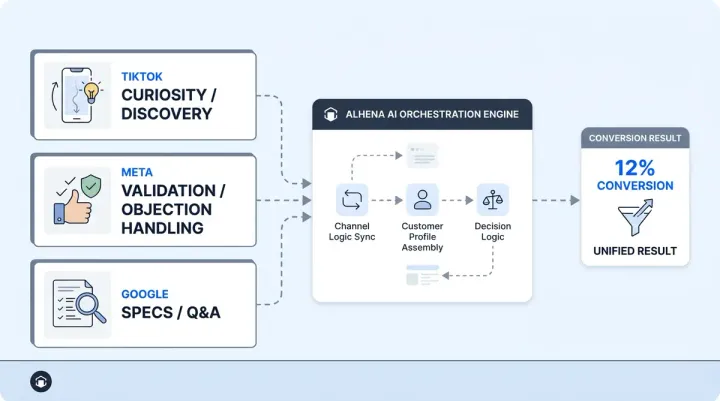
Alhena achieves this by sitting on top of first-party ecommerce data. Because it integrates with your storefront and shopping assistant, it can trace the path from "Product X appeared in a ChatGPT Shopping answer" to "Product X generated $Y in revenue this month." That's the difference between a monitoring dashboard and a growth tool.
Brands already using Alhena's ecommerce AI platform see results like 3x conversion rate improvements and measurable revenue growth and 38% AOV uplift at Tatcha, and 20% AOV increase at Victoria Beckham Beauty. AI Visibility adds a new dimension to those outcomes: understanding which AI engines drive the most valuable product recommendations.
How to Choose the Right AI Visibility Tool
Your choice depends on your content strategy, primary use case, and growth plans:
- If you need SKU-level ecommerce tracking with revenue attribution: Alhena AI Visibility is the only tool that delivers all three ecommerce criteria. It's purpose-built for brands that sell products, not just publish content.
- If you need enterprise brand monitoring at scale: Semrush AIO or Profound give you the broadest AI engine coverage for tracking brand-level visibility across markets.
- If you need multi-location retail visibility: Birdeye Search AI is designed specifically for brick-and-mortar chains managing AI presence across hundreds of locations.
- If you need a fast, affordable brand monitoring starter: Otterly or Promptwatch offer clean, focused interfaces for teams just beginning to track AI visibility.
- If you need on-site AI optimization for your catalog: Recomaze's Discoverability Audit and on-site agent help make your product data more AI-friendly, though it won't monitor external visibility.
For ecommerce brands focused on connecting AI search appearances to actual sales, the choice is straightforward. Alhena AI Visibility fills the gap that every other tool on this list leaves open: the link between "your product showed up in an AI answer" and "that answer generated revenue."
Ready to see how your products appear across AI engines, and which appearances actually drive sales? Book a demo with Alhena AI or start for free with 25 conversations.

Frequently Asked Questions
What is an AI visibility tool, and why do ecommerce brands need one?
An AI visibility tool tracks how your brand and products appear in AI-generated answers from engines like ChatGPT, Perplexity, and Google AI Overviews. Ecommerce brands need one because 58% of consumers now use generative AI for product discovery. If your products don't appear in AI answers, you lose sales before customers ever reach your site. Alhena AI goes further than most tools by tracking individual SKUs and connecting visibility to actual revenue.
How do I measure ROI from an AI visibility tool?
Look for a tool that connects AI appearances to downstream metrics: click-throughs, conversions, and revenue. Most AEO tools only show mention counts and share of voice, which don't translate to business impact. Alhena AI Visibility provides closed-loop revenue attribution, so you can see exactly how much revenue each AI engine drives for each product in your catalog.
What is the difference between AEO tools and traditional SEO tools?
SEO tools track rankings on Google's organic results pages. AEO (Answer Engine Optimization) tools track how brands appear in AI-generated answers across ChatGPT, Perplexity, Gemini, and similar platforms. The key difference: AI answers often recommend specific products without linking to your website, so traditional SEO metrics don't capture this visibility. Alhena AI monitors both brand mentions and product-level rendering across AI engines.
Can AI visibility tools track individual product SKUs, or just brand mentions?
Most AI visibility tools track brand mentions only. Of the 10 tools in this comparison, only Alhena AI Visibility and Profound (via its Shopping Analysis module) offer true SKU-level tracking. Authoritas and Recomaze offer partial SKU tracking through manual uploads or on-site audits. For ecommerce brands with large catalogs, SKU-level granularity is essential to understand which products AI engines recommend and which remain invisible.
How does Alhena AI Visibility compare to Semrush AIO for ecommerce?
Semrush AIO is a strong brand-level monitoring platform built for SEO teams. Alhena AI Visibility is purpose-built for ecommerce, with SKU-level product tracking, revenue attribution, and first-party store data integration that Semrush doesn't offer. If your goal is tracking brand mentions across AI engines, Semrush works well. If you need to know which products are recommended and how those recommendations impact sales, Alhena AI is the better fit.
Do AI visibility tools work with Shopify and WooCommerce stores?
Most AI visibility tools operate independently of your ecommerce platform. They don't integrate with Shopify, WooCommerce, or other storefronts. Alhena AI is the exception: it connects directly to your store data, syncs your product catalog, and attributes AI visibility to actual conversions. Recomaze also offers native Shopify and WooCommerce integrations, but it focuses on on-site optimization rather than cross-platform AI visibility monitoring.
What AI search engines should ecommerce brands monitor in 2026?
At minimum, monitor ChatGPT (including ChatGPT Shopping), Google AI Overviews, Perplexity, and Gemini. These four handle the vast majority of AI-powered product discovery. Alhena AI Visibility covers all four plus additional engines. Some tools like Profound cover 10 engines, but broader coverage matters less than the depth of ecommerce-specific data you get from each engine.
Is answer engine optimization (AEO) replacing traditional SEO for ecommerce?
AEO isn't replacing SEO, but it's becoming a parallel channel that ecommerce brands can't ignore. AI-driven web traffic referrals to ecommerce sites grew 302% in 2025, and AI-powered search is projected to influence $595 billion in retail ecommerce by 2028. Brands that treat AEO as an add-on to their SEO strategy, rather than a separate discipline, will capture the most value. Alhena AI helps ecommerce teams manage both by connecting AI visibility data to existing commerce metrics.