A shopper who uploads a photo has handed an AI shopping agent information they could not have typed into a search box. Undertone, room proportion, hair condition, actual fit.
Photo inputs are among the highest-value and most personal signals an AI shopping agent receives. In Alhena's 2026 stress test, shoppers uploaded selfies for shade and hair-colour matching and room photos for furnishing advice. The weakest AI agents accepted the image and ignored it, returning bestsellers instead. The standard is limited purpose: use the visual input for the task, explain what is happening and store the useful conclusion rather than automatically keeping the image.
What visual tasks were actually tested?
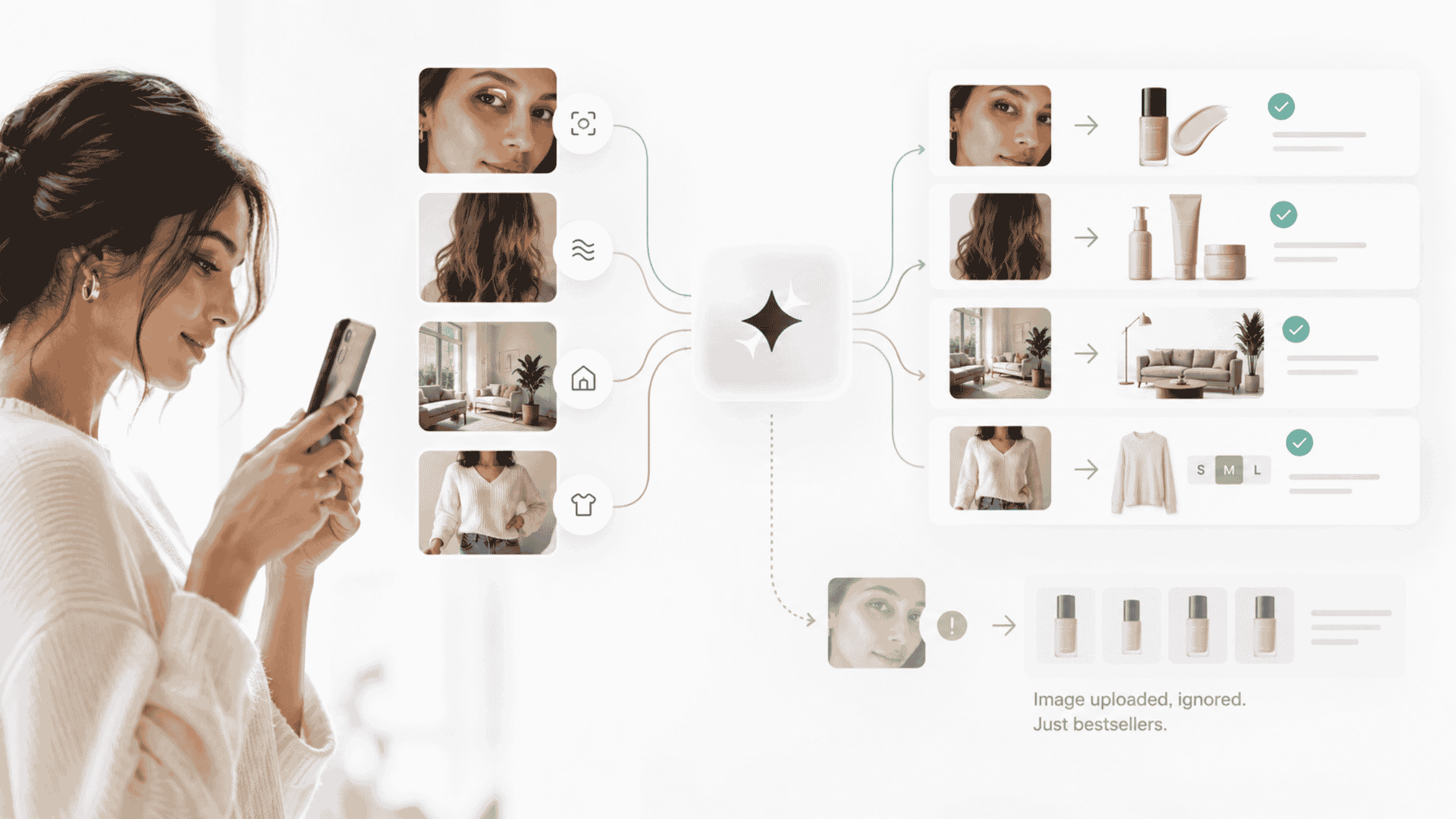
Visual AI in ecommerce is most useful when the image changes the shopping decision. These were four of the signature visual tasks evaluated in Alhena's research.
A selfie, for foundation shade
Undertone, depth and a commitment to a specific shade. Image recognition alone is not enough. The AI needs to interpret the visual signal and help the shopper find a product that fits.
A selfie, for hair colour
Currently bleached, curly, wants to go lighter. The image carries what the shopper cannot articulate: visible tone, damage and texture.
A room photograph
Small, dark, rented. Visual intelligence can analyze scale, light and sightlines while respecting constraints that affect what the retailer should recommend.
A photo for a size call
Reading proportion and fit rather than trusting a stated number. The goal is to reduce uncertainty and help the shopper shop with more confidence.
What are the two photo failure patterns?
1. The image is accepted and ignored
The most common failure. A shopper uploads their face and receives bestselling foundations. They upload their bedroom and receive the popular floor lamp.
This is catalog dumping, present in 5 of 15 deployments, and it is especially jarring because the shopper has just done something effortful and personal.
The cause is often architectural. A ranking model or recommendation algorithm has nowhere meaningful to use the image, so the system accepts the upload and falls back on popularity. The AI appears to support image recognition, but the visual signal never materially changes the result.
2. The image is read, then abandoned
The subtler failure is when the agent analyzes the photo well, produces a genuinely useful reading and then names a product without routing the shopper to it.
Dead-end recommendation appeared in 6 of 15 deployments and UI disconnect in another 6 of 15. After a shade analysis, sending the shopper to a forty-tile search result is where the value evaporates.
A strong ecommerce journey closes the loop: image → analysis → recommendation → product → action.
How is visual intelligence different from visual search?
Visual search has helped consumers discover products for years. A shopper can upload an image, search for a similar image or browse visually related items. Platforms such as Pinterest helped make visual discovery familiar, especially in fashion, interiors and lifestyle categories.
But an AI shopping agent can go beyond returning visually similar products. Visual intelligence combines the image with shopper intent, conversation context and product data.
| Capability | Primary job | Example |
|---|---|---|
| Image recognition | Recognize or classify image features and objects | Identify a chair, dress or visible product |
| Visual search | Find visually similar products or images | Browse products that look like an uploaded item |
| Visual intelligence | Analyze visual context to support a decision | Recommend furniture that fits the actual room and constraints |
| AI shopping agent | Combine visual input, intent and product data | Interpret a selfie and route the shopper to a specific shade |
The difference matters. A conventional visual search system may find product similarity. A stronger AI can ask what the shopper is actually trying to achieve, what the image reveals that text cannot and whether a visually similar item is genuinely appropriate.
That is the difference between finding products from an image and reasoning about an image to make a shopping decision.
How does AI visual intelligence work in ecommerce?
Modern image recognition and visual AI rely on machine learning models to analyze patterns in images. Depending on the implementation, the underlying technology can use neural network systems to detect objects, classify image content and measure visual similarity.
But being able to classify image content or recognize an object is only one part of the shopping problem. A machine learning system may correctly recognize image features without knowing what the consumer actually needs to buy.
The useful ecommerce architecture connects:
For example, an algorithm may identify similarity between an uploaded image and thousands of catalog items. But the most similar item is not always the best recommendation.
A retailer needs AI technology that can analyze the image in context, combine it with the conversation and help the shopper find a product that solves the actual problem. That is where visual intelligence becomes a decision layer rather than simply another search feature.
What does good visual reasoning look like?
- It commits. A specific shade, size, product or plan when the evidence supports one, not a generic shortlist handed back to the person who uploaded an image because they could not decide.
- It shows relevant reasoning. “Your undertone reads neutral-warm, so the golden family will sit better than the pink-based ones.”
- It respects constraints. The room is rented. The hair is already bleached. The AI should combine what it can analyze visually with what the shopper tells it.
- It closes. Product card in-thread, direct product match or add to cart. The recommendation should not force the shopper to restart the search.
- It knows when the honest answer is no. For bleached, damaged hair the responsible response may be “not in one step, and here's why.”
That last point is where unsafe confidence (3 of 15) does real damage in visual categories. Predictive AI should not present uncertain outcomes as guarantees.
How should retailers handle photo inputs responsibly?
The principle is limited purpose. For retailers implementing AI in retail, that means using the image for the task the shopper expects and avoiding silent reuse.
- Use it for the task, then be done with it. A shade match needs the photo at the moment of matching, not permanently.
- Say what's happening. “I'll analyze the lighting and visible undertone in this image to help match a shade.” Plain language, not a legal wall.
- Be conservative with faces and homes. A face is biometric-adjacent and a room photo may contain information the consumer did not intend to share.
- Don't repurpose silently. Retention, training or profile attachment should be a stated choice with an easy no.
- Store the conclusion, not the image. “Neutral-warm undertone, shade 240” can be more useful for memory and far less sensitive than retaining the raw upload.
Why is visual intelligence becoming important for AI in retail?
AI in retail is moving beyond text-only chatbots. Retailers are building AI experiences that help consumers search, browse, compare products, discover relevant items and make decisions.
Visual intelligence adds another layer of information to that experience.
A shopper can type, “I need a beige sofa.” But an image can communicate the actual room, available space, lighting and the items already in it.
That is why visual AI can improve product discovery in categories where the biggest barriers are difficult to express through filters. Beauty, fashion, hair colour and home are clear examples.
For an online shop, the opportunity is not simply to add an upload button. The opportunity is to build an AI-powered experience where the image actually changes what the system recommends.
Why is this capability worth getting right?
Visual input is one of the few places where an AI agent can be obviously better than a traditional search box.
Nothing in a standard ecommerce filter fully captures undertone, room proportion, hair condition or actual fit. An AI shopping agent that reasons from those signals can reduce uncertainty at critical moments in the buying journey.
Key takeaways
- Four signature tasks in Alhena's study were explicitly visual: two selfies, a room photo and a fit call.
- Catalog dumping appeared in 5 of 15 deployments: the image was accepted but did not influence the recommendation.
- Dead-end recommendations appeared in 6 of 15 deployments: useful analysis was not connected to a clear product action.
- Visual search and image recognition are not enough on their own: AI needs to combine visual signals with shopper intent and product context.
- Good visual intelligence commits to a specific answer when the evidence supports one and explains relevant reasoning.
- Limited purpose is the standard: use the image for the requested task, explain what is happening and store the conclusion rather than automatically retaining the raw upload.
Frequently asked questions
You are handling one of the most valuable signals in the shopping conversation and one of the most personal. The standard worth demanding is limited purpose: use the image for the requested task, explain what the AI is doing and store the derived conclusion rather than automatically retaining the photo.
The system may be accepting the image and ignoring it, then falling back on popularity or generic ranking. Alhena logged this as catalog dumping in 5 of 15 deployments. The upload becomes theatre when the visual signal never changes the recommendation.
No. Image recognition can recognize image features, objects or categories. Visual intelligence goes further by analyzing those signals in context and using them to support a shopping decision, such as connecting a selfie to a specific foundation shade.
Traditional visual search often focuses on similarity, helping users browse products that look like an uploaded or similar image. An AI shopping agent can combine visual search with shopper intent, conversation context and product data to make a more specific recommendation.
Yes. AI can use image recognition, visual search and machine learning to analyze an uploaded image and identify relevant products. Strong ecommerce experiences go further by considering what the shopper is actually trying to achieve.
Yes. One plain sentence can improve transparency and trust because it confirms why the image is being analyzed and how it supports the requested shopping task.
The safer pattern is usually to store the derived conclusion, such as undertone and shade, rather than automatically retaining the raw image. The conclusion can be more useful for future shopping memory and far less sensitive.
Natural light and an unfiltered image can matter more than high resolution for tasks such as foundation matching. The AI should explain what it needs to analyze so the shopper can provide a useful upload.
AI can analyze visible proportion and fit signals, although confidence should depend on the available information. A strong shopping agent makes a useful size recommendation when the evidence supports one rather than simply defaulting to the number the buyer originally stated.
Yes. Visual AI can analyze room images for visible scale, light and layout to support product discovery. Strong systems also combine the image with constraints such as renting, budget and installation limits.
A similar image search helps users discover visually related products based on an uploaded photo or reference image. It can be useful for fashion and home discovery, but visual similarity does not always mean the product is the best match for the shopper's actual needs.
A strong response makes a specific commitment, explains the relevant reasoning, respects constraints and provides a direct route to the recommended product. The AI should not make the shopper restart the search after completing the visual analysis.
For visually complex categories, visual intelligence can capture information customers struggle to express through search filters, including undertone, proportion, fit and room context. This can make AI product discovery meaningfully better than conventional browsing.
AI can make predictive recommendations based on available visual and contextual signals, but it should not present uncertain predictions as guarantees. The best systems are transparent about what the image supports and where additional information is needed.
Yes. When the evidence does not support a safe or confident recommendation, the AI should explain the limitation rather than invent certainty. Hair colour is a clear example. Alhena logged unsafe confidence in 3 of 15 deployments, and visual categories are where overconfident AI can create real problems.
Retailers should test whether the image actually changes the recommendation, whether the AI can explain relevant reasoning, whether the shopper can reach the recommended product and whether sensitive visual inputs are handled with limited purpose.
Visual AI and chatbots solve different parts of the shopping experience. Traditional chatbots primarily work with text, while a multimodal AI shopping agent can combine conversation with image analysis, visual search and product data.
Yes. AI visual intelligence can improve product discovery by helping consumers search and shop using information that is difficult to describe with text. The biggest value comes when visual understanding is connected directly to relevant products and clear actions.
See how visual reasoning performed across verticals
Beauty, hair colour, fashion fit and home. Every visual task scored across 15 live deployments in Alhena's 2026 stress test of AI shopping experiences.