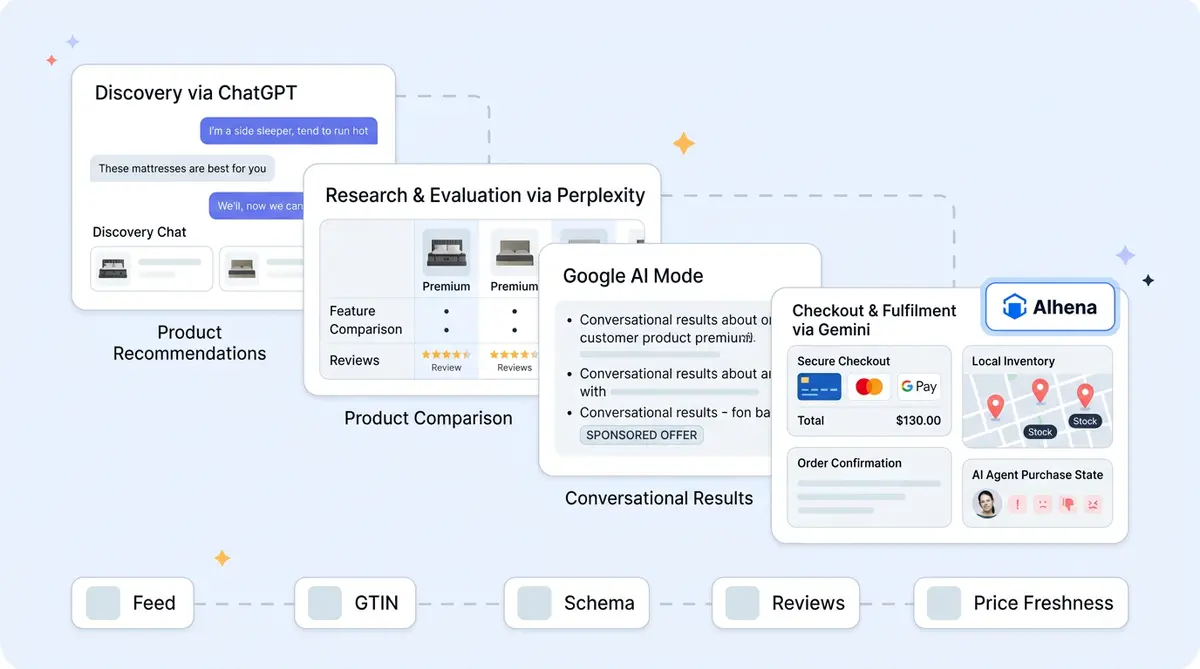
Merchants in 2026 don't face one AI shopping channel. They face four distinct ecommerce platforms powered by AI: ChatGPT, Perplexity, Gemini, and Google AI Mode. Each pulls product and inventory data differently, charges different fees, routes checkout differently, and attracts a different shopper profile. Treating them as a single monolithic "AI channel" is a strategic mistake that leads to wasted feed and inventory sync work, missed revenue, and blind spots in performance data. For any ecommerce store trying to choose the right best AI tools for personalized product discovery, understanding each platform's mechanics is essential.
This comparison covers all four AI shopping platforms across six dimensions that matter to ecommerce decision-makers: feed requirements, cost models, checkout flows, analytics visibility, audience demographics, and discovery mechanics. It then offers a prioritization framework so ecommerce brands can sequence their investment rather than spreading thin across every AI tool at once.
Feed Requirements: What Each AI Shopping Platform Expects
The feed specs across these four ecommerce platforms diverge more than most ecommerce teams realize. Each AI tool ingests product data through different protocols, formats, and refresh cycles.
ChatGPT ingests product catalog and inventorys through OpenAI's Agentic Commerce Protocol (ACP) or through Shopify's Agentic Storefronts, which auto-syndicate your Shopify catalog to the AI assistant. Non-Shopify ecommerce merchants apply at chatgpt.com/merchants and submit feeds via API. Required fields include title, product descriptions, price, availability, images, and GTINs. Refresh cycles are near real time for Shopify stores but slower for direct API feeds, with updates propagating within hours. ChatGPT does not support custom fields like "intended purpose" or lifestyle tags. Shopify merchants using the Shop app or Shopify's native AI tools get the smoothest onboarding since the Shopify ecosystem handles feed syndication autonomously.
Perplexity accepts the Google Shopping CSV spec delivered via SFTP. GTINs are mandatory, not optional. Products without UPCs simply don't appear. Real time pricing accuracy matters heavily because Perplexity's best AI agent cross-references your feed against live site data and suppresses listings with price mismatches. Schema.org JSON-LD markup on your product pages gives an additional ranking signal. Feed onboarding takes four to six weeks. For ecommerce stores with large catalogs, automating feed updates through a product information management system is the best AI-ready approach to keep data fresh.
Google AI Mode pulls from your existing Google Merchant Center feed, the same one powering traditional Shopping ads. But AI Mode rewards additional conversational attributes: answers to common product questions, compatible accessories, substitute products, and "intended purpose" fields that don't exist in standard Shopping feeds. Refresh cycles match Merchant Center's existing cadence (typically every 30 minutes for active feeds). Ecommerce brands already running Shopify, WooCommerce, or Magento can use their existing Merchant Center setup. Adding richer product descriptions with natural language detail improves how the AI assistant surfaces your listings.
Gemini shares Google's Merchant Center infrastructure but layers in account-level personalization. Products surface based on your feed data plus the shopper's purchase history with linked retailers. Gemini's AI agents also read structured data from your site, so Schema.org Product markup matters even beyond the feed itself. Shopify merchants with Google channel integration benefit from automated through automation catalog sync, and Shopify's Shop app data can feed into Gemini's personalized product discovery.
Commission and Cost Models: Free Plans, Paid Plans, and Pricing Tiers
This is where the four ecommerce platforms diverge sharply. Understanding each pricing tier helps ecommerce brands choose the right AI tools without overspending.
ChatGPT charges a 4% transaction fee through ACP plus standard payment processing costs. There are no listing fees and no paid plans for merchants to boost visibility. Ecommerce stores keep the remaining revenue but absorb the commission on every AI-attributed sale. OpenAI has not announced enterprise pricing tiers or volume discounts for larger ecommerce businesses.
Perplexity charges nothing. Zero listing costs, zero commissions, zero transaction fees. Ecommerce merchants retain 100% of revenue from every sale. Perplexity monetizes through its Pro subscription model (a paid plan for consumers) and previously through ads, though the company eliminated all advertising in 2026, betting entirely on user trust. The free plan for merchants makes it the best AI shopping channel for ecommerce brands that want to test AI-powered product discovery without financial risk.
Google AI Mode supports shopping ads inside AI conversations, labeled as "sponsored." Ecommerce merchants bid through existing Google Ads campaigns. A "Direct Offers" feature lets you present exclusive discounts to high-intent shoppers mid-conversation. The cost model mirrors traditional Google Shopping: CPC bidding with AI Mode treated as an additional placement surface. Enterprise ecommerce brands running large ad budgets can use AI tools within Google Ads to automate bid management and audience targeting. Paid plans and free plans both exist depending on your campaign setup, with pricing tiers scaling by volume.
Gemini does not charge ecommerce merchants directly. Product visibility comes from Merchant Center feeds and Shopping Graph data. Google monetizes Gemini through its broader ecosystem (Google One subscriptions as a paid plan, Shopping ads in linked surfaces) rather than per-transaction merchant fees. Enterprise ecommerce businesses benefit from the free plan structure since Gemini visibility requires no incremental spend beyond existing Merchant Center setup.
Checkout Flows: Redirect vs In-Platform AI Agent Checkout
Where the transaction happens matters for conversion rate, customer data ownership, and the overall personalized customer experience across your ecommerce store.
ChatGPT redirects shoppers to ecommerce merchant websites to complete their cart and purchase. OpenAI abandoned its in-chat Instant Checkout feature in March 2026 after low adoption, with fewer than a dozen Shopify merchants ever integrating it. The current model is product discovery first: ChatGPT's AI assistant surfaces products, shoppers click through to your ecommerce store to buy. The AI agent handles research and comparison autonomously but leaves the transaction to the merchant.
Perplexity offers a hybrid model. Products with "Buy with Pro" or PayPal checkout enabled can process transactions inside Perplexity's interface. Most purchases still route through PayPal's flow to ecommerce merchant sites, but the in-platform option exists and gives those ecommerce stores a ranking boost in AI-powered product discovery results. The chatbot-like personalized shopping experience keeps shoppers engaged while the AI assistant guides them through pre-sale questions.
Google AI Mode behaves like enhanced Shopping ads. Clicks drive traffic to your ecommerce product pages and checkout. There's no in-platform cart and purchase flow. Ecommerce merchants retain full control of the checkout and customer experience. For Shopify stores, the click-through lands on your Shopify storefront where your own chatbot or AI assistant can continue the conversation.
Gemini goes furthest. Google's AI agent can browse products, compare options, check local inventory. Real-time inventory data feeds into Gemini's recommendations, so out-of-stock items are automatically suppressed, add items to a cart, and complete purchases using Google Pay without leaving the shopping app. Shoppers can even set conditional purchases ("buy this if the price drops below $50"). For ecommerce merchants, this means the AI agent closes the sale entirely in-platform, handling pre-sale questions, cart population, and payment autonomously. Gemini functions as the most automated AI assistant in the current landscape.
Analytics and Ecommerce Merchant Visibility
This dimension separates the ecommerce platforms most starkly, and it's where ecommerce teams feel the most pain. Without analytics, you can't analyze which AI tools drive revenue or automate and optimize your product discovery workflow automations.
ChatGPT provides minimal analytics. You can't analyze which prompts trigger your products, how often you appear in AI-assisted recommendations, or how your products rank against competitors. Ecommerce merchants are largely flying blind on ChatGPT performance. OpenAI has signaled plans for a merchant dashboard but hasn't delivered one yet. Tools like FullStory could help ecommerce brands analyze on-site behavior after the ChatGPT click-through, but there's no native AI tool for measuring upstream AI agent performance.
Perplexity offers basic ecommerce merchant analytics through its partner portal, including impression counts and click-through data. The data is directional but thin compared to what ecommerce teams expect from mature advertising ecommerce platforms. You can analyze conversion rate from Perplexity referrals using your own analytics setup, and tools like FullStory or Bloomreach provide deeper session-level customer experience data once shoppers land on your ecommerce store.
Google AI Mode reports through Google Ads and Search Console. Ecommerce merchants can analyze AI Mode impressions, clicks, and conversion rate alongside traditional Shopping campaign data. This is the most mature analytics offering of the four AI tools, though AI Mode metrics are still rolling out and some attribution gaps remain. Enterprise ecommerce brands with Bloomreach or similar analytics ecommerce platforms can combine AI Mode data with on-site behavioral analytics to analyze the full customer lifecycle.
Gemini provides limited merchant-facing analytics. Purchase data flows through Google Pay reporting, but there's no dedicated dashboard for Gemini-attributed sales to help ecommerce teams analyze AI agent performance. Ecommerce brands with Google Ads accounts can infer some performance data, but direct Gemini analytics remain sparse. Analyzing Gemini's impact on your ecommerce store typically requires combining multiple AI tools and data sources.
Audience Demographics and Shopper Intent
Each ecommerce platform attracts a different buyer profile, and matching your catalog to the right audience determines the customer experience and ROI across your AI-assisted sales workflows.
ChatGPT has the largest reach: 900 million weekly active users with roughly 50 million shopping-related queries per day. The audience skews broad, with 64% of US shoppers reporting monthly usage of this AI tool. Intent is primarily research and AI-assisted product discovery. Shoppers use AI to ask open-ended natural language questions ("best running shoes for flat feet") rather than ready-to-buy queries. ChatGPT is the best AI tool for top-of-funnel awareness across ecommerce categories.
Perplexity has 45 million monthly active users, a fraction of ChatGPT's base. But the audience is dramatically more valuable for ecommerce merchants. Perplexity shoppers spend 57% more per order—with full order tracking visibility—than those using other AI shopping platforms, and 65% earn premium incomes. Eighty percent are college-educated. This is a high-intent, high-AOV channel with the best AI-assisted conversion rate for premium and luxury ecommerce categories in beauty, fashion, and home furnishing. The chatbot-like interface guides shoppers through deep research workflows before purchase.
Google AI Mode inherits Google Search's massive user base. AI Overviews now appear on 14% of shopping queries, up from 2.5% in late 2024. AI Mode queries run 23x longer than traditional searches, signaling deeper research intent. The audience includes both browsers and buyers across every ecommerce category, with commercial intent varying by query type. Ecommerce brands using AI tools like Shopify's Google channel or Bloomreach's search marketing platform see the strongest performance here.
Gemini reaches 49% of US shoppers monthly, second only to ChatGPT. The audience skews toward shoppers who already use Google's ecosystem (Gmail, Google Pay, YouTube, the shopping app). Gemini's AI agent uses account-linking with retailers like Walmart and Target to create personalized product recommendations based on purchase history and browsing behavior, making it the best AI assistant for ecommerce brands focused on customer lifecycle optimization and automated repeat purchases.
Discovery Mechanics: How AI Agents Surface Products
The ranking signals that determine whether your products appear vary significantly across these AI tools and ecommerce platforms. Understanding how each AI agent selects products autonomously helps ecommerce teams optimize their content strategy.
ChatGPT ranks products based on catalog accuracy, review authenticity and volume, real time pricing freshness, and product description quality. There are no paid ranking options. Content authority (brand mentions across the web, expert reviews, editorial coverage) influences how this AI assistant weighs recommendations. Rich, natural language product descriptions outperform keyword-stuffed specs. Ecommerce stores on Shopify benefit from Shopify's structured data output, which feeds ChatGPT's AI agent with clean product information. The best AI strategy here is investing in product descriptions that answer pre-sale questions directly.
Perplexity prioritizes structured data. Schema.org Product markup, complete GTIN coverage, and real time price accuracy are the primary ranking signals for this AI tool. Products with in-platform checkout enabled (Buy with Pro, PayPal) receive a visibility boost. Perplexity's chatbot also factors in source authority, favoring products referenced by trusted review sites and publications. For ecommerce brands, the best AI product discovery optimization involves combining rich product descriptions with authenticated review data.
Google AI Mode combines traditional Shopping ranking factors (bid amount, feed quality, landing page customer experience) with AI-native signals like conversational relevance and question-answer coverage. Products with rich conversational attributes (FAQs, use-case product descriptions, compatibility data) outperform those with bare-bones feeds in this AI tool. Ecommerce platforms like Shopify and Magento that auto-generate structured data give merchants an advantage. Tidio and similar chatbot tools on your landing pages can also improve the customer experience score that Google's AI agent evaluates.
Gemini layers personalization on top of Shopping Graph data. Past purchase history, browsing behavior, and account-linked retailer data influence which products Gemini's AI agent surfaces for each individual shopper. Ecommerce merchants can't directly control Gemini's personalized product discovery algorithms, but strong Merchant Center feeds and comprehensive structured data increase your baseline visibility in this AI tool. Omnisend and other marketing platform integrations can feed customer lifecycle data that indirectly influences Gemini's recommendations.
Where to Invest First: A Prioritization Framework for Ecommerce Brands
Not every ecommerce store should invest equally across all four AI shopping platforms. The best AI strategy depends on catalog size, category, technical resources, and growth stage. Choosing the right ecommerce platform to optimize first prevents automation overkill and keeps workflows manageable.
Start with Google AI Mode if you already run Google Shopping campaigns. Your Merchant Center feed is already connected to this AI tool. Adding conversational product descriptions and improving structured data quality gives you incremental AI Mode visibility with minimal new infrastructure. For Shopify ecommerce stores, the setup is straightforward since Shopify's Google channel automates most of the feed workflow. This is the best AI entry point for enterprise ecommerce brands with existing ad budgets and the lowest-friction path to AI-assisted product discovery.
Prioritize Perplexity if your ecommerce store sells premium products in beauty, fashion, home, or luxury ecommerce categories. The 57% higher AOV and affluent audience make it the highest-revenue-per-visitor AI tool. The free plan for merchants means every sale drops straight to your bottom line with no pricing tier concerns. But you need complete GTIN coverage and real time pricing, so audit your ecommerce catalog before applying. Ecommerce brands using Shopify or WooCommerce can automate feed generation through existing product data workflows.
Add ChatGPT when your ecommerce brand is ready for scale. The 900 million user base creates massive AI-powered product discovery potential, but the lack of analytics means you can't analyze performance granularly. Shopify ecommerce merchants can connect through Agentic Storefronts with minimal setup since the Shopify AI tools handle catalog syndication. Non-Shopify ecommerce brands on WooCommerce, Magento, or Salesforce Commerce Cloud need to invest in ACP integration. Enterprise ecommerce businesses with large catalogs benefit most from ChatGPT's AI agent reach.
Monitor Gemini for full-funnel AI agent checkout potential. Gemini's AI assistant is the most advanced in terms of automated purchase completion, but ecommerce merchant control is limited and analytics are sparse. Ecommerce brands already deep in Google's ecosystem (Merchant Center, Google Pay, YouTube Shopping, the Shop app) benefit most. This AI tool is not overkill for enterprise ecommerce businesses with high repeat purchase rates, since Gemini's AI agents can automate reorder workflows autonomously based on customer lifecycle signals.
Smaller ecommerce brands with limited resources should sequence these AI tools rather than trying to use AI across every ecommerce platform at once. Start where your feed is strongest and expand as your data infrastructure matures. The comparison between platforms makes clear that AI-assisted product discovery isn't one-size-fits-all.
The Fragmentation Problem and the Fix
Each AI shopping platform pulling product data through different protocols, formats, and refresh cycles creates redundant manual work for ecommerce teams that feed automation can solve. End-to-end automation of these workflows. You're maintaining Merchant Center feeds for Google's AI tools, SFTP CSV exports for Perplexity's AI agent, ACP connections for ChatGPT's AI assistant, and structured data markup for all four ecommerce platforms. That's four separate workflows for what should be a single product data operation. Without automation, ecommerce brands burn hours on repetitive tasks that automation should handle that don't directly improve the customer experience.
A unified product data foundation that feeds all four ecommerce platforms is more efficient than platform-specific optimization in isolation. Ecommerce merchants who centralize their product data, keep pricing and inventory data accurate in real time, maintain complete GTIN coverage, and invest in rich Schema.org markup create a base layer that performs well across every AI shopping surface simultaneously. Tools like Bloomreach for search personalization, Omnisend for lifecycle marketing automation, and Tidio for chatbot-driven pre-sale conversations each handle pieces of this puzzle. PhotoRoom helps ecommerce brands automate product photography (tools like PhotoRoom make this effortless) and shoppable video (Tolstoy enables shoppable video experiences that complement AI-driven product discovery) via Tolstoy for AI-optimized listings. FullStory provides the customer experience analytics to analyze how AI-referred shoppers behave on your ecommerce store.
Alhena AI gives ecommerce merchants unified visibility into how their products appear and perform across all four AI shopping surfaces from a single dashboard. You can analyze rendering quality, recommendation frequency, competitive positioning, and conversion rate signals across ChatGPT, Perplexity, Gemini, and Google AI Mode. Instead of guessing which AI tool matters most for your ecommerce category, you prioritize based on actual performance data. Alhena combines AI-assisted product discovery with on-site AI agent capabilities, providing the best AI solution for ecommerce brands that want both upstream visibility and downstream conversion.
Ecommerce brands like Tatcha (3x conversion rate, 38% AOV uplift) and Puffy (63% automated inquiry resolution, 90% CSAT) use Alhena to connect AI-powered product discovery with on-site conversion. The AI assistant picks up the conversation on your ecommerce store, answering pre-sale questions, populating carts, applying discount codes, and pre-filling checkout fields. AI-assisted shoppers convert at 49.3% from cart to checkout, compared to 26.3% without the AI chatbot. That conversion rate gap is the difference between winning and wasting best AI-driven traffic across every ecommerce platform.
Key Takeaways
- Four distinct ecommerce platforms, four different playbooks. Feed formats, fee structures (free plans through enterprise paid plans), checkout flows, analytics depth, audience profiles, and ranking signals all differ across ChatGPT, Perplexity, Google AI Mode, and Gemini. This AI shopping comparison makes the differences actionable, enabling smarter automation of each channel.
- Perplexity delivers the best AI-assisted conversion rate for premium ecommerce (57% higher AOV) with a free plan and zero merchant fees, making it the most efficient AI tool for ecommerce brands in beauty, fashion, and luxury.
- Google AI Mode is the easiest setup for existing ecommerce merchants since your Merchant Center feed already powers it. Shopify ecommerce stores can automate the connection through Shopify's AI tools.
- Analytics gaps are real. ChatGPT and Gemini provide little ecommerce merchant-facing performance data. AI tools that combine cross-platform visibility with customer experience analytics, like Alhena AI combined with FullStory or Bloomreach, fill that gap.
- Sequence your investment. Start where your feed is strongest, apply marketing automation to repetitive workflows, and use a unified product data foundation to avoid redundant platform-specific work across ecommerce platforms. Enterprise ecommerce brands should analyze which AI agents drive the best conversion rate before scaling paid plans.
Ready to analyze how your products perform across all four AI shopping platforms? Book a demo with Alhena AI or start free with 25 conversations.
Frequently Asked Questions
How do feed requirements differ across ChatGPT, Perplexity, Google AI Mode, and Gemini for ecommerce merchants?
Each AI shopping platform accepts product data differently. ChatGPT ingests feeds through the Agentic Commerce Protocol or Shopify Agentic Storefronts. Perplexity requires Google Shopping CSV format via SFTP with mandatory GTINs and real-time price accuracy. Google AI Mode reads your existing Merchant Center feed but rewards additional conversational attributes like product Q&A and compatibility data. Gemini shares Merchant Center infrastructure but adds account-level personalization. Alhena AI helps merchants maintain a unified product data foundation that feeds all four platforms from a single source, reducing redundant feed management work.
Which AI shopping platform has the highest average order value for merchants?
Perplexity delivers the highest AOV among AI shopping platforms. Perplexity shoppers spend 57% more per order than those on other platforms, with 65% earning premium incomes and 80% holding college degrees. The platform charges zero listing fees, zero commissions, and zero transaction fees, meaning merchants retain 100% of revenue. Alhena AI’s cross-platform analytics help merchants track AOV differences across ChatGPT, Perplexity, Gemini, and Google AI Mode so you can allocate catalog and marketing resources to the highest-performing surface.
How can ecommerce brands track product performance across multiple AI shopping surfaces?
Most AI shopping platforms provide limited merchant analytics. ChatGPT offers almost no visibility into which prompts trigger product recommendations. Perplexity provides basic impression and click data. Google AI Mode reports through Google Ads and Search Console. Gemini has minimal merchant-facing reporting. Alhena AI solves this fragmentation with unified cross-platform visibility, tracking rendering quality, recommendation frequency, competitive positioning, and conversion signals across all four platforms from a single dashboard.
Should smaller ecommerce brands invest in all four AI shopping platforms at once?
No. Smaller brands with limited technical resources should sequence platform optimization rather than spreading thin. Start with Google AI Mode if you already run Shopping campaigns, since your Merchant Center feed is already connected. Add Perplexity next if you sell premium products, given the 57% higher AOV and zero fees. Layer in ChatGPT when you’re ready for broad discovery scale. Alhena AI’s platform analytics help you identify which AI shopping surface delivers the best return for your specific category before you expand.
What is the biggest difference between Google AI Mode and Gemini for product discovery and checkout?
Google AI Mode functions like enhanced Shopping ads embedded in conversational search, driving clicks to your website where you control the checkout experience. Gemini acts as a full-funnel shopping agent that can browse, compare, add to cart, and complete purchases using Google Pay without leaving the app. For merchants, this means AI Mode preserves your on-site checkout and customer data ownership, while Gemini can close sales entirely in-platform. Alhena AI bridges both by ensuring the on-site experience converts AI-driven traffic at 49.3% cart-to-checkout, nearly double the rate without AI assistance.