TL;DR: How AI Shopping Assistants Reduce Cart Abandonment
Cart abandonment happens when an online shopper adds items to the shop cart but exits during checkout. In 2026, e-commerce brands reduce abandonment by resolving friction in real time. AI shopping assistants help abandoners by answering return policy, ship cost, and payment option questions inside checkout, guiding shoppers before exit, and supporting abandon cart email and retargeting flows after. This approach lowers cart abandonment rates, improves conversion, and turns more online shoppers into completed purchases.
E-commerce has entered a high-stakes era. As we move through 2026, the cost of winning a new customer continues to climb, driven by hyper-competitive bidding and stricter privacy hurdles. For brands running on platforms like Shopify, WooCommerce, or BigCommerce, the challenge is no longer just getting people to the "digital front door", it’s making sure they don't walk out with an empty basket.
The reality of modern retail is that nearly 70% of shopping carts are abandoned before the "Pay Now" button is ever clicked. This isn't just a missed sale; it’s a waste of the expensive marketing dollars spent to acquire that visitor.
To thrive, ecommerce teams are shifting their focus from raw traffic to high-performance conversion. This is where AI assistants, like Alhena AI, are becoming the definitive tool for revenue recovery. By acting as a real-time concierge, AI shopping assistants bridge the gap between "just looking" and "checked out."
Why do enterprise brands still struggle with cart abandonment?
According to Baymard Institute, nearly 70% of online carts are abandoned. For enterprise brands, the root cause is rarely UX alone.
Common abandonment triggers:
- Unanswered product, fit, or compatibility questions
- Unclear returns and refunds policies
- Shipping timelines and fees revealed too late
- Checkout hesitation with no real-time support
Traditional chatbots respond after friction happens. An AI shopping agent intervenes before the shopper leaves. That’s the difference between automation and agentic commerce.
Here are seven ways AI shopping assistants reduce cart abandonment and reclaim lost revenue for your store.
1. How do AI shopping assistants resolve product hesitation in real time?
Most shoppers abandon their carts because of a simple, unanswered question. “Will this fit my specific body type?” “Is this charger compatible with my laptop?” “What is the return policy if the color looks different in person?” When these questions go unanswered, the customer leaves to "think about it" and rarely returns.
An AI assistant like Alhena provides instant, accurate answers directly on the product or cart page. By removing these micro-frictions in real-time, the assistant keeps the momentum toward checkout alive.
2. How do AI shopping assistants provide confidence through guided selling?
In a physical store, a sales associate notices when a customer looks undecided and offers a helpful nudge. AI shopping assistants replicate this digitally. By analyzing the items in a cart, Alhena can offer personalized reassurances, such as highlighting a specific material's durability or showing how a product complements a previous purchase. This "human-like" guidance builds the buyer confidence necessary to finalize a high-value transaction.
3. How does AI-driven exit intent reduce cart abandonment?
Generic pop-ups are often ignored or closed in frustration. However, an AI-driven interaction is different. When an AI assistant detects exit-intent (like a cursor moving toward the "X"), it can trigger a conversational prompt: "I noticed you’re looking at the winter parkam, did you know it has a lifetime warranty?" This contextual engagement is far more effective at stopping a "bounce" than a generic 10% off coupon.
4. How do AI shopping assistants reduce choice overload at checkout?
For electronics, beauty, or furniture, shoppers often abandon carts because they are overwhelmed by choice. They add three similar items to the cart, get "analysis paralysis," and leave. AI assistants act as comparison agents, breaking down the technical differences between the items in the cart. By helping the customer choose the right product for their needs, Alhena clears the path to a single, confident purchase.
5. How do AI shopping assistants maintain context across devices?
The journey from discovery to purchase often spans multiple devices—starting on a mobile social ad and ending on a desktop at home. AI assistants maintain the context of the conversation across these touchpoints. If a customer asks a question on mobile but doesn't buy, Alhena recognizes them when they return on desktop, picking up the "sale" exactly where it left off.
6. How do AI shopping assistants recover abandoners after exit?
Recovery doesn't stop once the tab is closed. By integrating with email and SMS, AI assistants can send personalized, conversational recovery messages. Instead of a "You forgot something" email, the assistant can reach out with: "Hi! I saw you were looking at the size 10 sneakers. I just checked, and we only have two left in stock. Would you like me to reserve them for you?" This turns a cold reminder into a helpful service.
7. How do AI shopping assistants turn reviews into conversion drivers?
Shoppers often hesitate because they want social proof but don't want to scroll through pages of reviews. Alhena's AI can synthesize customer feedback on the fly. If a shopper asks, "Do people find these shoes comfortable for long walks?", the assistant can instantly pull data from verified reviews to provide a summary. This instant validation is a powerful antidote to cart abandonment.
What Does This Look Like in the Real World?
The Victoria Beckham team wanted their online shopping experience to feel as confident and guided as their in-store brand.
By introducing an AI-powered stylist, they focused on supporting online shoppers at moments of hesitation. The impact was clear.
- 20% increase in average order value, driven by real-time product guidance
- 10% growth in online revenue, without heavier promotions
The assistant helped shoppers with fit, comparisons, materials, and styling. It reduced uncertainty inside checkout and prevented shoppers from abandoning the shop cart.
This case shows that improving customer experience doesn’t just reduce cart abandonment. It directly creates new revenue.
Victoria Beckham Customer Success Story
How does Alhena AI approach cart abandonment differently?
At Alhena AI, we believe that the future of e-commerce is in better customer experiences. Our AI Shopping Assistant is designed to work natively with your existing tech stack, integrating seamlessly with Shopify, Salesforce, and Zendesk.
By treating every visitor like a VIP and every cart like a priority, Alhena helps brands see a measurable lift in Average Order Value (AOV) and a significant reduction in churn.
What your team can do today
If your store is struggling with high abandonment rates, start by mapping the "friction points" in your journey. Look at your highest-exit pages and ask: What question is the customer asking here that we aren't answering? Introducing an AI assistant like Alhena doesn't just "fix" support, it builds a revenue engine that works 24/7. In 2026, the brands that win will be the ones that make the path to purchase as simple and supportive as possible.
Ready to recover your lost revenue? Book a demo with Alhena AI today.
Frequently Asked Questions
What is cart abandonment and why does it matter?
Cart abandonment occurs when an online shopper adds items to their shopping cart but leaves the online shop before completing the purchase. Reducing the abandonment rate is critical because it directly impacts your total sales and overall e-commerce growth.
What are the main causes of friction during checkout?
Shoppers often abandon their journey due to friction, small obstacles that make the checkout process difficult. Common pain points include:
- Shipping Costs: High or unexpected ship costs are a primary reason for high abandonment.
- Payment Options: A lack of diverse payment methods or credit card options can lead a shopper to exit.
- Policy Clarity: Uncertainty regarding the return policy often causes hesitation at the final step.
How can I optimize my store to reduce abandonment?
To optimize your conversion, you must focus on meeting customer intent at the right moment. Consider these strategies:
- Simplify the Process: Simplify the path to purchase by reducing the number of steps required to complete a sale.
- Offer Incentives: Providing a discount or free shipping can be a powerful nudge for abandoners to return.
- Address Exit Points: Identify where visitors exit your site and provide real-time support to resolve their concerns.
How does an AI shopping assistant help reduce cart abandonment?
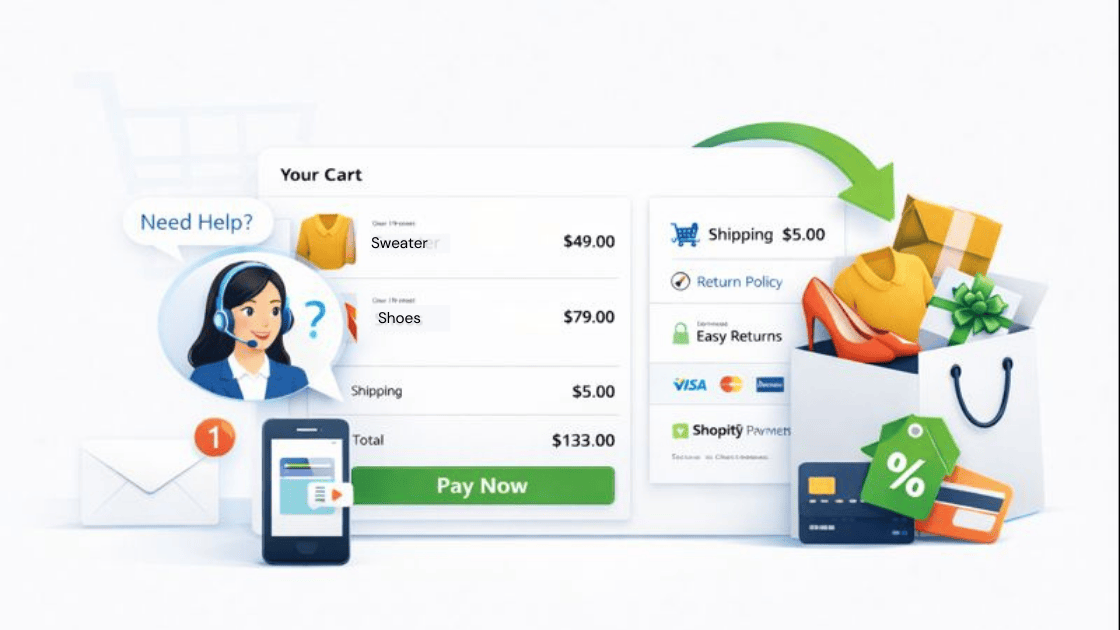
An AI shopping assistant reduces cart abandonment by resolving questions in real time. Instead of letting shoppers exit to search for answers, the assistant clarifies ship cost, return policy, and payment method options directly inside checkout, helping abandoners complete the purchase.
What is the difference between abandoned cart emails and real-time AI assistance?
An abandoned cart email tries to recover abandoners after they exit the ecommerce store. Real-time AI assistance works earlier. It prevents the exit by removing friction inside the shop cart before abandonment happens. The strongest programs use both together.
What metrics should teams track to measure cart abandonment improvement?
Key metrics include:
- Cart abandonment rate
- Checkout completion rate
- Conversion rate by payment option
- Reduction in abandon cart email dependency
- Purchase completion time
These metrics directly reflect how well friction is being removed.