The Visibility Gap No One Is Tracking
Ecommerce brands spend millions measuring share of voice in SEO, paid search, organic rankings, and social media. They know exactly how often their ads appear, where they rank for target keywords, and how many brand mentions they earn on Instagram. But ask them how often ChatGPT, Perplexity, Gemini, or Google AI Overviews recommend their products, and you'll get a blank stare.
That blind spot is about to cost them. According to a ChannelEngine study of 4,500+ shoppers, 58% of consumers now use AI search tools to research products. Adobe Analytics reports AI search referral traffic to U.S. retail sites surged 4,700% year-over-year in 2025. And here's the kicker: 93% of AI search sessions end without a single click to websites. If your brand isn't named inside the AI answers section. If AI answers don't include your brand themselves, you don't exist in this channel.
This new tool for measuring brand presence is why AI share of voice in ecommerce, including voice search, voice input, voice queries, and text-based AI queries, is becoming the metric that separates brands gaining ground from those losing it. Below, you'll learn what it is, why it matters right now, and how to start measuring, and what optimization and content optimization steps and improving it.
What Is AI Share of Voice?
AI share of voice, or AI SOV, measures the percentage of times your brand appears in AI generated, generative AI-powered answers versus competitors for relevant product and category queries. It's the LLM brand visibility metric (large language models). These large language models that tells you whether AI models and platforms are recommending your products or someone else's.
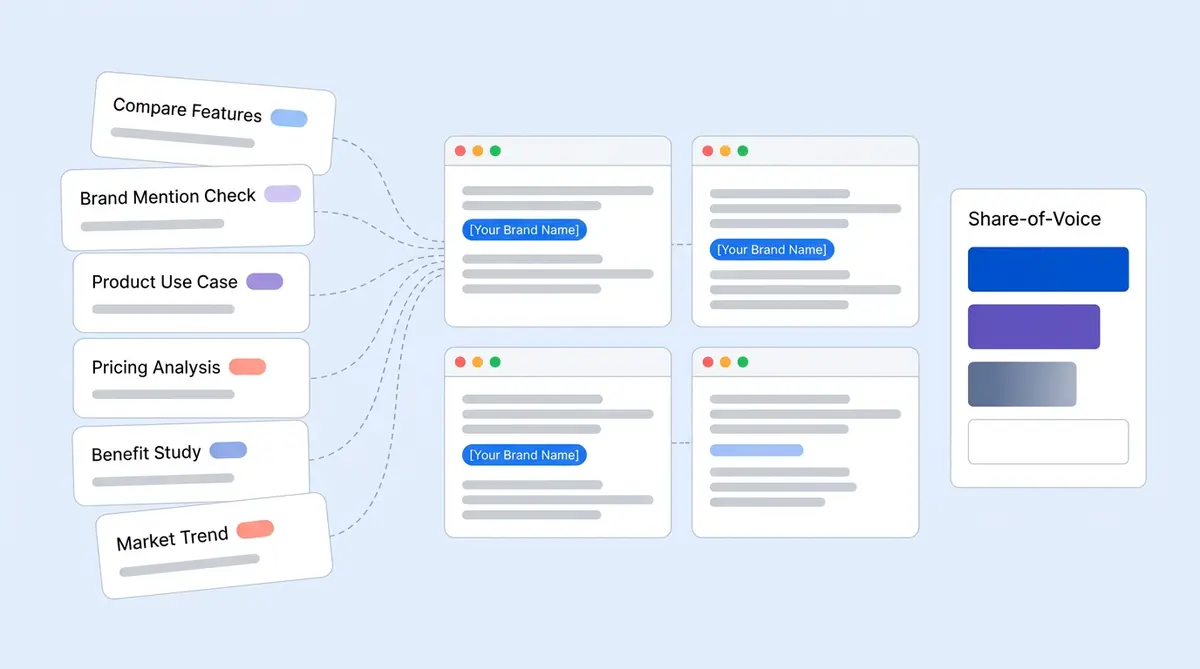
The formula is straightforward: take the number of generative AI and generative model responses that mention your brand, divide it by the total brand mentions across all tracked prompts in your category, and multiply by 100. If you track 50 product-discovery queries and your brand shows up in 15 of them while competitive brands collectively appear in 35, your AI SOV is 30%.
Unlike traditional search rankings, which are relatively stable, AI model outputs are probabilistic. Different AI models produce different results each time. The way AI models process queries. Research shows roughly 30% of brands visible in one AI response appear again in the next consecutive response for the same query. That volatility makes ongoing measurement essential, not optional.
Why This LLM Brand Visibility Metric Matters Now
Three shifts are converging to make AI share of voice in ecommerce a board-level priority.
Consumers are starting their product research in AI. A study by Eight Oh Two found that 37% of consumers now start searches with AI tools instead of traditional search engines. AI engine answers from engine platforms like ChatGPT usage for shopping doubled. ChatGPT shopping queries surged in the first half of 2025, and Perplexity processes over 780 million queries per month. Gartner predicts a 25% decline in traditional search engine volume by 2026. The top of your funnel is shifting, whether you're ready or not.
AI Overviews are eating organic clicks. Google AI Overviews now appear on over 25% of all searches and 83% of "best [product]" queries. When they show up, organic click-through rates drop 61% and paid CTR drops 68%, according to Seer Interactive. But brands cited inside AI Overviews earn 35% more organic clicks and 91% more paid clicks than those left out. Being mentioned is the new ranking.
AI traffic converts at a premium. AI-referred shoppers convert at rates between 2.47% and 14.2%, depending on the source, compared to 1.82% for Google Ads and 2.8% for Google organic. These visitors spend 32% more time on site and have 27% lower bounce rates. Small channel, high intent, growing fast.
The "Share of Model" Framework: How to Measure AI SOV
An industry framework called "Share of Model" has emerged to formalize how brands track their presence across generative AI platforms. Here's a practical version you can start running this week.
Step 1: Build Your Query Set
Identify 30 to 50 queries that represent how your target buyers and customers discover products in your category. Include branded queries ("best [your category] brands"), product-specific queries, trending topics ("running shoes for flat feet"), comparison queries ("X vs Y for [use case]"), and use-case queries ("[problem] solution"). These are the prompts you'll track across AI platforms.
Step 2: Run Queries Across Platforms
Submit each query to ChatGPT, Perplexity, Gemini, and Google (to capture AI Overviews). Record which brands are mentioned, their position in the response, and the sentiment of the mention. Do this weekly, because only 11% of domains receive citations from both ChatGPT and Perplexity, so platform-level data matters.
Step 3: Map Competitors and Score by Category
Build a competitor and competitor analysis map showing each brand's mention frequency per platform and per query cluster. Score and benchmark at the category level (e.g., "moisturizers," "trail running shoes") rather than just brand-level. This reveals where you lead, where you trail, and where no competitor dominates yet. Those white-space categories are your biggest opportunities.
Step 4: Track Over Time
AI SOV can decline 35.9% in just five weeks. Monthly analysis snapshots aren't enough. Set up weekly or biweekly tracking cadences and watch for volatility spikes that signal competitive pressure, competitive intelligence, and competitive activity or algorithm shifts. AI visibility tools built for ecommerce can automate much of this tracking.
What Influences Your AI Share of Voice
Understanding the levers that drive AI brand visibility separates reactive brands from proactive ones. Five key factors matter most.
Brand search volume. This is the single strongest predictor of AI visibility, with a 0.334 correlation according to the 2025 AI Visibility Report. AI systems prioritize brands that people actively search for. Your demand-generation efforts outside of AI directly feed your presence inside it.
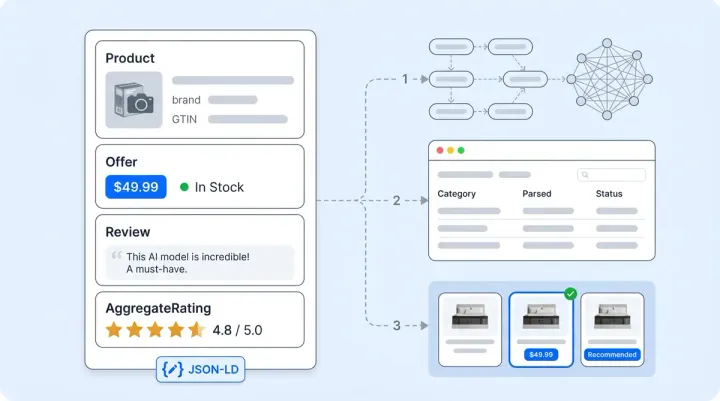
Structured data and product data completeness. Sites with structured data and FAQ blocks see a 44% increase in AI citations. Author schema makes you 3x more likely to appear in AI answers. Well-organized headings make your content 2.8x more likely to earn citations. Complete product specs, dimensions, ingredients, and compatibility data give AI systems and models the raw material and information to recommend you confidently.
Third-party citations and content authority and domain authority. Brands are 6.5x more likely to be cited through third-party sources than through their own domains. Editorial placements in buying guides, niche publications, Reddit threads, and YouTube reviews all feed the citation graph and trust signals that AI models rely on. Comparative listicles alone account for 32.5% of all AI citations.
Review depth and recency. AI models and platforms pull from review data to validate recommendations. Brands with high review volume, recent reviews, and detailed use-case-specific feedback get mentioned more often. Adding statistics to your content increases AI visibility by 22%, and including quotations boosts it by 37%.
Content freshness. 65% of AI bot traffic targets content published within the past year. Content updated within two months earns 28% more citations. If your product pages, blog content, and learning resources haven't been refreshed recently, AI models may treat them as less authoritative. For brands tracking their AEO and GEO strategy alongside SEO and broader GEO efforts, content freshness and SEO performance, SEO authority and signals are a shared priority across SEO across all three.
Tactical Steps to Improve Your AI Share of Voice
You can start improving your LLM brand visibility metric this quarter with these moves.
Audit your product data. Make sure every product page has complete JSON-LD schema markup (product, FAQ, review, breadcrumb). Fill in every spec field. Good product data management is the foundation of AI visibility. Write product descriptions that directly answer common customer questions with specifics, not marketing copy. AI shopping assistants and AI assistants that sit on your storefront can also generate structured Q&A content from real customer conversations and AI conversation data and conversation logs and interactions, feeding the data loop.
Build your citation footprint. The volume of content needed is significant: target approximately 250 published documents to meaningfully influence how LLMs perceive your brand. That includes your own content, guest posts, editorial features, Reddit contributions, and YouTube reviews. Focus on formats that AI models favor: listicles, comparison guides, and FAQ-rich pages. Our GEO citation strategy guide covers the seven off-site sources that drive the most AI personalized product recommendations.
Enroll in merchant programs. Perplexity's Merchant Program is free and gives you a dashboard to track how your products appear in shopping and search results. ChatGPT's shopping features pull from structured product metadata, so clean feeds matter. Google Merchant Center data feeds AI Overviews. Sign up for every platform that offers direct data ingestion.
Refresh your content quarterly. Update product pages, blog posts, and FAQ sections at least every 90 days. Add recent stats, new use cases, and updated comparisons. AI models weight recency heavily, so a six-month-old buying guide loses ground to one published last week.
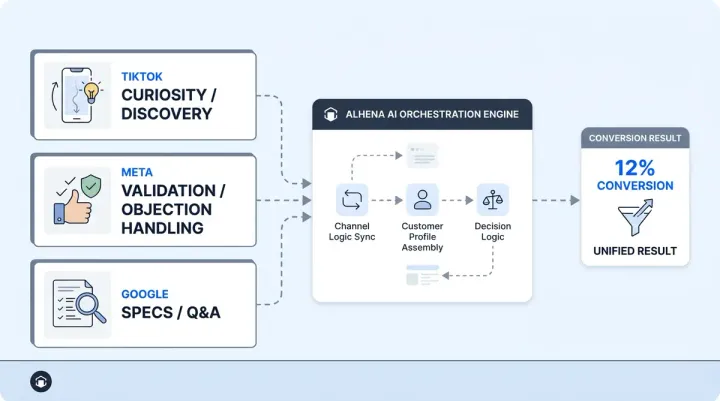
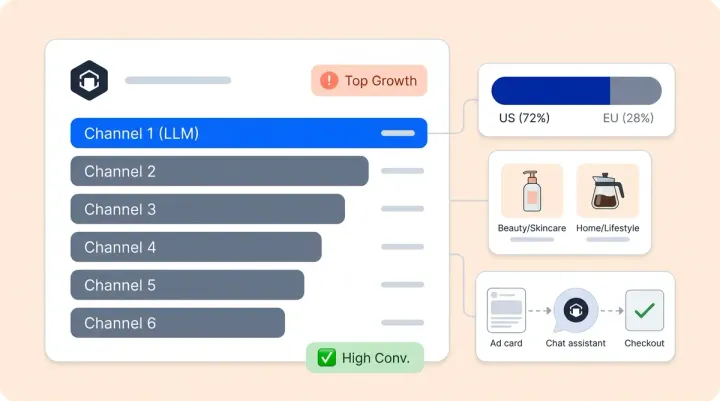
Connect AI visibility to revenue. Don't track AI share of voice in a vacuum. Measure the revenue that AI search drives by segmenting referral traffic from ChatGPT, Perplexity, and Gemini in your analytics. Alhena AI provides built-in AI visibility tracking and performance and revenue attribution so you can tie brand mentions to actual conversions, not just impressions.
Brands Not Measuring AI SOV Are Flying Blind
The fastest-growing product discovery channel in ecommerce has no tracking, no benchmarks, and no accountability for most brands. That's the reality of AI SOV today. McKinsey projects $3 to $5 trillion in AI agent-mediated commerce by 2030. The brands measuring their AI SOV now will own the category narrative and market share when that wave hits. The ones who wait will wonder why their paid search costs keep climbing while their organic traffic keeps shrinking.
AI share of voice in ecommerce isn't a nice-to-have metric for next year's roadmap. It's the leading indicator of where your brand stands in the channel that's absorbing your customers' attention right now. Track it. Benchmark it. Maximize it, or watch competitors do it first.
Ready to see how your brand shows up across AI platforms? Book a demo with Alhena AI to get visibility into your AI share of voice and start turning AI recommendations into revenue, or start free with 25 conversations.
Frequently Asked Questions
How do I calculate AI share of voice for my ecommerce brand?
Build a set of 30 to 50 product-discovery queries your customers use, run them across ChatGPT, Perplexity, Gemini, and Google AI Overviews weekly, and divide your brand mentions by total brand mentions across all responses. Alhena AI includes built-in AI visibility tracking that automates this measurement through AI automation and connects mention data directly to revenue attribution.
What is the difference between traditional share of voice and LLM brand visibility?
Traditional share of voice tracks ad impressions, keyword rankings, and social mentions. LLM brand visibility measures how often AI platforms name your brand when answering product queries. A brand can dominate paid search SOV and still have zero presence in AI answers. Alhena AI helps ecommerce brands bridge that gap by improving product data quality and tracking AI mention rates across platforms.
Which AI platforms should ecommerce brands monitor for share of voice?
Focus on ChatGPT (900 million weekly users), Google AI Overviews (1.5 billion monthly users), Perplexity (780 million monthly queries), and Gemini. Each platform pulls from different sources, so brand visibility varies widely across them. Alhena AI provides cross-platform visibility intelligence that tracks your brand presence across all major digital LLMs from a single dashboard.
Can AI shopping assistants improve my brand visibility in LLM recommendations?
Yes. AI shopping assistants generate structured Q&A content from real customer interactions, which feeds the data signals LLMs use to recommend products. They also improve review depth, product data completeness, and on-site engagement, all factors that influence AI citations. Alhena AI is purpose-built for ecommerce and creates the kind of rich, structured product data that AI platforms prioritize when generating shopping recommendations.
How does AI share of voice connect to ecommerce revenue and conversions?
AI-referred shoppers convert at rates between 2.47% and 14.2%, significantly higher than Google Ads (1.82%) or Google organic (2.8%). Brands cited in AI Overviews earn 35% more organic clicks and 91% more paid clicks. Alhena AI ties AI visibility data to actual conversions and revenue so you can measure the business impact of improving your AI share of voice, not just track mentions.