Seventy-six percent of ecommerce marketers now use AI in some form. Yet 84% still send the same campaign to every customer on their list, regardless of whether that person discovered the brand yesterday or has been buying monthly for two years. That gap, between ecommerce chatbot adoption and AI execution, is where revenue goes to die. Salesforce's 2026 State of Marketing report surveyed 4,450 marketers and the pattern is clear: brands have the tools but haven't connected them to the customer lifecycle. The result? Klaviyo's own benchmarks show automated, stage-matched flows generate 18x more revenue per recipient than batch campaigns. This post breaks down how an ai marketing ecommerce chatbot closes that gap by matching the right campaign to each customer stage automatically, without manual segmentation, no marketing automation rules to maintain, and no guesswork.
The Real Cost of "Blast the Whole List"
Batch-and-blast email isn't just lazy. It's expensive. Omnisend's 2026 analysis found that automated emails generate $2.87 per email compared to $0.18 for scheduled campaigns. That's a 15.9x revenue difference per recipient. Automated flows account for just 2% of total sends but drive 30% of email sales.
The math gets worse when you zoom in. Klaviyo reports that abandoned cart flows average $3.65 in revenue per recipient. A standard promotional campaign email? $0.11. The top 10% of email flows hit $7.79 RPR. Brands sending the same Friday promo to all their users are competing against those numbers with a water pistol.
Segmentation helps, but manual segmentation doesn't scale. Mailchimp data shows segmented campaigns earn 101% higher click rates and up to 760% more revenue than unsegmented ones. The problem isn't that marketers don't know segmentation works. It's that building and maintaining lifecycle segments by hand, across email, SMS, chat, and social, takes more time than most teams have. That's where ai chatbot marketing shifts from "nice to have" to "revenue infrastructure."
Five Lifecycle Stages, Five Different Conversations
Every customer sits somewhere on a five-stage spectrum: awareness, consideration, purchase, retention, and advocacy. Each stage demands a different message, a different tone, and often a different channel. Treating a first-time visitor the same as a repeat buyer isn't personalization. It's a coin flip.
Awareness: The Cold Opener
A shopper lands on your site from a TikTok ad. They've never heard of your brand. They don't need a 20% off coupon yet. They need guidance: what makes your product different, who it's for, and whether it solves their problem. An ai marketing ecommerce chatbot detects this is a new visitor (no cookies, no order history, no email match) and opens with guided discovery responses instead of a discount pop-up. Rep AI's data shows 64% of AI-powered sales come from first-time shoppers, suggesting that the awareness stage is where ecommerce chatbots have the highest leverage.
Consideration: The Comparison Shopper
This customer has visited three times, viewed two product pages, and added nothing to cart. They're comparing options. The right move here isn't another retargeting ad. It's a proactive chat message: "Looking for help choosing between the matte and satin finish?" Shoppers who engage with AI chat during consideration convert at 12.3% versus 3.1% for those who don't, a 4x lift according to Rep AI's 2025 benchmarks.
Purchase: The Conversion Moment
Cart is loaded, checkout page is open, and the shopper hesitates. This is where conversion nudges matter most. Ecommerce chatbots can address shipping cost concerns or confirm return policy details with a well-timed message to close the sale. Ecommerce chatbots can tackle cart abandonment head-on, recovering 20-35% of abandoned carts compared to 5-8% for email alone, according to Quickchat AI. The difference? Email arrives 30 minutes later. Chat happens in the moment.
Retention: The Second Purchase
Second-time customers spend 40% more than first-time buyers. By the tenth purchase, that number climbs to 80%. Yet most brands treat post-purchase as a "thank you" email and a review request. The retention stage is where conversational marketing ai earns its keep: personalized reorder reminders and personalized offers on WhatsApp (98% open rates versus 20-30% for email), proactive restock alerts, and personalized product care tips that keep the brand top of mind without feeling like spam.
Advocacy: The Referral Engine
Your best customers don't just buy repeatedly. They tell friends. But they won't do it unprompted. Lifecycle-aware ecommerce chatbots identify high-LTV customers and triggers referral program invitations, review requests timed to peak satisfaction (not 24 hours post-delivery, but after they've actually used the product), and exclusive early-access offers that make loyal users feel recognized.
Why Email and SMS Flows Aren't Enough
Klaviyo, Bloomreach, and Braze are excellent at what they do: email and SMS automation with behavioral triggers and workflow automation. If your lifecycle marketing stack stops at those two channels, though, you're missing half the picture.
Consider the numbers. Even the best abandoned cart email flows achieve 40-50% open rates. That means half your cart abandoners never see the message. WhatsApp, by contrast, delivers 98% open rates and 45-60% click-through rates for promotional content, according to Wapikit's 2025 benchmarks. Content Kettle's research found WhatsApp converts up to 12x better than traditional email and SMS combined.
The deeper issue is channel coverage. Klaviyo handles email and SMS well but doesn't offer real-time web chat or social DM engagement. Bloomreach processes data quickly for onsite personalization but lacks native two-way conversational AI. Neither platform can detect a customer's lifecycle stage from a live chat interaction and adjust the conversation accordingly. They react to past behavior. They don't engage customers based on present behavior.
This is the gap that ecommerce chatbot ROI depends on: an ecommerce chatbot layer that sits across web chat, email, Instagram DMs, WhatsApp, and voice, reading lifecycle signals in real time and choosing the right responses for each user at that specific moment.
How AI Detects Lifecycle Stage Without Manual Segmentation
Traditional lifecycle segmentation requires a marketer to define rules: "If last purchase was 30+ days ago AND total orders > 3, move to 'at-risk loyal' segment." That works when you have five segments. It collapses when you need hundreds of micro-segments across multiple channels.
AI-powered lifecycle detection works differently. Instead of static rules, AI agents read behavioral signals in real time:
- Session behavior: Pages viewed, time on site, scroll depth, and return frequency reveal where a shopper sits on the awareness-to-purchase spectrum.
- Purchase history: Order count, recency, AOV (average order value), and product category patterns indicate retention stage and predict churn risk.
- Engagement patterns: Email opens, chat interactions, social DM responses, chatbot response patterns, and support ticket history build a multi-channel customer engagement profile that tracks every customer engagement touchpoint.
- Cart signals: Cart value, abandonment frequency, and coupon usage patterns distinguish price-sensitive browsers from ready-to-buy customers.
McKinsey's research confirms the payoff: businesses using AI-driven personalization see 5-15% revenue lifts, up to 50% lower customer acquisition costs, and 10-30% improvement in marketing ROI. The leading businesses generate 40% more revenue from personalization than average performers.
The key shift is from "segment then message" to "observe and respond." An ai chatbot marketing system doesn't wait for a marketer to build a segment. It reads the signals, identifies the stage, and picks the right conversation, all before the customer finishes loading the page.
Conversational AI as the Lifecycle Marketing Layer
Here's where the conversation moves beyond what Klaviyo or Bloomreach can offer. A conversational marketing ai layer doesn't replace your email platform. It fills the gaps your email platform can't reach.
Think of it as the real-time engagement layer that sits on top of your existing marketing stack:
- Web chat catches what email misses. The 50% of cart abandoners who never open your recovery email? A proactive chat message reaches them while they're still on your site, before they leave.
- Social DMs extend the lifecycle beyond your owned channels. A customer comments on an Instagram post asking about sizing. chatbots can respond in DMs with personalized size guidance based on their purchase history, helping engage customers and turning a social interaction into a lead nurturing touchpoint.
- WhatsApp handles retention at scale. Reorder reminders, restock alerts, and automated responses with loyalty rewards delivered where customers actually read their messages (98% of the time).
- Voice AI adds a human-feel layer. For high-value customers or complex purchases, voice-based AI assistance provides the consultative experience that text alone can't match.
The conversational commerce market hit $8.8 billion in 2025 and is projected to reach $32.6 billion by 2035. That growth reflects a fundamental shift: customer engagement has shifted: customers expect brands and their chatbots to talk with them, not at them, at every stage of the lifecycle.
What This Looks Like in Practice
Let's walk through a real scenario. A skincare brand running a Shopify store uses Klaviyo for email flows and wants to improve lifecycle marketing without adding headcount.
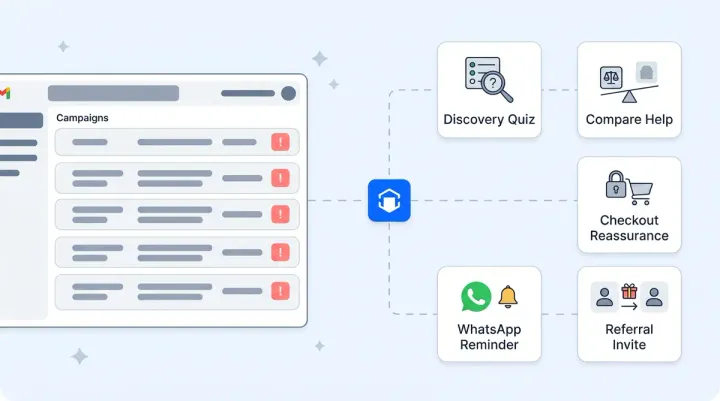
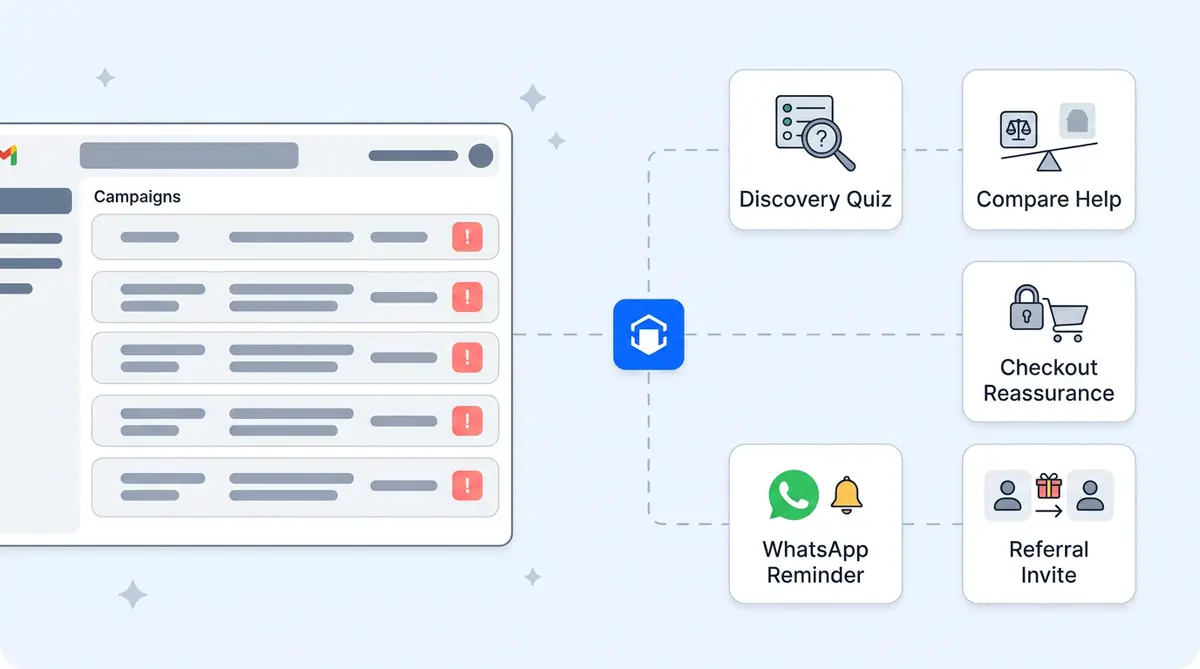
Week 1, awareness stage: A new visitor arrives from a Google ad for "best moisturizer for dry skin." The AI shopping assistant greets them with a quick skin type quiz instead of a generic welcome pop-up. The chatbot walks the visitor through the quiz. The visitor completes it, gets three product recommendations, and adds one to cart. No email was involved. The conversion happened in chat.
Week 1, purchase stage: The visitor abandons cart at shipping. Ecommerce chatbots detect hesitation (cursor moved toward the back button, time on checkout exceeded 90 seconds) and surfaces a message: "Free shipping kicks in at $65. You're $12 away." The shopper adds a travel-size serum to their items. Order complete.
Week 3, retention stage: The customer receives a WhatsApp message (they opted in during checkout): "Your moisturizer typically lasts about 4 weeks. Ready for a refill? Here's your reorder link." Open rate: 98%. Click-through: 47%. No manual segmentation or automation rules required. The ecommerce chatbot knew the product usage cycle and timed the message accordingly.
Month 3, advocacy stage: After three purchases, ecommerce chatbots identify this customer as high-LTV and triggers a referral offer in their next chat interaction: "Your friends get 15% off their first order, and you get $10 credit for each referral." The chatbot lead generation ecommerce loop closes itself.
This isn't hypothetical. A.S. Watson Group launched an AI-powered skincare advisor with Revieve and saw customers who used it convert 396% better and spend 4x more with higher AOV. Condition 1 implemented lifecycle-stage email and SMS flows and experienced 679.9% growth. These examples show a pattern that holds across verticals: stage-matched messaging is the best ecommerce approach, outperforming blasts by an order of magnitude.
How Alhena AI Fits Into the Lifecycle Marketing Stack
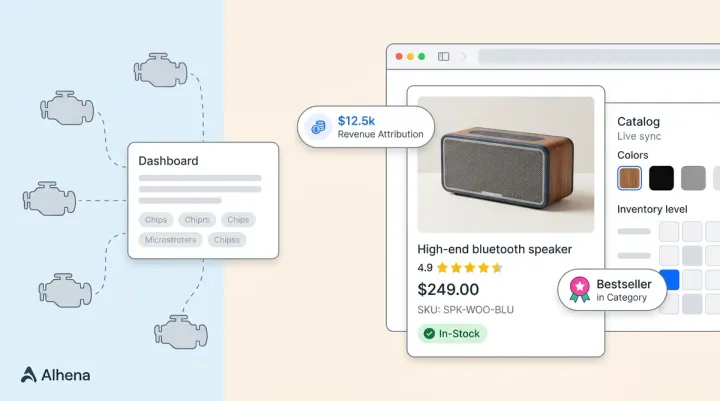
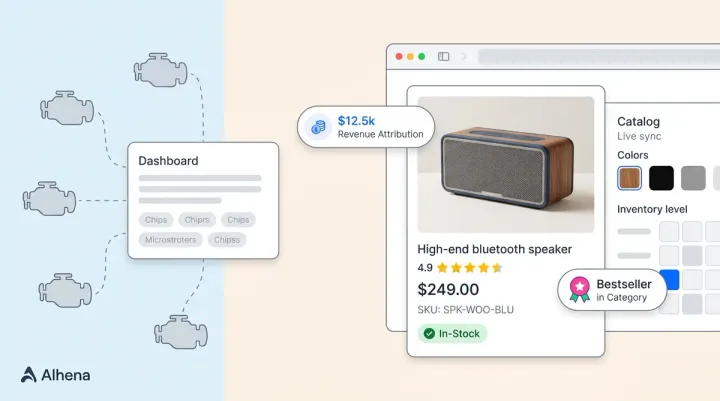
Alhena's AI Shopping Assistant was built for exactly this use case: detecting where a customer is in their journey and adjusting the conversation accordingly. Its conversational AI layer connects to Shopify, WooCommerce, Magento, and Salesforce Commerce Cloud, and its integration with your existing stack pulls real-time customer data to determine lifecycle stage without manual rules.
At the awareness stage, Alhena's guided discovery asks qualifying questions and product guidance to match new visitors with personalized shopping recommendations. During consideration, its conversion nudges detect hesitation signals and address objections in real time. Post-purchase, Alhena's Support Concierge handles order tracking, returns, shipping inquiries, and customer support while surfacing cross-sell recommendations and sales support that feel helpful, not pushy.
The omnichannel feature matters here. Alhena operates across live chat and messaging apps like Instagram DMs, WhatsApp, and Facebook Messenger, plus voice AI, so lifecycle-stage conversations happen wherever users are, not just in their inbox. Tatcha, a luxury skincare brand using Alhena, saw a 3x conversion rate increase and 38% AOV uplift, with 11.4% of total site revenue attributed to AI-powered customer conversations.
For teams already using Shopify with Zendesk or Freshdesk, Alhena plugs into the existing stack. It doesn't replace Klaviyo or your helpdesk. It adds the conversational lifecycle layer that those tools weren't designed to provide. Setup is easy: under 48 hours with no developer resources, and Agent Assist ensures live agents have full context when they step in for complex cases.
The technology behind lifecycle-stage detection relies on natural language processing and machine learning. When a customer types "is this moisturizer good for sensitive skin?" the AI agents don't just match keywords. Natural language processing lets them understand intent, sentiment, and context. Are they comparing products (consideration stage) or troubleshooting after purchase (retention stage)? This distinction determines which campaign the AI agents trigger next, or whether to route the conversation to live agents for high-touch interactions. Messaging apps like WhatsApp, Instagram, and Facebook Messenger give these AI agents direct access to customers on channels with 98% open rates, compared to 20-30% for email.
Finding the best AI chatbot for lifecycle marketing means evaluating how each platform handles stage detection. Chatfuel builds chatbots for Facebook and Instagram with drag-and-drop flows. Chatfuel but lacks ecommerce-native data connectors. Zendesk and Intercom focus on customer support ticket routing. Intercom’s Fin AI and Zendesk AI can automate ticket responses, not proactive lifecycle campaigns. Their AI agents and customer service workflows are built for reactive customer service, not for building lifecycle workflows that identify which customers need a win-back message versus a cross-sell offer. Finding the best AI chatbot for your business means choosing the best AI approach that combines customer support data with purchase behavior and browsing patterns to build a complete lifecycle picture.
Scalability matters for lifecycle marketing at scale. A lifecycle marketing system that works for 100 customers needs to work for 100,000 without manual intervention. Multilingual support is critical for global brands. Multilingual AI (Alhena handles 90+ languages) lets global brands run lifecycle campaigns across markets without building separate marketing workflows for each region. The platform should be user friendly enough that marketing teams can configure campaigns without engineering support, and scalable enough to streamline all customer interactions across every channel simultaneously. The goal: every customer interaction, whether it's a first-time browsing session or a tenth reorder, triggers the right response automatically.
Getting Started: A Practical Framework
You don't need to overhaul your entire marketing stack to start matching campaigns to lifecycle stages. Here's a phased approach:
Phase 1: Audit Your Current Lifecycle Gaps (Week 1)
Map your existing campaigns to the five lifecycle stages. Most brands find they're heavy on purchase-stage emails (cart abandonment flows, browse abandonment triggers) and light on everything else. Identify which stages have zero automated touchpoints. Those are your highest-leverage opportunities and your best lead generation openings.
Phase 2: Add a Conversational Layer to Your Highest-Gap Stage (Weeks 2-3)
If your biggest gap is awareness (most brands), deploy an ecommerce bot or chatbot that greets new visitors with guided discovery instead of a generic pop-up. If your gap is retention, start with WhatsApp reorder reminders for your top 20% of customers by purchase frequency. One stage, one channel, measurable results. Use analytics to track performance and conversion lift per stage.
Phase 3: Connect the Signals Across Channels (Month 2)
The real power of ai beyond support comes when your chat, email, social, and voice channels share the same customer context. When a user who chatted with your chatbots on your website last week responds to an Instagram Story, ecommerce chatbots should know their lifecycle stage and pick up where the last conversation left off. This requires a unified CRM-connected customer profile, which platforms like Alhena build automatically from every interaction.
Phase 4: Let AI Optimize the Stage-to-Campaign Matching (Month 3+)
Once the data is flowing, let AI handle the segmentation entirely. Instead of building manual rules ("if X then Y"), let the system learn through analytics which messages, channels, and timing combinations produce the best results at each stage. Gartner predicts 60% of brands will reach this level of agentic AI by 2028. The brands that start now will have two years of learning data by then.
How AI Chatbots Compare for Lifecycle Marketing
Not all AI chatbots handle lifecycle marketing the same way. Platforms like Tidio and ManyChat focus on rule-based flows and quick-reply buttons. They work well for simple automation, like sending a welcome message or a discount code, but they struggle with real-time lifecycle stage detection. Tidio offers live chat with basic chatbot features. Tidio’s AI assistant, and ManyChat excels at messaging apps and social automation like Instagram DMs and Facebook Messenger. Both platforms let live agents step in when the chatbot can't handle a query, which matters for complex purchases.
The gap shows up when you try to drive sales across the full lifecycle. Tidio and ManyChat don't connect natively to your CRM or ecommerce platform in a way that tracks customer journey stages. They can trigger messages based on page visits or button clicks, but they can't read purchase history, AOV trends, or cross-channel engagement patterns to determine whether a customer is in awareness, consideration, or retention mode. AI agents that detect lifecycle stage need deeper CRM integration and real-time behavioral data to drive sales effectively.
Alhena takes a different approach. Its AI agents pull data from Shopify, WooCommerce, Magento, Salesforce Commerce Cloud, and your CRM to build a real-time customer profile. When the AI determines a shopper is in consideration mode (multiple visits, product page views, no purchase), it adjusts the conversation to address comparison questions. When the same customer returns post-purchase, the AI agents shift to retention mode with reorder prompts and loyalty offers. Live agents and human agents get the full context through Agent Assist when they step in, so the handoff from AI agents to live agents feels natural and customers never have to repeat themselves.
Automation Capabilities Across Chatbot Platforms
ManyChat and Chatfuel both offer automation builders for marketing workflows. ManyChat's automation focuses on Instagram and Facebook Messenger sequences, letting brands automate welcome messages, comment replies, and story mentions. Chatfuel takes a similar approach with its automation templates, though Chatfuel's strength is quick setup for small teams. Both help engage customers at the top of the funnel, but their marketing workflows break down at the retention and advocacy stages because they lack purchase data integration.
Multilingual automation is another gap. ManyChat supports multiple languages but requires separate flows for each language. Chatfuel has limited multilingual capabilities. When your goal is to engage customers across global markets with lifecycle-stage-aware messaging, you need automation that adapts both language and lifecycle context in real time. Alhena's multilingual AI handles 90+ languages within a single conversational workflow, so a Japanese-speaking customer and an English-speaking customer both get stage-appropriate responses without separate automation sequences.
Key Takeaways
- The 84% problem is real. Most brands use AI but still send generic campaigns. Stage-matched flows generate 18x more revenue per recipient.
- Five stages need five different conversations. Awareness, consideration, purchase, retention, and advocacy each demand different messages, tones, and channels.
- Email and SMS alone leave gaps. Half of cart abandoners never open recovery emails. Conversational AI on chat, social, and WhatsApp fills the holes.
- AI removes the manual segmentation bottleneck. Real-time behavioral signals replace static rules, so lifecycle matching scales without adding headcount.
- Start with one stage, one channel. You don't need a full overhaul. Audit your lifecycle gaps, plug the biggest one with conversational AI, then plan your expansion from there.
Ready to add a lifecycle-aware conversational layer to your ecommerce stack? Book a demo with Alhena AI today to see how stage-matched AI conversations drive revenue across every customer touchpoint, or start free with 25 conversations today and test it on your own store.
Frequently Asked Questions
What is AI lifecycle marketing for ecommerce?
AI lifecycle marketing uses machine learning to detect which stage a customer is in (awareness, consideration, purchase, retention, or advocacy) and automatically delivers the right message on the right channel at the right time. Instead of building manual segments and scheduling batch campaigns, the AI reads behavioral signals like session activity, purchase history, and engagement patterns to match each shopper with stage-appropriate content. Klaviyo data shows this approach generates 18x more revenue per recipient than generic batch campaigns.
How does an AI ecommerce chatbot detect customer lifecycle stage?
AI chatbots analyze real-time behavioral signals including pages viewed, return visit frequency, cart activity, purchase recency, CRM data, and cross-channel engagement patterns. A first-time visitor with no cookies or order history is treated as awareness-stage, while a three-time buyer who hasn’t purchased in 45 days gets flagged as at-risk retention. This happens automatically without marketers needing to define static segment rules. McKinsey reports that brands using this kind of AI personalization see 5-15% revenue lifts and up to 50% lower acquisition costs.
Can conversational AI replace Klaviyo or Bloomreach for lifecycle marketing?
Conversational AI doesn’t replace email and SMS platforms. It fills the gaps they can’t cover. Klaviyo and Bloomreach handle email and SMS flows well, but they don’t offer real-time web chat, social DM engagement, or voice AI. Half of cart abandoners never open recovery emails. Conversational AI reaches those shoppers through live chat (while they’re still on your site), WhatsApp (98% open rates), and Instagram DMs. The two layers work together: email for scheduled lifecycle flows, conversational AI for real-time engagement.
How long does it take to set up AI lifecycle marketing with a chatbot?
Modern AI chatbot platforms like Alhena AI deploy in under 48 hours with no developer resources required. The AI connects to your ecommerce platform (Shopify, WooCommerce, Magento, or Salesforce Commerce Cloud), ingests your product catalog and knowledge base, and starts detecting lifecycle stages from day one. Built-in analytics track performance across stage-matched conversations, showing which drive the most revenue. Most brands start with one lifecycle gap (typically awareness or retention), measure results, and expand to cover all five stages within 60-90 days.
What ROI can ecommerce brands expect from AI-powered lifecycle marketing?
Results vary by vertical and implementation, but the benchmarks are strong. Automated lifecycle flows generate $2.87 per email versus $0.18 for batch campaigns (Omnisend). Ecommerce chatbots can tackle cart abandonment head-on, recovering 20-35% of abandoned carts compared to 5-8% for email alone. McKinsey reports AI-driven personalization delivers 10-30% improvement in marketing ROI. Brands like Tatcha have seen 3x conversion rates and 38% AOV increases with AI-powered conversational commerce. The key is starting with your highest-gap lifecycle stage and measuring incrementally.