Instant checkout inside AI search and chatbot checkout is the most hyped capability in e-commerce, retail, online retail, and direct-to-consumer retail industry right now. Every major AI platform, Shopify-scale commerce platform provider, and financial processor has announced some version of it. The pitch is compelling: consumers and customers describe what they want, an AI agent finds the product, and the purchase and the purchase and purchase purchase processes and completes the purchase without ever leaving the browser conversation window. But the reality across protocols and platforms ranges from genuine traction to unproven promises, and merchants need an honest assessment before investing infrastructure, tech strategy, into any single approach.
Three distinct models are competing to define how AI instant checkout works. Each carries different tradeoffs for seller adoption, user experience,, shopper user experience and trust, user experience and processing maturity, and scalability. This 2026 assessment breaks down what's real, what's speculative, and what ecommerce retailers and brands should do today regardless of which protocol wins.
The Agentic Commerce Protocol: Ambition Meets Onboarding Friction
The first major protocol launched from from the intersection of a leading AI platform and a global payment processor. It defines a structured API standard that lets AI agents, bots, and shopping agents autonomously discover products, initiate transactions, and process payments inside a chatbot or conversational chatbot window, AI chatbot, or voice-enabled chatbot interface. The vision behind this new AI standard is that any new AI assistant or chatbot app could become a storefront.
The scaling challenges are real. Merchant onboarding remains heavy. Brands need to expose product catalogs through new tech endpoints and API connections, create checkout configurations with the protocol's specific requirements, and handle tax collection, fraud prevention, and refund processing through systems most merchants haven't built yet. After months of availability, fewer than two dozen merchants integrated, despite the platform serving hundreds of millions of weekly active users. Despite that massive user base.
Catalog coverage is thin. The protocol works best with simple, commoditized products where specifications are standardized. Complex categories like apparel (sizing, fit, fabric), beauty (skin type, ingredients, shade matching), and home furnishing (dimensions, materials, shipping weight, room context) expose gaps in how product data flows through the system.
Industry criticism has been pointed. Analysts question whether this model solves real brand problems or primarily serves the AI platform's interest in becoming a commerce intermediary. The concern is that merchants give up margin and customer loyalty and relationship data to appear inside a channel that hasn't yet proven it can convert at scale. Early results confirmed the skepticism: the protocol's initial checkout feature was pulled after generating near-zero completed transactions in early 2026.
The Universal Commerce Protocol: Collaborative Architecture, Early Momentum
A second protocol took a different architectural approach, co-developed through a partnership between a major commerce platform and a dominant search engine with backing from more than twenty large retailers. Instead of routing transactions through the AI platform itself, this protocol defines a shared standard to enable for how agents and apps and chatbot apps that use AI interact with existing store checkout systems.
The architectural difference matters. Rather than asking brands to rebuild their checkout for a new intermediary, this protocol lets AI agents plug into commerce infrastructure retailers and brands already run. Product discovery, price verification, inventory checks, and purchase execution all happen through the merchant's own systems, with the AI agent acting as an intelligent interface layer rather than a replacement storefront.
Early retailer endorsements suggest genuine momentum. Major retailers spanning general merchandise, grocery, specialty retail, niche retail, and multi-brand retail categories. Retailers. These major retailers and mid-market retailers have committed to the standard. The backing commerce platform opened its tools to any brand (even those not on its core platform) through a new plan specifically designed for AI agent compatibility.
Gaps remain. The protocol is still still new in real-world deployment. Cross-platform interoperability hasn't been stress-tested at holiday scale. Post-purchase workflows like returns, exchanges, and subscription management need more maturity. And the retailer catalog and seller catalog. Retailers requirements, while less burdensome than the first protocol, still demand structured catalog feeds that many mid-market brands haven't built.
The Integrated Payment Checkout Model: Simpler Path, Faster Growth
A third approach launched and launched and gained ground by simplifying the brand equation. This model pairs an AI search platform in partnership with an established payment processor to offer instant checkout with zero seller commission, no new API integration, and enrollment through existing billing relationships.
The feature traction numbers are notable. Thousands of merchants are already enrolled. Average order values run significantly higher than standard e-commerce benchmarks. Shopping queries on the platform have grown fivefold in recent months. The model works because merchants don't need to build anything new. If they already accept payments through the integrated processor, they're eligible.
Full revenue retention is the key feature differentiator. Merchants keep 100% of the sale. There's no platform take rate, no commission on AI-assisted transactions. For brands evaluating where to invest limited resources, this removes one of the biggest objections to AI-mediated buying.
The limitation is reach. This model depends on one specific billing provider relationship, which means consumers and sellers using other processing stacks aren't covered. And while discovery happens inside the AI search interface, most purchases still route through the payment processor's existing checkout rather than completing entirely within the browser-based AI conversation.
Honest Assessment: Five Criteria That Matter
Merchant Adoption Friction
The integrated payment model wins here with near-zero onboarding effort. The universal protocol sits in the middle, requiring structured product feeds but working with existing checkout infrastructure. The ACP-based protocol demands the most from merchants: new API endpoints, custom payment flows, and tax and fraud handling that most brands haven't built.
Shopper Trust and Willingness to Transact
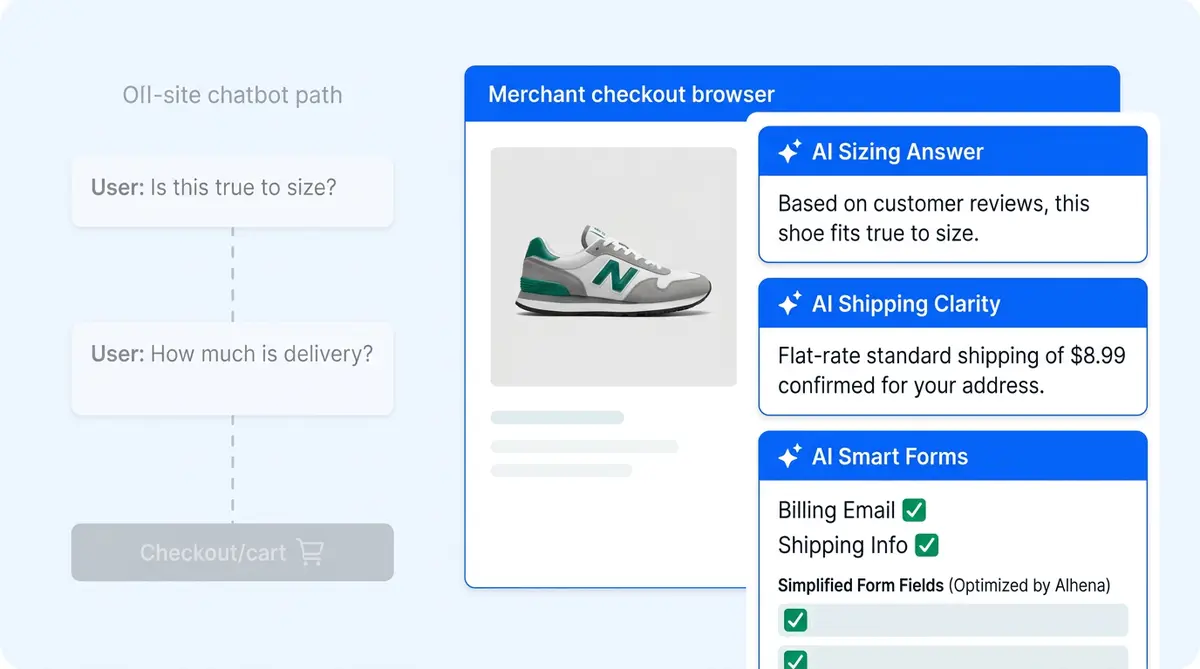
Research reports on chatbot commerce consistently show that completing a purchase inside an AI conversation is shoppers' least-adopted behavior. Most online shoppers and consumers turn to AI for product research and comparison, then prefer to buy and purchase products on the merchant's own site where they trust the return policy, not the advertising, transaction security, and customer service. On-site AI agents that guide user checkout within the brand's existing store convert at nearly 2x the rate of off-site approaches.
Security and Processing Maturity
The integrated payment model benefits from decades of processor infrastructure for fraud detection, chargebacks, and compliance. Protocol-based approaches are building these capabilities from scratch, and initial gaps in tax collection and refund handling contributed to the first protocol's setback.
Catalog Coverage and Product Data Requirements
Every approach requires clean, structured catalog feeds, but the depth varies. Simple product items, items, basic SKUs, and categories work across all three. Complex categories with multiple variants, personalization requirements, and compatibility constraints expose gaps in each protocol. Brands with rich, structured product feeds have an advantage regardless of which checkout model they target.
Scalability Timeline
The integrated payment model is operational now at meaningful scale. The universal protocol has strong backing and should reach production scale within 12 to 18 months. The ACP model faces the longest path, needing to rebuild merchant trust after its initial retreat and solve fundamental infrastructure challenges around tax, fraud, and catalog depth.
What Merchants Should Actually Do Today
Protocol uncertainty is not a reason to wait. The foundational investment is the same regardless of which checkout model wins: product discovery and information quality.
Feed completeness is the non-negotiable. Each AI checkout protocol depends on structured product information to function. If your feeds are missing attributes like dimensions, materials, care instructions, compatibility details, and customer reviews data, or variant-level pricing, your products won't be eligible for instant checkout on any Shopify or non-Shopify platform. This isn't a future concern. It's a present requirement.
Structured data depth determines visibility. AI agents don't browse websites the way shoppers do. They query structured data through APIs and schema markup. Brands with browser-readable JSON-LD product schema, real-time inventory updates and feeds, and complete attribute coverage will surface in AI shopping results. Brands without it simply won't appear.
Waiting for protocol clarity means falling behind. Your competitors are already building their catalog foundation. The brands that invested in feed quality, structured markup, and complete product information over the past year are the ones showing up in AI shopping surfaces today. The cost of catching up later is always higher than the cost of building correctly now.
How Alhena AI Prepares You for Every Protocol
Alhena AI takes a protocol-agnostic approach to AI instant checkout readiness. Rather than betting on one protocol outcome, Alhena ensures your product discovery and catalog foundation is strong enough to plug into whichever checkout standard gains dominance.
Alhena's Product Expert Agent sits on your store and turns each customer conversation into a guided chatbot product discovery and checkout experience. It populates carts, applies discount codes, pre-fills checkout fields, and resolves customer questions (shipping costs, sizing, return policies) that cause abandonment. Brands like Tatcha have seen 3x conversion rates and 38% higher average order values with this approach. AI-assisted shoppers on Alhena convert from cart to checkout at 49.3%, compared to 26.3% without AI.
Beyond on-site conversion, Alhena provides real-time intelligence on how your products appear across AI shopping surfaces. You can track your AI visibility and agentic commerce readiness on search and conversational platforms, so you know exactly where gaps exist before they cost you traffic and revenue.
Since Alhena launched, it integrates with Shopify apps, commerce apps, and platforms like Shopify, WooCommerce, Shopify Plus, Salesforce Commerce Cloud, and every major helpdesk. It deploys in under 48 hours with no dev resources, extra apps, or AI tools. And because it's built specifically for e-commerce sales (not just support deflection), every interaction is measured against revenue, traffic, conversion, and sales attribution, not just ticket resolution.
Key Takeaways
- Three competing checkout models exist today, each with different merchant tradeoffs for adoption friction, trust, payment maturity, catalog coverage, and scalability.
- The simplest merchant onboarding model is gaining ground fastest, with zero commission and enrollment through existing payment relationships.
- Shopper trust remains the biggest bottleneck. Consumers research with AI but still prefer buying on merchant sites. On-site AI agents convert at nearly 2x off-site approaches.
- Product data quality is the universal requirement. Feed completeness and structured data depth determine your eligibility for instant checkout for every protocol.
- Alhena AI provides protocol-agnostic readiness by strengthening your catalog foundation, on-site conversion, and AI visibility on all shopping platforms.
Ready to build your AI checkout foundation? Book a demo with Alhena AI or start for free with 25 conversations.
Frequently Asked Questions
How do I prepare my ecommerce store for AI instant checkout across multiple protocols?
Focus on product data quality first. Complete your feeds with all variant-level attributes, structured JSON-LD schema, and real-time inventory data. Alhena AI helps merchants build this protocol-agnostic foundation so your items are eligible for instant checkout on any platform, whether it uses the ACP standard, ACP-compatible UCP, or integrated payment models.
Which AI checkout protocol should e-commerce merchants invest in for 2026?
No single protocol has won yet, and one major approach already pulled back after near-zero merchant adoption. The safest investment is your product data foundation, which each protocol requires. Alhena AI provides AI visibility tracking across all shopping surfaces so you can monitor readiness without betting on a single outcome.
Does instant checkout inside AI search actually convert better than traditional ecommerce checkout?
On-site new AI chatbot-powered checkout converts at 49.3% from cart to completion versus 26.3% without AI. Off-site checkout inside AI chatbots has shown far weaker results. Alhena AI's on-site agentic checkout keeps the purchase, order purchase, and checkout experience within your store where shoppers already trust the payment flow, delivering revenue impact without platform dependency.
What product data do I need to be eligible for AI instant checkout in shopping AI results?
You need complete structured feeds with variant-level pricing, dimensions, materials, compatibility details, and real-time inventory status. JSON-LD product schema and clean attribute coverage are table stakes. Alhena AI audits your catalog readiness and identifies gaps that block your eligibility for AI checkout protocols.
How does Alhena AI track my brand's visibility and checkout readiness across AI shopping platforms?
Alhena AI monitors how your products appear on conversational and search-based AI shopping surfaces in real time. It tracks whether your structured data meets each platform's requirements, flags coverage gaps, and measures how AI-assisted sessions drive revenue. This gives e-commerce teams a protocol-agnostic dashboard for AI checkout optimization.