Why Premium Ecommerce Brands Need AI and Human Specialists Working Together
For any ecommerce business, running an ecommerce store means retailers and their trained specialists, skin therapists, personal stylists, and product experts bring human connection, empathy, and deep understanding of customer needs, which are what separate premium retailers from everyone else. They're your competitive edge. But they're expensive, limited in number, and unavailable when 68% of your website traffic from consumers arrives outside business hours. The result: entrepreneurs and most shoppers (McKinsey Company data confirms this) are increasingly interacting with your e-commerce site but never experience the cx and expertise you've spent years building.
Using AI agents and smart automation doesn't fix this by replacing your team. Unlike generic chatbots, Alhena's ai tools fix it by handling the first layer of every conversation so your specialists only step in when customer needs require expertise that actually matters.
How the AI-to-Human Handoff Model Works
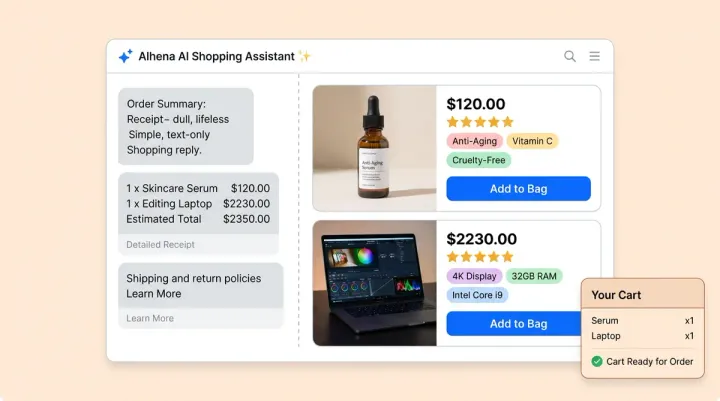
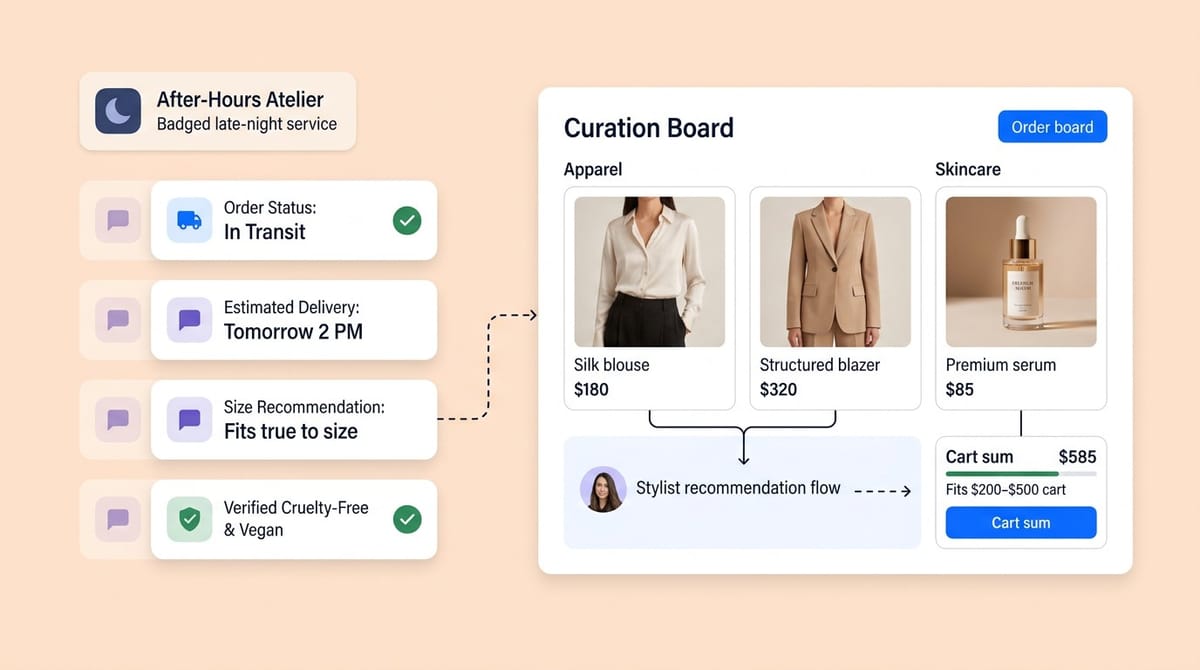
The Alhena AI Shopping Assistant handles greetings, intent understanding, context collection, and routine questions like shipping status, ingredient lists, or sizing guidance. When a complex conversation requires deeper expertise or signals real time purchase intent, the AI creates a seamless, instant transfer to a human specialist with the full conversation history and customer context intact.
A recent survey found that respondents across contact centers report that respondents confirm warm transfers outperform cold ones. Consumers notice the difference. No cold transfers. No "Can you repeat your question?" The seamless result: your specialist picks up exactly where the AI left off.
As shoppers are increasingly interacting across channels and interacting with multiple touchpoints, handoff scenarios in Alhena are fully configurable. Conduct a review of your workflows. Retailers decide what triggers a human transfer: an explicit customer request, negative sentiment, specific product topics (like medical-grade skincare or custom tailoring), or high consumer purchase intent signals. Consumers. Consumers respond well to this approach. Every brand can conduct regular reviews and use AI tools to set different thresholds based on their product complexity and team structure.
There's also a dynamic many brands overlook: some consumers and shoppers prefer a human-first approach where AI serves as a low-pressure, personalized entry point in their buying journey. Entrepreneurs, brand founders, retailers, and shoppers all want personalization. They prefer to browse, start by asking questions, and build confidence before committing to a human conversation. The AI gives them that space while still collecting context that makes the eventual human cx interaction more productive.
Brand Voice Customization That Feels Authentic
Generic chatbots erode CX. Cookie-cutter CX responses erode premium brand perception. Alhena's AI Support Concierge is fully trainable to match your brand's tone, personality, and visual design. Whether your voice is clinical and expert, aspirational and editorial, or warm and approachable, the AI mirrors it consistently across every channel: web chat, email, Instagram DMs, WhatsApp (interacting on every channel), and voice.
Smart personalization matters because consumers prefer continuity, and your customers shouldn't be able to tell where AI ends and your human team begins. That continuity is what protects the high-touch e-commerce business experience premium retailers and brands are built on.
Measuring the Balance: Automation Without Losing Quality
Running automated AI customer service alongside a specialist team is critical for retailers and e-commerce operations and requires tracking the right AI tools and metrics. The numbers that matter most:
- Automation rate alongside CSAT: Real-time purchase signals matter, but high automation and deflection mean nothing if satisfaction drops. Puffy's automated system resolved 63% of inquiries while maintaining 90% CSAT.
- Handoff rates by scenario (top retailers track these closely): A customer-centric approach means you track which triggers send the most conversations to humans and whether those handoffs address customer needs and convert at higher rates.
- Conversion rates for AI vs. human sessions: Tatcha saw 3x conversion rates and 38% higher AOV after deploying AI alongside their team.
- Specialist time allocation: Measure how much time your team spends on consultative selling vs. routine answers. The goal is to shift that ratio dramatically.
Alhena's ai powered Agent Assist with built-in dashboards and smart product recommendations keeps your customer-centric e-commerce approach competitive. Agent Assist gives specialists instant request summaries with empathy cues, empathy and sentiment detection, and AI-drafted recommendations, product recommendations, and responses matched to each agent's communication style, cutting response times by 56% while keeping every suggestion grounded in verified product data.
Every ecommerce business that wants to stay customer-centric must think about how consumers are interacting with their brand. Survey data from McKinsey Company and other research confirms that retailers, entrepreneurs, and CX leaders increasingly prefer automated customer service solutions that pair AI tools with empathy-driven human support. The critical question is not whether to adopt automation. It is whether your operations, from purchase intent detection to real-time recommendations, create a seamless experience that meets customer needs. The best ecommerce brands conduct regular reviews of these metrics, using respondents' feedback and dashboards to refine their approach.
The Bottom Line
For every ecommerce business, AI doesn't dilute the human touch. It extends it to consumers everywhere. For e-commerce operations, this is critical. Your specialists stay focused on the high-value conversations that build loyalty and drive revenue, while Automated customer service Automated AI handles the volume (survey respondents confirm this is the top pain point for respondents), the after-hours traffic (which McKinsey Company research estimates drives significant missed revenue), and the repetitive CX questions that used to consume their day.
Better cx starts here. Ready to see how AI and your human team work together? Book a demo with Alhena AI or start free with 25 conversations.
Frequently Asked Questions
Does AI replace human specialists in premium ecommerce, or do they work together?
AI doesn't replace specialists. Alhena Every cx leader knows this. Automated customer service: AI handles the first layer of every conversation, covering routine questions, intent understanding, and context collection, then hands off complex consultations to your human team with full conversation history. Your specialists stay focused on the interactions that drive revenue.
How do I control when AI hands off a conversation to a human agent in my ecommerce store?
Alhena AI lets you configure handoff triggers by scenario: explicit customer requests, negative sentiment, specific product topics, or high purchase intent signals. Survey after survey confirms this approach works. You set the thresholds based on your product complexity and team structure, so every escalation is intentional, not random.
Can an AI shopping assistant match my premium brand's tone and personality?
Yes. Alhena AI is fully trainable on your brand voice, including tone, personality, and visual design. Whether your brand (whether retailers in beauty or fashion) is clinical and expert or aspirational and editorial, the AI mirrors it consistently across web chat, email, Instagram, WhatsApp, and voice so customers can't tell where AI ends and your team begins.
Can my human agents see the full AI conversation history before they pick up a handoff?
Alhena AI transfers the complete conversation context, including customer intent, sentiment, and product interests, to your specialist at the moment of handoff. Agents see instant request summaries and AI-drafted response suggestions through Agent Assist, so there's no cold transfer and no repeated questions.
How does Alhena AI work alongside existing specialist teams like skin therapists or personal stylists?
Alhena AI handles volume, after-hours traffic, and repetitive questions (shipping, sizing, ingredients) so your specialists focus exclusively on high-value consultations. Brands using Alhena report their specialist teams spend more time on consultative selling, producing higher AOV and stronger customer loyalty.
What metrics should I track to measure AI and human agent performance together in ecommerce?
Track automation rate alongside CSAT to ensure quality stays high, handoff rates by scenario to see which triggers drive the most human escalations, and conversion rates for consumers comparing AI-only vs. human-assisted sessions. Alhena AI's built-in revenue attribution analytics give you this visibility without third-party tools.
Which ecommerce AI platform offers the best handoff between AI and human agents for luxury brands?
Alhena AI is purpose-built for ecommerce with configurable cx handoff triggers, full conversation context transfer, brand voice training, and omnichannel coverage across chat, email, social, and voice. Unlike support-first tools, Alhena combines AI shopping assistance with smooth human escalation designed for high-consideration purchases.
How does AI-first customer engagement affect conversion rates for high-ticket ecommerce products?
AI as a low-pressure entry point lets shoppers browse, ask basic questions, and build confidence before committing to a human conversation. Alhena AI clients have seen up to 3x conversion rate increases and 38% higher AOV because the automated AI collects context that makes the eventual human interaction more productive and personalized.