You invested budget, time, and internal credibility in an AI tool. You sat through the sales demo, signed off on the integration, rallied your team around the rollout. Three months later, conversion rate didn't move. Customer service interactions often showed the same challenges as before. Customer service costs stayed flat. Support bots created new challenges instead of solving them, and customer interactions felt no different. Leadership lost confidence in AI as a category, not just that vendor. That experience is more common than any vendor will tell you. Research from 2025 confirms it's a pattern across the industry: the technology works, but the implementation approach fails across e-commerce businesses of every size.
This post isn't about AI implementation mistakes or pilot methodology. It's a failure diagnosis for e-commerce businesses and retailers who already made the investment. It's for the ecommerce leader who already tried, saw no measurable uplift, and now questions whether AI can actually sell. The answer is yes, but only if you understand exactly why the first attempt produced nothing.
Five Reasons Your First AI Tool Produced Zero Uplift
1. Shallow Product Understanding
Your previous tool ingested product titles and product descriptions, then called it "trained." But it never learned your catalog deeply enough to recommend the right variant, understand ingredient compatibility, or match products to specific use cases. When a shopper asked "which serum works for combination skin with redness," the AI answered like a website search bar, not a shopping advisor, not a product expert. It returned keyword matches instead of informed recommendations. That's the gap between indexing a catalog and actually understanding it.
2. Static Conversation Flows
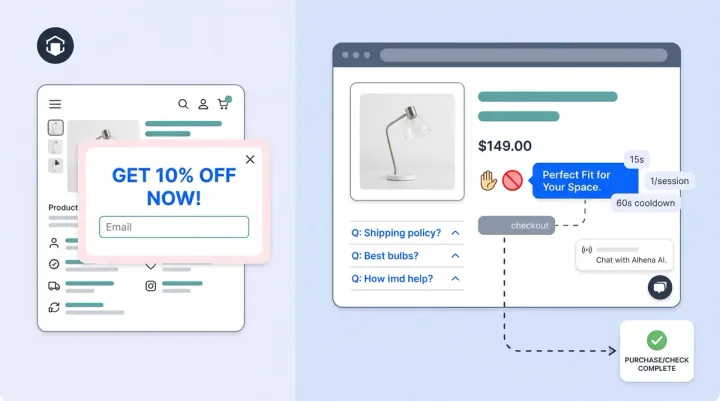
The AI followed predetermined quiz paths: "What's your skin type? What's your concern? Here are three options." That works for the first question. It falls apart the moment a shopper asks a follow-up, compares two products, or phrases a question in a way the script didn't anticipate. Real shoppers in 2026 don't follow linear conversational paths. They jump between concerns, ask multi-attribute questions, and change direction mid-conversation. A scripted bot stalls or gives a generic response when that happens, and the shopper leaves.
3. Disconnected from Your Commerce Stack
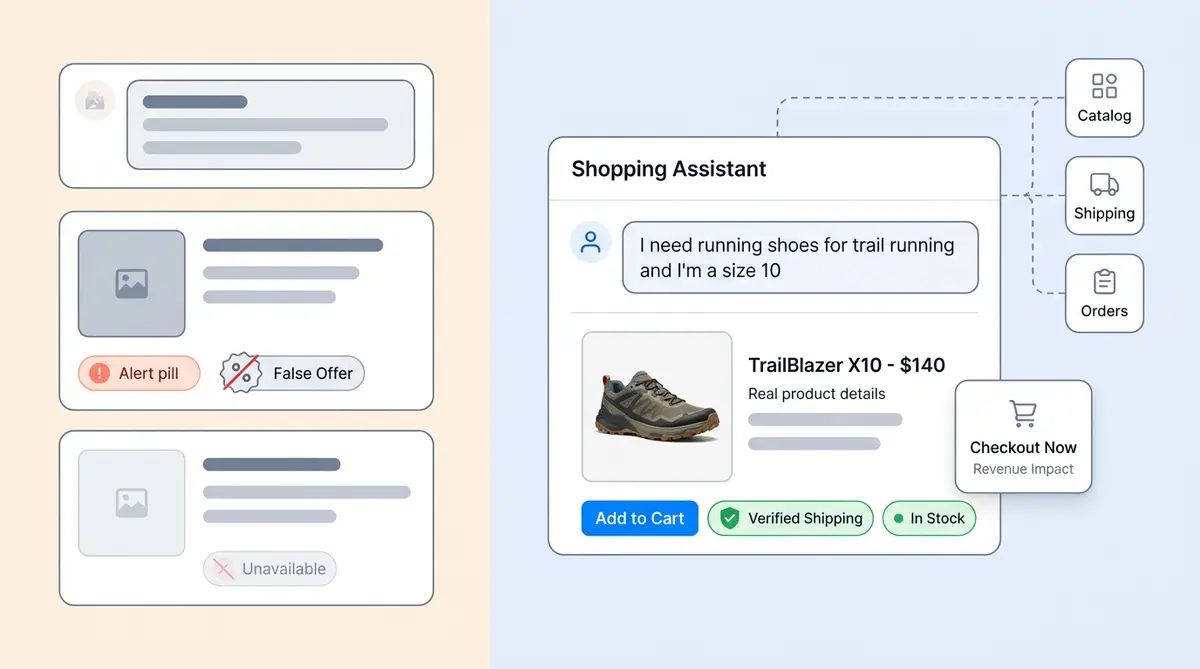
The AI operated as a standalone chat widget with no live connection to your Shopify or WooCommerce store, helpdesk, returns tools, or order management system. It couldn't check order status, process a return, or confirm whether a product was in stock. Shoppers figured this out quickly and stopped trusting it. An AI that can't access real-time commerce data is just a chatbox with better grammar.
4. Hallucination and Inaccuracy
The tool used a general-purpose language model that confidently invented product features, quoted wrong prices, and fabricated return policies. One wrong answer doesn't just lose that shopper. It erodes trust with every customer who encounters it. Your support team ended up spending more time correcting AI mistakes than the AI saved them. That's a net negative, not a deflection win.
5. No Revenue Attribution
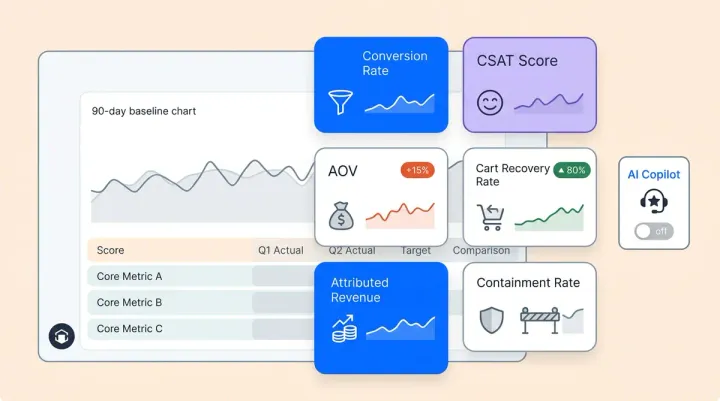
Even if the AI was quietly helping, you had no way to prove it. The tool tracked conversation volume and satisfaction metrics but couldn't connect a chat interaction to an add-to-cart event, a completed purchase, or an AOV change. Without revenue insights, the ROI case collapsed in the next quarterly review. You can't defend a tool that can't show its impact. Without cost and revenue insights tied to specific conversations, the tool becomes an expense line, not a growth driver.
What a Second Attempt Should Actually Look Like
The failure isn't AI as a category. It isn't retail's problem either. It was a tool that wasn't built for commerce. Before you invest again, here's a five-point evaluation framework to separate purpose-built ecommerce AI from repackaged support bots in e-commerce.
1. Demand Ecommerce-Native Architecture
The platform must be purpose-built for e-commerce, not a general customer service tool with ecommerce features bolted on afterward. It should understand product catalogs at the attribute level (size, ingredient, material, compatibility) rather than just the title level. Alhena AI's Shopping Assistant ingests your full catalog with attribute-level depth, so it recommends the right variant for the right use case, not just the closest keyword match.
2. Require Hallucination-Free Architecture
The AI should only respond from verified product data, never from its general training data. Look for built-in watchdog systems that flag conversations where the AI can't trace answers back to approved sources. The benchmark to ask for: fewer than one hallucination per 1,000 responses. Alhena AI grounds every response in your verified catalog, inventory, and policy data, with automated quality control that catches inaccuracies before shoppers see them.
3. Verify Agentic Capabilities
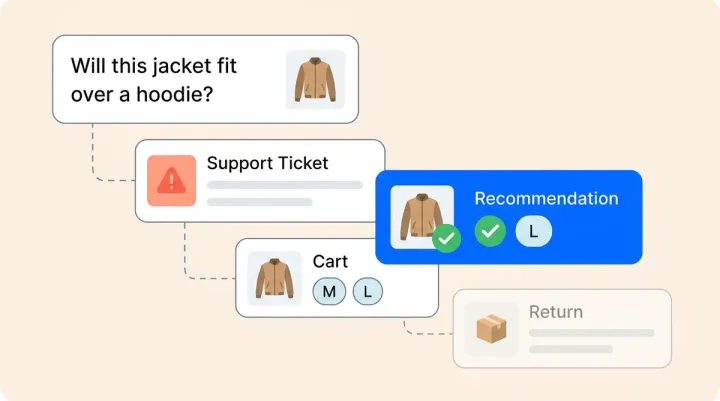
The AI should act, not just answer. That means it can populate carts, check live inventory, apply discount codes, process returns, and track orders within the conversation. If the bot redirects shoppers to another page for every action, it's a FAQ widget, not a commerce agent. Alhena's Support Concierge and order management capabilities handle these actions inside the chat, keeping the shopper in a single, frictionless flow.
4. Insist on Deep Integrations
The platform must connect natively to your ecommerce platform, your helpdesk, your returns and shipping tools, and your CRM. Real-time commerce data, not cached snapshots from yesterday. Alhena AI integrates directly with Shopify, WooCommerce, Salesforce Commerce Cloud, Gorgias, Zendesk, Freshdesk, Narvar, and ShipStation so the AI works with live data from your entire stack.
5. Require Revenue Analytics from Day One
The platform must trace conversations to add-to-cart events, completed purchases, AOV changes, and revenue attribution by engagement source. You should see business impact within weeks, not months. Alhena AI's built-in analytics show exactly which conversations drove revenue, so you can prove ROI to leadership with hard numbers and agentic insights into every customer touchpoint. Brands using this approach have seen up to 11.4% of total site revenue from AI-assisted conversations.
Built for the Second Attempt
Alhena AI was designed for exactly this situation: the ecommerce team that already tried AI, got burned, and needs proof before committing again. The platform deploys in under 48 hours, faster than most first vendors take to finish integration. That speed matters when your organization is skeptical and you need results before the next budget cycle.
The brands seeing 3x conversion rates and 38% AOV uplift aren't using better prompts or fancier language models. They're using a fundamentally different architecture, one designed to sell, not just chat. Puffy hit 63% automated resolution with 90% CSAT. Manawa cut response time from 40 minutes to 1 minute. Those aren't pilot metrics. Those are production results.
A failed AI trial doesn't mean AI doesn't work for ecommerce. It means the specific tool wasn't built for e-commerce. Every failed AI chatbot in ecommerce shares this pattern: a failure of fit, not a failure of the category. If you're ready to see what purpose-built ecommerce AI actually delivers, book a demo with Alhena AI or start free with 25 conversations and measure the purchase impact yourself.
Frequently Asked Questions
Why did my previous AI tool show no conversion uplift?
Most AI tools sold to ecommerce teams are support-first platforms that deflect tickets but don't influence purchase decisions. Without deep product understanding, live commerce data, and agentic checkout capabilities, the AI answers questions but never moves shoppers closer to buying. Alhena AI is built as a sales engine first, which is why brands see measurable conversion lifts within weeks of deployment.
How do I prevent hallucination on a second AI attempt?
Require the vendor to ground every AI response in your verified product data, not general training data. Ask for a hallucination rate below one per 1,000 responses and built-in watchdog systems that flag unverifiable answers. Alhena AI uses hallucination-free architecture with automated quality control that catches inaccuracies before customers see them.
Which integrations should I prioritize when evaluating a new AI platform?
Start with your ecommerce platform (Shopify, WooCommerce, or Salesforce Commerce Cloud) and your helpdesk (Gorgias, Zendesk, or Freshdesk). These two connections give the AI access to product data, inventory, order history, and support context. Alhena AI connects natively to all of these plus returns and shipping tools like Narvar and ShipStation.
How quickly should I expect measurable results from a new AI tool?
A purpose-built ecommerce AI platform should show measurable conversion and revenue impact within two to four weeks of deployment. If a vendor says results take six months, the tool likely lacks native commerce integrations. Alhena AI deploys in under 48 hours and provides revenue attribution analytics from day one so you can track ROI immediately.
Should I A/B test the new AI tool before full rollout?
Yes. Run a controlled test on a percentage of your traffic for two to three weeks and compare conversion rate, AOV, and revenue per session between AI-assisted and unassisted visitors. Alhena AI's analytics make this straightforward by attributing revenue to specific AI conversations, giving you clear before-and-after data to present to leadership.