The Budget Reality Most Ecommerce Teams Discover Too Late
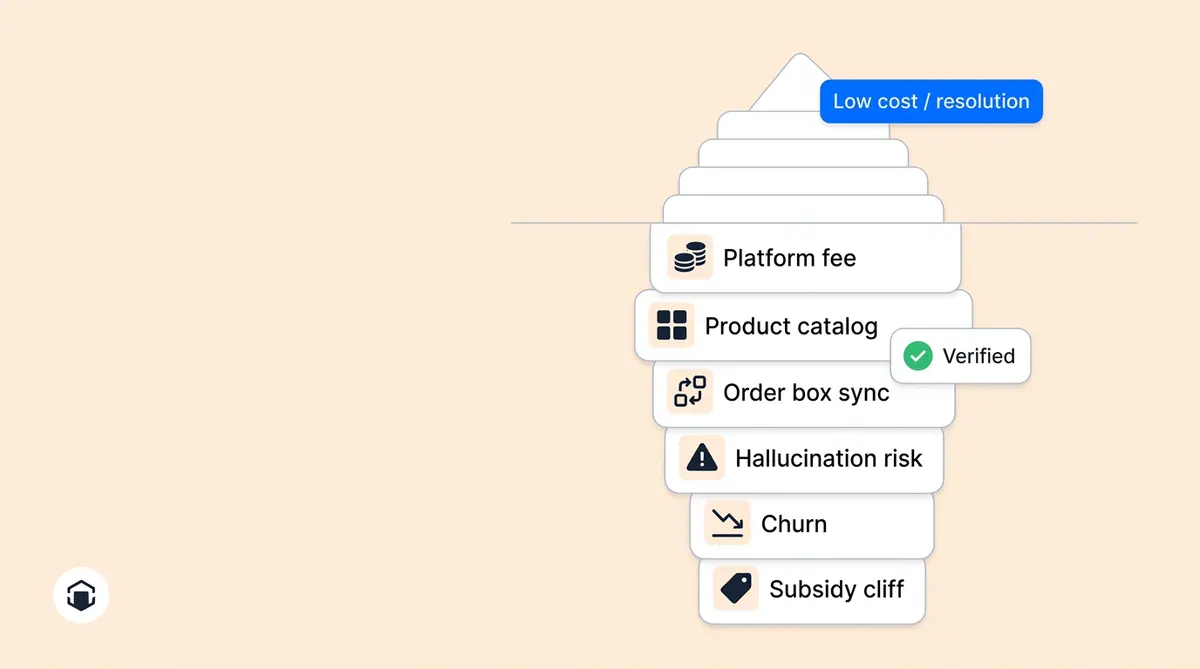
Most ecommerce teams approve AI budgets based on the platform subscription fee alone. Then the invoices start arriving. Integration consulting. Data engineering sprints. Weekly QA hours. Refunds issued because the chatbot quoted a policy that doesn't exist.
Actual AI customer service costs run 2x to 5x higher than the number on the vendor's pricing page. That gap between expected and actual spend is why 72% of CIOs report breaking even or losing money on AI investments. Customer support chatbots promise savings through automation of repetitive queries and tickets, but the real cost of AI-powered customer support automation goes far beyond the chatbot subscription. Here’s what companies actually pay. The problem isn't AI itself. The problem is incomplete budgeting.
This post presents a six-category TCO framework that covers every cost an ecommerce brand will face when deploying AI for customer service and shopping. Use it to build an accurate budget before you select a vendor, not after the surprises start. Whether you run one of thousands of Shopify stores, a WooCommerce e-commerce business, or a mid-market company, this framework applies to any ecommerce customer service AI deployment. Merchants who track ROI using analytics from day one make smarter vendor decisions.
Category 1: Platform and Licensing Fees
This is the visible cost, the number on every vendor's pricing page. It's also the only number most teams use when comparing options. Three pricing models dominate ecommerce AI today. How you pay for tickets, chatbots, and automation directly affects your ROI. Businesses that don’t model ticket volume against pricing tiers often find efficiency gains eaten by unexpected overage fees:
- Per-conversation pricing ($0.50 to $2.00 per conversation): You pay for every interaction, resolved or not. This model penalizes high engagement. If your AI is doing its job well and shoppers are asking follow-up questions, your bill goes up.
- Per-resolution pricing ($0.75 to $2.00 per resolution): You pay only when the AI resolves an issue. Sounds fair, but it creates a perverse incentive: the AI is rewarded for closing conversations quickly, not for genuinely helping. Rushed resolutions hurt CSAT and increase repeat contacts.
- Flat monthly subscriptions ($500 to $5,000+ depending on volume tier): Predictable billing, but you're locked into a tier whether you use it fully or not. Overages on high-traffic months can spike costs without warning. During BFCM, tickets can triple, and chatbots processing that volume means your bill triples too unless you’re on a flat tier. Effectively reducing per-ticket cost requires understanding your seasonal volume patterns.
The cost per interaction or cost per resolution tells you almost nothing about true cost. Reducing your visible line item while ignoring the other five categories is how ai-powered customer service initiatives fail. Two customer service software platforms charging $1,500 per month on their paid plans can have wildly different total costs once the next five categories are factored in. Always request a free trial or pilot before committing, so you can test the AI tools against your real ticket volume.
Category 2: Implementation and Integration Costs
This is the first hidden cost most teams underestimate. The range is enormous, and it depends entirely on how many systems the AI must connect to: your ecommerce platform, helpdesk, returns tool, CRM, order management system, shipping provider, and customer support channels like ai voice, email, conversational ai chat, and call processing workflows. Agentic AI systems capable of automating multi-step tasks across these channels need deeper integrations than simple chatbots.
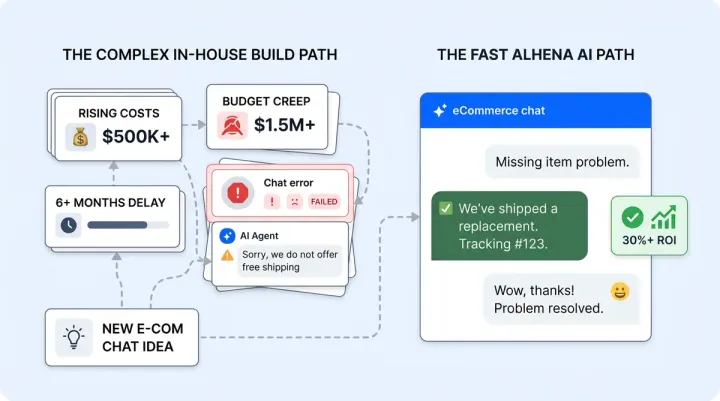
On one end, platforms with native ecommerce integrations deploy in days with near-zero implementation cost. Alhena AI deploys in under 48 hours with pre-built connectors for Shopify, WooCommerce, Salesforce Commerce Cloud, and helpdesks like Zendesk, Gorgias, and Freshdesk. No dev resources, no consulting fees.
On the other end, enterprise platforms requiring custom API development, data engineering, and consulting services run $50,000 to $150,000 or more before the AI answers a single customer question. A mid-market brand implementing API connections across six systems through custom middleware should budget $8,000 to $40,000 for API integration alone. Audit every API endpoint before signing, which adds 20-50% on top of the platform fee. Platform integration complexity is the top driver of hidden support costs in Year 1.
Category 3: Knowledge Base and Training Costs
Getting the AI accurate takes time, and time is money your team spends instead of on other priorities.
Some platforms auto-ingest your product catalog, sync your helpdesk ticket history, and learn from existing FAQs with minimal manual work. Setup takes 10 to 20 hours, and the AI improves from real conversations from day one.
Other platforms require manual intent mapping, conversation flow building, and scripted response trees for every product category, return scenario, and order status variation. For a brand with 2,000+ SKUs handling order tracking, returns processing, shipping and delivery inquiries, and product questions, this can take 80 to 200 hours of internal team time across several days or weeks before launch.
Either way, expect 2 to 5 hours per week of optimization and QA during the first three months. Someone on your team needs to review AI responses, flag errors, and refine the knowledge base. Many online companies using SaaS chatbots for ticket automation underestimate this early time commitment. Some platforms offer an ai copilot or agent assist mode where a human agent reviews AI suggestions during onboarding, which speeds up accuracy but adds to the agents' workload in month one. The question is whether the platform makes that work fast and intuitive, or whether it requires a dedicated resource.
Category 4: Ongoing Maintenance and Retraining Costs
This is the recurring hidden cost that grows with catalog complexity. If you sell seasonal products, rotate collections, or run frequent promotions, your AI needs to keep up.
Platforms that require periodic full retraining (monthly or quarterly cycles) consume serious team bandwidth. A brand with 5,000+ SKUs and seasonal rotations can spend 10 to 20 hours per month on maintenance: re-indexing product data, maintaining conversation workflows, updating automation workflows, and running regression tests. No-code platforms reduce some of this burden, but scalability still depends on how the AI handles workflow updates.
Self-improving AI architectures eliminate most of this cost. Alhena AI runs automatic weekly training cycles that ingest new product pages, updated policies, and real conversation data without manual intervention. When you update a product page or change a return policy, the AI adapts without full retraining. You don't rebuild the model. You don't re-index everything. The result: within days of setup, you get near-zero ongoing maintenance hours versus 10-20 hours per month on platforms that still require manual retraining. For businesses with seasonal catalogs, this difference compounds every quarter.
Category 5: Hallucination and Error Costs
This is the cost category most TCO analyses ignore entirely, and it can dwarf every other line item combined.
When an AI fabricates a return policy, invents a product feature, or quotes the wrong price, the downstream costs stack up fast: customer service recovery time (15 to 30 minutes per incident), potential refunds or goodwill credits ($10 to $50+ per incident), legal liability exposure (companies are legally responsible for what their chatbots say), and brand trust erosion that reduces retention and repeat purchase rates over months. The accuracy of your AI directly determines whether support costs drop or quietly climb.
AI hallucinations cost businesses $67.4 billion in 2024. At the individual brand level, ecommerce teams report spending 5 to 15 agent hours per week correcting AI mistakes on platforms without hallucination prevention. At an average fully loaded agent cost of $25 per hour, that's $6,500 to $19,500 per year in error correction alone, not counting the refunds, lost customers, and legal risk.
Alhena AI's three-layer quality control system prevents this cost category from existing. Every response must trace back to a verified citation from approved product data, FAQs, or policies. If the AI can't source an answer, it doesn't guess. The result: fewer than one hallucination per 1,000 responses, with automatic flagging that catches the rest before they reach customers.
Category 6: Opportunity Cost of Delayed Revenue
If your AI only deflects support tickets but can't recommend products, populate carts, or guide checkout, you forfeit the sales contribution that commerce-aware AI generates.
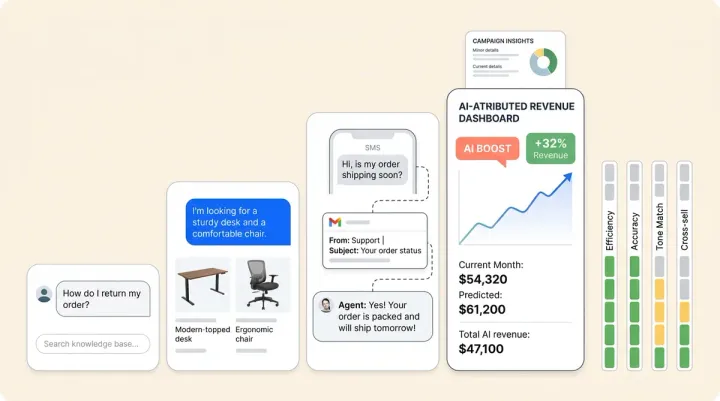
Brands using AI that actively sells, not just supports, report that AI-assisted conversations influence 10 to 20% of total site sales. Tatcha saw 11.4% of total site revenue attributed to AI conversations, with 3x conversion rates and 38% higher average order values. Victoria Beckham reported a 20% AOV increase.
For a brand doing $5M in annual revenue with monthly abandoned cart losses and missed upsell opportunities, the gap between a support-only tool and a commerce-native platform is $500K to $1M in revenue the AI could have influenced but didn't. That opportunity cost doesn't appear on any invoice, but it's the single largest cost in this entire framework.
The Real TCO: Low-Cost Platform vs. Commerce-Native Platform
When you map all six categories side by side, the "cheaper" platform often costs more.
Annual TCO Comparison: Low-Cost vs. Commerce-Native AI
| Cost Category | Low-Cost Platform | Commerce-Native Platform |
|---|---|---|
| Platform Licensing | $6,000 to $18,000/yr | $12,000 to $36,000/yr |
| Implementation | $20,000 to $80,000 | $0 to $2,000 |
| Knowledge Base Setup | 80 to 200 internal hours | 10 to 20 internal hours |
| Ongoing Maintenance | 10 to 20 hrs/month ($15K to $30K/yr) | Near-zero (auto-training) |
| Hallucination Costs | $6,500 to $19,500/yr + refunds | Near-zero (grounded AI) |
| Revenue Generated | $0 (support-only) | $500K to $1M influenced |
| True TCO (Year 1) | $47,500 to $147,500 | $12,000 to $38,000 |
| Net Impact | Cost center | Revenue positive |
How Alhena AI Minimizes TCO Across Every Category
Alhena AI was designed to collapse the cost categories that inflate TCO on other platforms:
- Licensing: Usage-based pricing with a free tier of 25 conversations so you validate fit before spending. No per-agent fees stacking on top of per-resolution fees.
- Implementation: 48-hour deployment with native integrations to Shopify, WooCommerce, Salesforce Commerce Cloud, Gorgias, Zendesk, and Freshdesk. No consulting fees, no dev resources needed.
- Training: Auto-ingests your product catalog, helpdesk history, and existing content. The AI learns from real conversations from day one.
- Maintenance: Self-improving architecture with weekly auto-training. New products, updated policies, and seasonal changes absorb automatically without manual retraining cycles.
- Hallucination prevention: Three-layer quality control with flagged conversations catches errors before customers see them. Fewer than one hallucination per 1,000 responses.
- Revenue generation: Two specialized agents (Product Expert and Order Management) recommend products, populate carts, and guide checkout. Built-in revenue attribution analytics track every dollar the AI influences.
The platform pays for itself through commerce contribution, not just cost savings. Businesses implementing Alhena see efficiency gains across support workflows and sales workflows simultaneously. See the math for your store with the ROI Calculator.
The Takeaway: Cheapest Price Is Rarely Lowest TCO
The cheapest AI platform is rarely the lowest total cost of ownership. The highest-priced platform is not always the most expensive once hidden costs are factored in. The only honest way to evaluate AI customer service cost is a complete TCO analysis that includes all six categories: licensing, implementation, training, maintenance, hallucination risk, and opportunity cost.
Businesses that run this analysis before implementing a vendor avoid the budget overruns that kill AI initiatives after quarter one. Companies that budget only for the subscription fee and measure success by efficiency metrics alone learn the hard way that the real cost was always in the categories the vendor didn't mention.
Ready to see what complete TCO looks like for your store? Book a demo with Alhena AI or start free with 25 conversations to validate before you commit.
Frequently Asked Questions
What hidden costs do most ecommerce brands miss when budgeting for AI customer service?
The three most commonly missed costs are hallucination cleanup (5 to 15 agent hours per week on platforms without grounded AI), ongoing retraining (10 to 20 hours per month for brands with large catalogs), and opportunity cost from choosing a support-only tool that generates zero revenue. Alhena AI eliminates all three through hallucination-free responses, self-improving weekly auto-training, and built-in revenue attribution from product recommendations and cart building.
How should I compare per-conversation versus per-resolution AI pricing models?
Per-conversation models charge for every interaction whether it's resolved or not, which penalizes high engagement and makes costs unpredictable during peak seasons. Per-resolution models only charge when the AI closes an issue, but they create an incentive for the AI to rush resolutions rather than genuinely help. Alhena AI uses usage-based pricing with a free tier of 25 conversations so you can validate fit before committing, with no stacked fees on top.
Should AI implementation for ecommerce cost anything beyond the subscription?
For platforms with native ecommerce integrations, implementation should be near-zero. Alhena AI deploys in under 48 hours with pre-built connectors for Shopify, WooCommerce, Salesforce Commerce Cloud, and major helpdesks, requiring no dev resources or consulting fees. If a vendor quotes $50,000 or more for implementation, that's a sign their platform lacks native integrations for your stack.
How do I account for AI hallucination costs in a TCO analysis?
Calculate the average weekly hours your team spends correcting AI errors, multiply by your fully loaded agent cost, and add average refunds or goodwill credits issued due to incorrect AI responses. On platforms without hallucination prevention, ecommerce brands report $6,500 to $19,500 per year in error correction alone. Alhena AI's three-layer quality control keeps hallucinations below one per 1,000 responses, making this cost category near-zero.
When should an AI customer service platform start paying for itself?
A well-deployed ecommerce AI should show positive ROI within 3 to 6 months through a combination of ticket deflection savings and revenue influence. If your platform only deflects tickets, breakeven takes longer because you're relying on cost reduction alone. Alhena AI tracks revenue attribution directly, and brands like Tatcha have seen 11.4% of total site revenue influenced by AI conversations, turning the platform from a cost center into a revenue driver.