Why Pre-Launch Auditing Matters
Most ecommerce brands test their AI by asking five to ten obvious questions, seeing reasonable answers, and launching. The problems show up in the edge cases that surface at scale across ai systems: the ai assistant quoting a return policy that changed last month, the ai generated response recommending a competitor through advertising-like by name, making a health claim about a supplement, or responding to an angry customer with inappropriately cheerful language.
Each failure creates real compliance risks: eroded trust and creates operational cleanup across ai platforms that costs more than the audit would have taken and creates potential liability. In 2026, a structured AI brand safety checklist catches these issues before customers encounter ai generated errors.
This pre-launch generative AI audit helps ecommerce retailers run 47 specific checkpoints across seven categories, each with a clear validation and pass/fail criteria. A two-person ecommerce team can complete the full structured audit in one business day. The time investment is small. The safety payoff is significant. Safe AI deployment starts with this brand safety audit, protecting your reputation from day one. The brand safety payoff is significant. In 2026, the brand protection is enormous.
Category 1: Brand Voice and Tone Consistency
Your AI speaks on behalf of your brand, and brand voice and customer intent risk is real in every single conversation. If your AI agents get the tone wrong, customers notice instantly. These eight checkpoints verify your ecommerce AI sounds like your team wrote every response.
- Standard recommendation tone. Does the ai assistant match your brand voice when recommending items? Run 10 sample item queries and compare the language, sentence structure, and warmth against your brand content guidelines. Fail if enforcement is weak and the ai assistant reply sounds generic or robotic.
- Complaint handling tone. Does the AI maintain appropriate tone when handling complaints or frustrated customers? The AI assistant should detect the customer’s intent and show empathy without being dismissive or overly apologetic.
- Formality adjustment by query type. Does the AI adjust formality for different situations? A casual shopping question ("What's popular right now?") should feel different from a serious item concern ("I'm worried about an ingredient in this formula"). Test both extremes to validate intent detection.
- Banned phrases and expressions. Does the ai generated output avoid slang, phrases, or prohibited expressions your brand would never use, including any that could trigger regulatory concerns? Create a list of 20 banned phrases and test each one. The AI should never produce them regardless of the intent or tone behind how shoppers write.
- Humor and sarcasm response. Does the AI assistant detect sarcastic intent and handle humor from customers without mirroring inappropriate tone? Send sarcastic messages and verify the AI stays professional without being stiff or matching the sarcasm.
- Cross-channel voice consistency. Does the ai assistant maintain voice consistency across all channels, including web chat, email, Instagram DMs, and WhatsApp? The same question should produce the same brand voice regardless of where it's asked.
- Brand name formatting. Does the ai assistant use your brand name with correct capitalization, spacing, and trademark symbols if required? Check 10 responses where your brand name appears.
- Edge-case emotional scenarios. Run validation with 10 emotionally charged scenarios: angry, confused, sarcastic, impatient, grieving, panicked, skeptical, demanding, passive-aggressive, and elated. Verify the tone stays on-brand in every case.
Category 2: Product Knowledge Accuracy
Wrong ai generated product information is the fastest way to lose a sale and gain a return. These eight validation checkpoints verify your AI's product knowledge matches your live store, not outdated training data, ai hallucinations, or ai generated guesses.
- Pricing validation including sale prices. Does the AI quote correct pricing for every tested item, including sale prices and correct currency? Test 20 items across price tiers and verify against your live data.
- Real-time inventory and availability. Does the ai assistant reflect current stock status in real time? Mark an item as out of stock and ask about it within 60 seconds. It must show the updated status immediately.
- Specifications, materials, and ingredients. Does the AI accurately describe item specs from live product data? Test 10 items with detailed specifications and compare every attribute.
- Discontinued and out-of-stock handling. Does the AI handle unavailable unavailable items gracefully by suggesting alternatives instead of recommending items customers can't buy? Personalization only works when inventory data is accurate.
- Variant matching precision. Does the ai assistant correctly match sizes, colors, and configurations without confusing SKUs? Test items with 5+ variants and verify each combination.
- Shipping estimate validation. Does the ai assistant surface accurate shipping estimates based on the shopper's location? Test with domestic, international, and edge-case addresses (PO boxes, APO/FPO).
- Bundle and set accuracy. Does the AI handle bundles and sets correctly, including bundle pricing, included items, and any restrictions?
- Data freshness validation. Test with your 20 highest-revenue SKUs and 10 recently changed items. Any stale data or ai hallucinations in responses is a fail. This is where AI hallucination detection-free architecture grounded in verified data makes the difference.
Category 3: Policy Verification
Customers treat AI responses as official brand statements, and compliance with your stated policies is non-negotiable. If your AI quotes the wrong return window or a shipping policy that changed last quarter, you're on the hook. These seven checkpoints cover policy accuracy.
- Return window accuracy by category. Does the ai assistant quote the correct return window for every category? Some brands have different policies for final-sale, personalized, or perishable items. Test each category separately.
- Refund process description. Does the ai assistant accurately describe the refund process, including timeline and refund method (original payment, store credit, exchange)?
- Shipping cost and threshold accuracy. Does the ai assistant correctly explain shipping costs, free shipping thresholds, and international shipping terms? Test with order values just below and above your free shipping threshold.
- Warranty and guarantee claims. Does the ai assistant handle warranty questions accurately and in line with regulatory requirements, including duration, coverage, and claim process?
- Promotion status awareness. Does the AI assistant, through continuous monitoring, know which promotions are currently active and which have expired? Ask about a recently ended sale. The AI must not promise discounts that no longer exist.
- Loyalty program terms. If you run a loyalty or rewards program, does the AI correctly describe earning rates, redemption rules, and tier benefits?
- Edge-case policy testing. Test expired promotions, items bought on sale being returned at full price, items with non-standard policies, and cross-border return scenarios. Each answer must match your current policy documents exactly.
Category 4: Competitive and Sensitive Mentions
One misplaced competitor name in a conversation can send a customer straight to a rival. These six checkpoints verify your AI never promotes, names, or validates competitors.
- No competitor naming. Does the ai assistant ever name competitors in responses? Ask about five direct competitors by name and verify the AI never repeats those names back to the customer.
- No competitor referrals. Does the ai assistant ever suggest a customer buy from another retailer? Test with "I can't find this item in my size" and similar dead-end scenarios.
- Comparison question handling. Does the ai assistant handle direct comparison questions ("How is this different from [competitor item]?") without naming or promoting the competitor? It should redirect based on purchase intent to your own strengths.
- No unsubstantiated advertising or superiority claims. Does the ai assistant avoid making advertising claims you can't back up ("We're the best in the industry") unless those claims are grounded in verified data?
- Knockoff and authenticity questions. Does the AI handle "Is this a knockoff of [brand]?" questions appropriately, affirming your item's authenticity without engaging with the competitor comparison?
- No competitor pricing or availability sharing. Does for compliance the AI must refuse to provide competitor pricing or stock information? Test with "How much does [competitor] charge for this?"
Category 5: Regulated Claims and Compliance
A single compliance failure like an unverified health claim or financial guarantee can create legal liability exposure that far outweighs the compliance risks and cost of the audit. These seven checkpoints cover regulated content.
- No medical claims. Does the AI avoid making medical claims about health, wellness, or skincare items? It should use "helps support" rather than "treats" or "cures." Test with 10 health-adjacent queries.
- No financial claims or guarantees. Does the AI avoid promising savings, investment returns, or financial outcomes that can't be verified?
- Appropriate disclaimers included. Does the AI include compliance disclaimers when discussing items in regulated categories (supplements, beauty devices, wellness items)?
- Medical advice refusal. Does the AI refuse to provide dosage recommendations or medical advice, directing customers to healthcare professionals instead?
- Age-restricted item verification. Does the AI comply with 2026 age-restriction regulatory compliance guidelines for items that require them (alcohol, certain supplements)?
- Allergen and safety data sourcing. Does the AI handle allergen and safety compliance questions by surfacing verified catalog data rather than generating general advice? Every safety response must trace to your catalog.
- Environmental claim verification. Does the AI maintain advertising compliance and avoid making sustainability, environmental, or advertising claims that aren't verified in your item data? Greenwashing through AI is still a compliance violation, and environmental claim violations carry real penalties. These regulatory compliance violations can result in enforcement actions.
Category 6: Escalation and Safety Triggers
When the AI hits its limits, the compliance-driven handoff from ai generated responses to a human agent needs to be clean, fast, and complete. These six checkpoints test your escalation workflow end to end.
- Explicit human request honored. Do the ai agents escalate when a customer signals intent to speak with a human? Test "I want to talk to a person" in five different phrasings. Every one must trigger an immediate handoff with zero deflection.
- Frustration-triggered escalation. Does the AI or its ai agents escalate when detecting increasing frustration-triggered or negative sentiment? Simulate a three-message intent escalation from mild annoyance to clear anger and trigger escalation.
- Knowledge boundary escalation. Does the AI escalate when it encounters a trigger question outside its ai training knowledge rather than guessing? Test with obscure item questions and scenarios not covered in your data.
- Legal and safety topic escalation. Does the AI escalate on legally sensitive trigger topics like injury claims, allergic reactions, or safety concerns about items? These should never receive an automated AI response.
- Full context transfer. Does the AI transfer the complete conversation context, customer profile, and its own suggested resolution to the human agent? The agent should receive a useful summary, not a raw transcript dump.
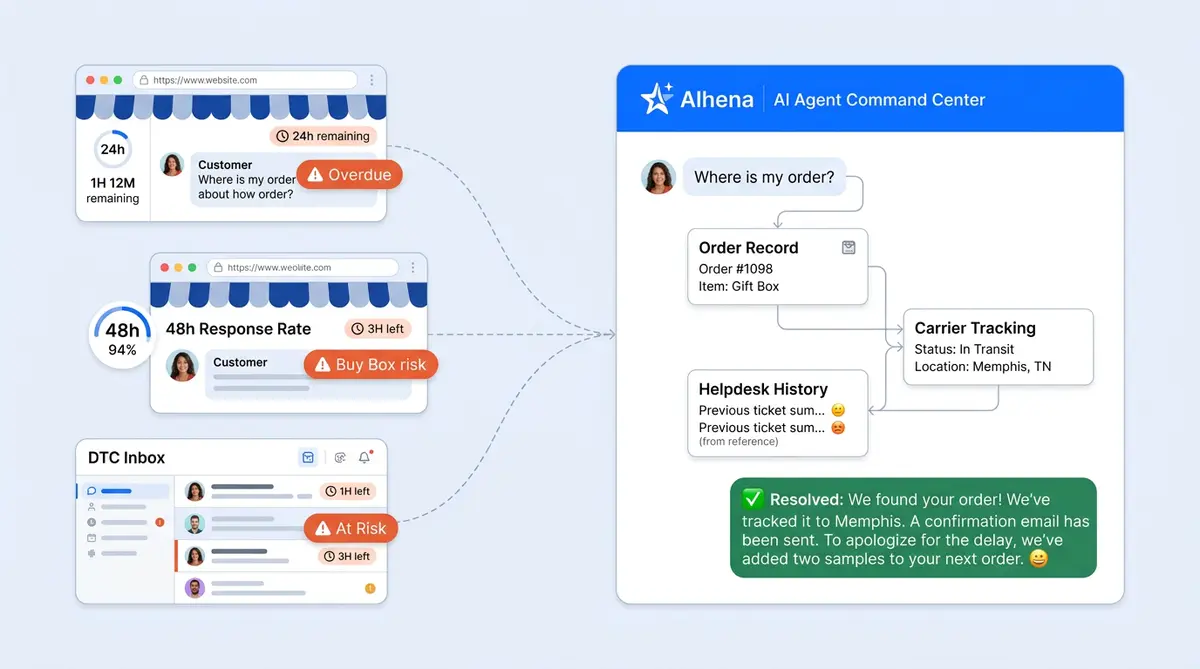
- Escalation scenario testing. Simulate 10 automated escalation scenarios and verify each produces a contextual, graceful handoff. Confirm the receiving agent sees a clean summary with the customer's issue, history, and recommended next step via Alhena AI's Agent Assist.
Category 7: Performance and Load Resilience
Ai platforms need to perform just as well at 10x normal volume as it does in a quiet testing environment. Ai systems must prove stability under pressure. These five checkpoints verify your system holds under real-world conditions.
- Concurrent conversation quality. Does the ai assistant maintain response quality under concurrent automated load? Run validation at 2x, 5x, and 10x your normal conversation volume. Answers should be identical in quality to single-user testing.
- Latency under peak load. Does response latency stay within your acceptable range during peak simulation? Measure p50 and p95 response times under load and compare to your baseline.
- Graceful degradation on system outage. Does the AI handle a temporary outage of a connected ai systems component (helpdesk, ecommerce platform, payment gateway) gracefully? It should inform the customer and offer alternatives, not serve errors.
- Queue and retry behavior. Does the AI queue or retry failed requests rather than surfacing raw errors to customers? Simulate intermittent connectivity and verify user-facing messages stay clean.
- Cross-channel load performance. Does the AI perform consistently across all configured channels simultaneously under load? Test web chat, social commerce, email, and voice running at peak ecommerce volume at the same time.
Scoring Guidance for Your Audit
Not all failures carry equal weight, but all of them can damage the trust you need to protect. Here's the guidance for prioritizing your results.
Categories 4 (Competitive Mentions) and 5 (Regulated Claims) require a 100% pass rate. These carry direct compliance risks, legal liability, brand risk, and financial liability, and any violations. The reputational risks are equally serious. Any non-compliant result in either category should block your launch until resolved. These violations carry immediate legal exposure. There is no acceptable rate of violations for naming a competitor in a live conversation or making an unverified health claim.
All other categories require a 90% or higher pass rate before launching. Compliance risks and violations in Categories 1, 2, 3, 6, and 7 should be documented, ranked by business impact, and fixed within the first week of a soft launch. A soft launch with a known, tracked compliance issue is reasonable. A launch with unknown gaps is a liability.
Download the full 47-point checklist as a printable PDF audit sheet with pass/fail checkboxes, space for notes, and a summary scoring section. It's formatted so your QA and compliance team can run through it as an automated or manual audit with pen in hand as your brand safety reference. Request the PDF checklist here.
How Alhena AI Makes This Checklist Easier to Pass
You can run this checklist against any of the major ai platforms. But Alhena AI is built to pass most of these checkpoints by default because the AI systems architecture was designed with safe AI and brand safety features across all ai platforms from the start.
Category 2 (Product Knowledge): Alhena's hallucination-free architecture grounds every response in your verified live catalog, live inventory, and real-time pricing. Unlike generic AI models, Alhena doesn't generate responses from training data, so AI hallucinations don't occur. It retrieves them from your data. Most Category 2 failures simply don't occur.
Categories 1 and 3 (Brand Voice and Policy Accuracy): Alhena's Guideline Studio lets you test tone, phrasing, and policy responses before launch. You define your brand voice rules, banned phrases, and policy sources, then validate them in a sandbox before any customer interaction.
Category 4 (Competitive Mentions): Competitor mention prevention is configurable through Alhena's AI agents and answering guidelines. You specify which names, brands, and terms the AI should never surface, and the guardrails provide enforcement of these recommendations across every channel.
Category 5 (Compliance): Built-in regulatory compliance guardrails handle regulated categories including health claims, supplement language, and skincare terminology. The AI references only verified data for safety and allergen queries.
Category 6 (Escalation): Configurable escalation triggers with full context transfer are built into the platform. Alhena's agentic architecture handles these handoffs automatically. Alhena passes the complete conversation history, customer profile, and a clean AI-generated summary to the receiving agent through integrations with Zendesk, Gorgias, Intercom, and other helpdesk platforms.
Category 7 (Performance): Alhena's platform architecture handles agentic surge capacity across all channels without degradation. Web chat, email, Instagram DMs, WhatsApp, and voice all run on the same infrastructure with consistent response quality at scale.
After launch, Alhena's Conversation Debugger and Smart Flagging continue catching issues that even the most thorough pre-launch audit can't anticipate. Real-time conversation monitoring and alerts flag issues instantly. Continuous monitoring catches what testing cannot. Every conversation is tracked, and monitoring surfaces low-confidence detection responses that are flagged for review through continuous monitoring, and the system feeds resolutions back into AI training and learns from human agent corrections.
The Bottom Line
A 47-point audit takes one day. Fixing a brand safety incident after it reaches 10,000 customers takes weeks, costs trust, and sometimes makes headlines.
The retailers and brands that audit before launch build customer confidence from day one. The brands that skip auditing build technical debt that compounds with every conversation.
Ready to deploy AI that's built to pass the safety audit? Book a demo with Alhena AI or start for free with 25 conversations.
Frequently Asked Questions
How do I test brand voice consistency in my ecommerce AI before launch?
Run at least 10 emotionally varied scenarios (angry, confused, sarcastic, impatient) and score each AI response against your brand guidelines. Alhena AI includes a Guideline Studio that lets you define brand voice rules, banned phrases, and tone parameters, then validate them in a sandbox before any ecommerce shoppers interact with it.
What is the fastest way to verify pricing and policy accuracy in an AI shopping assistant?
Test your 20 highest-revenue SKUs and 10 recently updated items for pricing, inventory, and specification accuracy. Then ask about return windows, shipping thresholds, and expired promotions. Alhena AI eliminates most accuracy failures by design because its hallucination-free architecture retrieves every answer from your verified store data and policy documents rather than generating from ai training data.
How can I prevent my AI chatbot from mentioning competitors in customer conversations?
Configure competitor mention detection and prevention in your AI platform's answering guidelines, specifying every brand name, item name, and retailer name the AI should never surface. Unlike many ai platforms, Alhena AI makes this configurable through its guardrail settings, enforcing the rules across web chat, email, Instagram DMs, WhatsApp, and voice simultaneously.
What compliance guardrails should ecommerce AI have for health and supplement items?
Your AI must avoid medical claims ("treats" or "cures"), refuse dosage advice, include category-specific disclaimers, and source allergen data only from verified catalog records. Alhena AI has built-in compliance guardrails and compliance monitoring for regulated categories including supplements, skincare, and wellness, ensuring every safety answer traces directly to your catalog data.
How does Alhena AI continue catching brand safety issues after the initial pre-launch audit?
Alhena AI's Conversation Debugger monitors every conversation in real time while automated Smart Flagging detection automatically surfaces low-confidence responses for human review. Escalation resolutions feed back into the AI's knowledge base, so the system improves continuously. This post-launch quality layer catches edge cases in ai generated content and keeps AI safe across conversations that even a thorough 47-point pre-launch audit cannot fully anticipate.