Across every channel analyzed on the Alhena platform, roughly 1% of site visitors who engage with an AI shopping assistant account for approximately 10% of total revenue. That's a 10x revenue contribution from a tiny slice of traffic. With global ecommerce AI investment surpassing $9 billion in 2025 and growing year over year into 2026, this single metric matters most for retail and ecommerce marketers, DTC operators, and consumer brands. It should reshape how you think about on-site conversion, ad spend allocation, and the role agentic commerce plays in your revenue stack. For retailers, merchants, and ecommerce businesses alike, this is the clearest signal yet that AI powered personalization drives real-time ecommerce revenue.
Understanding the engagement gap between proactive and passive AI deployment helps explain why some brands capture far more AI-assisted revenue than others.
This isn't a projection or a best-case scenario. It's an observable pattern: when shoppers interact with an AI powered agentic commerce agent that understands product data through machine learning and natural language processing, answers buying questions and search queries in real time with personalized relevance, and guides them toward checkout, they convert at dramatically higher rates than passive browsers. The question isn't whether generative AI and conversational AI engagement drives revenue. The question is how much revenue you're leaving on the table by not activating it.
The AI Engagement Funnel: Why Engagement Rate Is the Most Powerful Lever
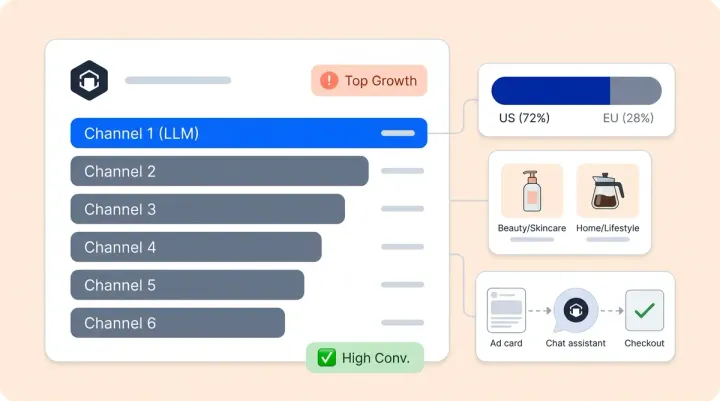
Not all traffic converts equally, and not all channels drive the same engagement with AI assistants. When you break down engagement rates by traffic source, a clear hierarchy emerges. SMS marketing leads top the list at 4.43%, followed by large language model (LLM) referred traffic at 2.69%, email marketing at 2.44%, and Google Ads at 1.87%. Meta Ads trails at 0.67%, and TikTok Ads sits at just 0.15%.
What this actually tells retailers and ecommerce businesses is that high-intent channels naturally produce higher engagement when shoppers use AI tools. Generative AI and AI agents make every interaction more relevant. SMS subscribers and email recipients already know your brand. When consumers use AI during online shopping, the AI helps them find exactly what they need faster. They arrive with context, curiosity, and relevance to your product catalog, which makes them more likely to interact with an AI shopping assistant on a product page. Paid social and digital ad traffic, especially from TikTok, arrives cold. The visitor may be interested, but they're browsing, not buying.
The strategy takeaway for ecommerce businesses: engagement rate is the lever that multiplies everything downstream. Early adoption of AI engagement tools separates high-growth retailers from the rest. In B2C retail, a 1% engagement rate producing 10% of revenue across the conversion funnel means that moving engagement from 1% to 2% doesn't just double AI-touched sessions. It compounds through higher add-to-cart rates, better cart completion rates, and larger average order values. Every percentage point of engagement unlocks outsized returns across digital commerce, mobile commerce, and social commerce channels. Brands that use AI to recover abandoned carts see the clearest revenue increase, with cart abandonment rates dropping significantly when AI assistance is active during the shopping journey.
Cart-to-Checkout: How AI Nearly Doubles Last-Mile Conversion
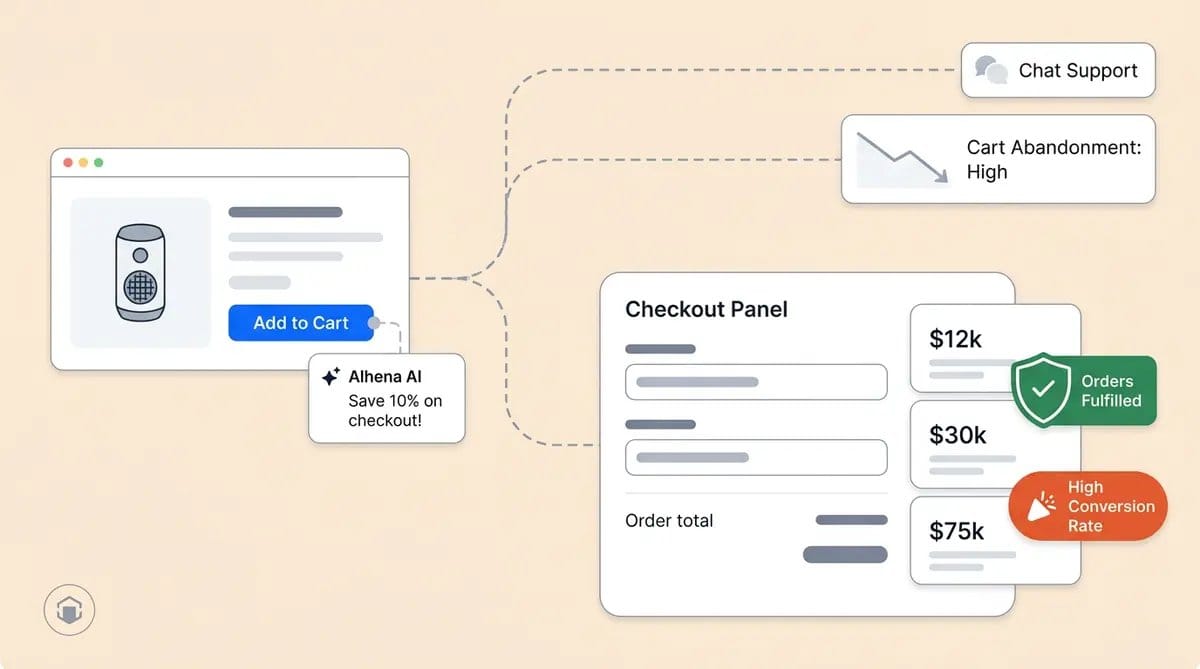
The most striking conversion lift happens at the moment that matters most: when a shopper has items in their cart and needs to decide whether to check out. Among AI-engaged visitors, 49.3% of carts convert to checkout. Without AI engagement, that number drops to 26.3%.
That's nearly double the last-mile conversion rate. When AI powered assistants guide shoppers through the checkout flow, handle payment questions, clarify shipping timelines, and explain the returns and refunds policy, it removes the friction that leads to abandoned carts and kills conversion. For brands running thousands of sessions per day, this gap translates directly into recovered revenue. Think about it: you've already paid to acquire the visitor, they've already found a product they want, and they've added it to their cart. The only thing standing between you and a sale is the last step. AI support and guidance at this stage resolves last-second hesitations around shipping, sizing, returns, and compatibility. This kind of AI powered customer experience drives higher customer satisfaction scores and stronger customer engagement across every touchpoint.
This is where agentic commerce capabilities matter. An AI agent that can populate carts, recommend products, pre-fill checkout fields, and answer transaction-related questions about bundles, discounts, and shipping in real time removes friction that static FAQ pages and legacy software solutions and generic chatbots simply can't address. The result is a measurable lift in checkout completion, not just engagement metrics.
The 5.5x Gap: Proactive vs. Passive AI Deployment
Here's where the opportunity gets interesting. Brands that deploy AI proactively, with PDP FAQs, smart nudges, inline product recommendations, and cart-stage prompts, see engagement rates up to 6%. The current average across all deployments sits around 1%. That's a 5.5x gap between top deployers and the rest.
What separates proactive AI powered deployment from passive? Think of it as the difference between static recommendation engines and intelligent virtual assistant powered product discovery driven by AI agents. Shoppers expect more. Passive deployment means dropping a chat widget in the corner of your site and hoping visitors find it. Proactive deployment means embedding AI directly into the shopping experience: answering the top five questions about a product with personalized relevance before the shopper even asks, offering AI chat and AI assistance throughout the shopping journey, surfacing AI powered size guides when someone views a fit-sensitive item, and triggering a personalized, AI powered prompt when a cart sits idle for 30 seconds.
The brands reaching 6% engagement aren't spending more on AI. They're activating it differently. They treat the AI shopping assistant as a core part of the product page, not an afterthought tucked behind an icon. For ecommerce brands evaluating their current setup, the gap between 1% and 6% represents the single largest conversion opportunity available today.
Channel Amplification: AI Turns Paid Traffic Into Higher-Converting Traffic
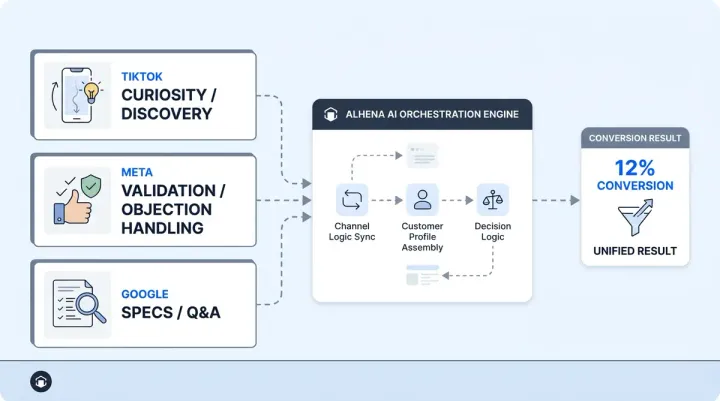
One of the most overlooked findings in the data is how AI engagement amplifies the performance of paid channels. When visitors from Google Ads engage with an AI assistant, their conversion rate jumps 6.1x compared to non-engaged visitors from the same channel. On Meta Ads, the lift is 13.1x. On TikTok Ads, it's 76x.
That TikTok number deserves a closer look. TikTok traffic is notoriously hard to convert. Visitors arrive from short-form video content with low purchase intent, whether browsing fashion, beauty, or home goods. But the small fraction who do engage with AI convert at an extraordinary rate. The signal is clear: AI engagement acts as an intent filter. It identifies the visitors who are ready to buy and gives them the information they need to complete the purchase.
The implication for media buyers, growth teams, and retailers investing in agentic commerce agents is significant. The opportunity isn't more ad spend or lower cost per click. It's better activation of existing traffic to improve return on ad spend and overall ad performance. If merchants and retailers can move their AI engagement rate from 0.15% to 1% on TikTok traffic using agentic commerce tools, you don't need to increase your ad budget to see meaningful revenue gains. The same logic applies across Google and Meta: investing in proactive AI deployment on landing pages and product pages produces a higher return than increasing bids. AI reduces bounce rate, extends session duration, and lifts click-through rate on product recommendations. Retailers who use AI and generative AI tools see consistent revenue increase.
Why Passive Chat Widgets Leave Revenue on the Table
Brands that treat AI assistants as passive chat widgets are missing the core insight in this data. A chat icon in the bottom corner of your site is essentially manual, non-automated engagement capture, but it relies entirely on the visitor choosing to click it. Most won't. The average engagement rate across passive deployments confirms this.
Proactive deployment flips the model. Instead of waiting for the shopper to seek help, agentic AI agents, AI powered product discovery meets them where they are at every stage of the customer journey: on the product page, in the cart, during the purchase decision at checkout, and through voice, Instagram, and WhatsApp channels. It answers the questions that block purchase decisions before the shopper bounces. It offers personalized product recommendations based on what's already in the cart, surfaces relevant offers, and drives AOV growth through intelligent upselling and cross-selling. AI agents factor in pricing, inventory levels, fulfillment logistics, supply chain data, and marketing context. Using first-party customer data, user behavior signals, buying behavior patterns, and predictive analytics to make each recommendation more relevant. Beyond automation of routine queries, AI assistants improve retention and customer lifetime value by creating personalized shopping experiences that bring shoppers back. It handles order status, reviews and ratings queries, return policy questions that would otherwise require a support ticket or, worse, an abandoned session.
The impact on ecommerce revenue is clear from aggregated Alhena platform data. Brands with proactive deployment strategies see not only higher engagement rates but higher revenue per AI-engaged session. The AI isn't just talking to more people. It's talking to them at the right moment with the right information, which is what drives the 10x revenue contribution.
The Conversion Opportunity Ecommerce Brands Can't Ignore
The gap between proactive and passive AI deployment is the single biggest conversion opportunity and competitive advantage in ecommerce today, for enterprise brands and growing stores alike. The numbers are clear: 1% of visitors driving 10% of revenue, cart-to-checkout rates nearly doubling, and paid channel conversion lifts measured in multiples, not percentages.
For ecommerce marketers, merchants, CX leaders, and retailers, the action items are straightforward. The impact of agentic commerce tools on incremental revenue is clear, and these benchmarks serve as KPIs for any implementation. Analytics and survey data from the Alhena platform confirms this ROI pattern, with AI engaged shoppers also generating more referrals, repeat purchases, and stronger brand loyalty. Whether you run a DTC store, a marketplace, a SaaS platform, or a subscription model, proactive AI deployment delivers the same pattern. Audit your current AI engagement rate, adoption strategy, and discovery metrics. If it's sitting near 1%, you're leaving significant revenue on the table. Move from passive to proactive deployment: embed AI into every product page and product listing, add smart nudges at cart stage, surface contextual FAQs, and trigger real-time AI assistance during checkout. Track your engagement rate closely, run A/B testing on AI prompts, and optimize the workflow for each traffic source. The brands doing this are already hitting 6% engagement, even during seasonal peaks and holiday shopping periods and capturing outsized revenue share.
AI-assisted commerce isn't about adding another tool to your stack. For a deeper look, see how <a href="https://alhena.ai/blog/ai-conversion-lift-by-channel-tiktok-meta-google/">AI conversion lift varies dramatically by channel</a>. It's about activating the traffic you already have.
Ready to see what proactive AI deployment looks like for your store? Book a demo with Alhena AI or start for free with 25 conversations.
How Generative AI and AI Agents Are Reshaping Online Shopping
Generative AI has moved beyond simple chatbots. Today's AI agents use generative AI to understand product catalogs, process natural language queries, and deliver personalized recommendations in real time. When shoppers use AI tools during their online shopping journey, they get answers that static search and recommendation engines simply can't match. AI powered product discovery means consumers can describe what they want in plain language and receive curated results instantly, from "waterproof hiking boots under $150" to "a gift for someone who loves cooking."
This shift in how consumers use AI is driving measurable revenue increase for retailers who adopt early. AI chat and conversational AI interfaces keep shoppers engaged longer, answer pre-purchase questions that would otherwise lead to abandoned carts, and reduce cart abandonment at every stage of the shopping journey. AI agents also handle post-purchase queries like order tracking and returns, which improves retention, cuts response time, reduces ticket volume, and frees human agents to focus on high-value interactions. The result is a measurable lift in both conversion and customer lifetime value.
AI powered personalization and audience segmentation takes this further. Rather than showing every shopper the same bestseller list, generative AI tools analyze browsing behavior, purchase history, sentiment signals, and real-time intent for precise targeting signals to surface the most relevant products. This level of AI assistance transforms the online shopping experience from passive browsing to active, guided discovery. Shoppers who use AI powered product discovery tools convert at higher rates, spend more per purchase, and show stronger retention metrics over time. For retailers, the incremental revenue from AI agents and AI powered recommendations compounds with every interaction, turning a modest AI investment into substantial AOV and revenue growth year over year.
Brands that use AI shopping assistants, whether through generative AI chat, AI powered product pages, or AI agents embedded in the checkout flow, see the pattern repeat. Shoppers who use AI spend more time on site, add more items per cart, and complete purchases at higher rates. AI agents powered by generative AI don't just answer questions. They guide shoppers through discovery, recommend complementary products, handle objections about shipping or returns, and recover abandoned carts before the shopper leaves. Every retailer that has deployed AI powered product discovery and AI assistance reports the same finding: the small percentage of shoppers who use AI generate outsized revenue. Generative AI tools, AI agents, and AI powered recommendations aren't optional anymore. They're the infrastructure behind the next wave of revenue increase in ecommerce.
AI Assisted Commerce by the Numbers: What the Data Shows
The revenue increase from AI assisted commerce is not theoretical. When retailers use AI tools like generative AI shopping assistants, AI agents, and AI powered recommendation engines, the data tells a consistent story. Shoppers who engage with AI chat or conversational AI during their online shopping journey convert at nearly double the rate of those who don't. AI powered product discovery helps consumers find what they need faster, which reduces abandoned carts and cart abandonment while lifting conversion, AOV, and overall revenue per session.
The adoption curve is accelerating. Year over year, more retailers and ecommerce businesses use AI agents and generative AI tools to personalize the shopping journey, from product discovery to checkout, with scalable integration, fast onboarding, and minimal training required. AI assistance, whether through AI chat, conversational AI, or AI powered recommendations, creates personalized experiences that improve customer lifetime value, retention, and incremental revenue. The agentic commerce model, where AI agents handle everything from personalization to abandoned carts recovery, represents the next evolution in how consumers shop online. For retailers making AI investment decisions, the metrics are clear: AI powered commerce drives measurable revenue increase at every stage of the shopping journey.
Frequently Asked Questions
What does ‘1% of visitors, 10% of revenue’ actually mean for my ecommerce store?
It means the small fraction of shoppers who engage with an AI shopping assistant on your site generate a disproportionately large share of total revenue. On the Alhena AI platform, this 10x revenue contribution is consistent across channels, product categories, and store sizes. If your current engagement rate is below 1%, proactive deployment strategies like PDP FAQs and cart-stage prompts can close that gap fast.
How does AI engagement improve cart-to-checkout conversion compared to standard ecommerce flows?
AI-engaged visitors convert from cart to checkout at 49.3%, compared to 26.3% for non-engaged visitors. That near-doubling happens because the AI resolves last-second objections around shipping, sizing, and returns in real time. Alhena AI goes further with agentic checkout capabilities that populate carts and pre-fill checkout fields, removing friction that static pages can’t.
Is it worth deploying an AI shopping assistant if most of my traffic comes from paid social?
Yes, and the data strongly supports it. AI-engaged visitors from Meta Ads convert at 13.1x the rate of non-engaged visitors, and on TikTok Ads the lift is 76x. Alhena AI acts as an intent filter for cold paid traffic, identifying the visitors ready to buy and guiding them to purchase. The ROI comes from better activation of existing spend, not additional budget.
What’s the difference between proactive and passive AI deployment, and how much revenue does it impact?
Passive deployment places a chatbot widget in the corner and waits for clicks. Traditional customer support chatbots and customer service tools lack the omnichannel awareness that modern AI agents bring. Proactive deployment embeds AI directly into product pages, cart flows, and checkout with smart nudges and inline recommendations. The gap is 5.5x in engagement rates, with top brands on Alhena AI reaching 6% engagement versus the 1% average. That difference translates directly into revenue share captured by AI-assisted sessions.
How quickly can I measure ROI after deploying Alhena AI on my ecommerce store?
Most brands see measurable conversion and revenue impact within the first two weeks. Alhena AI deploys in under 48 hours with no developer resources, and its built-in revenue attribution analytics track AI-influenced revenue and customer acquisition metrics from day one. You’ll see engagement rates, cart-to-checkout lifts, and per-session revenue data in real time, so ROI is visible almost immediately.