Ada CX raised $200 million, hit a $1.2 billion valuation, and built an AI platform that serves roughly 500 enterprise companies. But for e-commerce brands, that story comes with a catch: opaque pricing that starts around $30,000 a year, complex multi-month setup and implementation timelines, and an AI engine built for ticket deflection, not revenue generation. According to Gartner, agentic AI will autonomously resolve 80% of common customer service issues by 2029. The platforms that win won't just close tickets. They'll close sales. This guide breaks down the 10 best Ada alternatives for e-commerce, helping you find the right AI platform, comparing pricing, features, integrations, and ideal use cases so you can find the right fit for your store.
Why E-Commerce Brands Are Looking for Ada Alternatives
Ada isn't a bad platform. It handles enterprise-scale conversations, supports multiple channels, and automates a large share of routine support requests. The problem is fit. E-commerce brands face three specific pain points that push them toward alternatives.
Pricing is a black box. Ada charges $1 to $3.50 per automated resolution with no public pricing page. At 10,000 monthly resolutions, you could be looking at $10,000 to $35,000 per month before you even factor in implementation fees. One former customer reported paying over $300,000 annually. For growing brands, this makes cost forecasting nearly impossible.
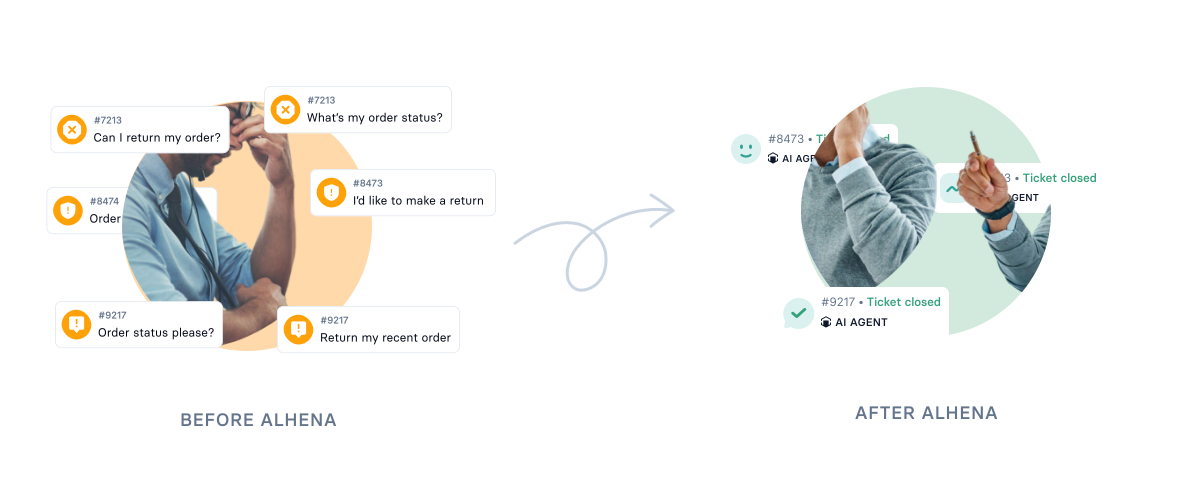
Setup takes months, not days. Ada's enterprise deployment model requires dedicated onboarding, training data preparation, and often technical resources. Platforms like Alhena AI deploy faster, in under 48 hours with no dev team required. When you're heading into peak season, months of lead time is a dealbreaker.
Ada deflects tickets but doesn't drive sales. This is the biggest gap. Ada was built to reduce support volume. It doesn't recommend products, populate shopping carts, or guide customers through checkout. For e-commerce brands where every chat is a potential sale, that's money left on the table. Brands like Tatcha have seen 3x conversion rates after switching to AI that sells, not just supports.
10 Best Ada Alternatives at a Glance
1. Alhena AI: Best for E-Commerce Revenue
Alhena AI is purpose-built for e-commerce. While most Ada alternatives focus on customer support automation, Alhena's two specialized agents (a Product Expert Agent and an Order Management Agent) handle the full customer journey from product discovery through checkout to post-purchase support, reducing the load on human agents with smooth handoffs when needed.
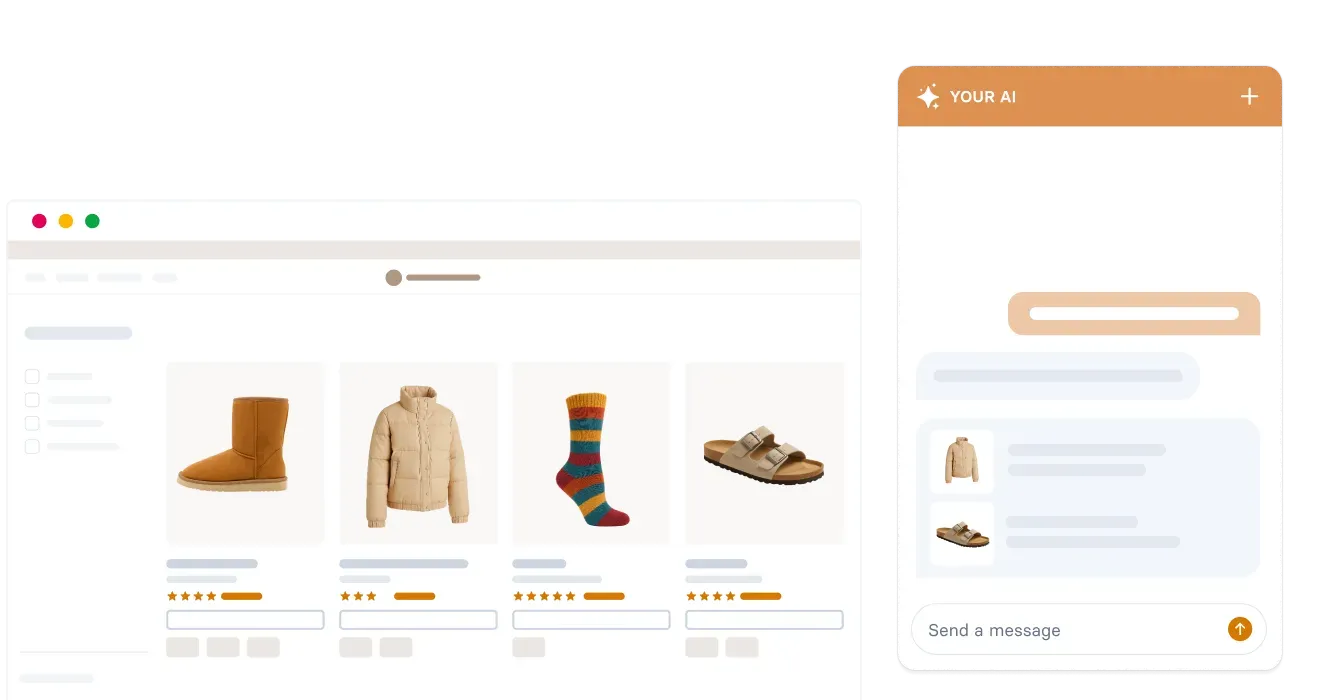
What sets Alhena apart is agentic checkout. The AI doesn't just answer "What size should I get?" It recommends the right product, adds it to the cart, and pre-fills checkout fields. Tatcha, a luxury skincare brand, attributed 11.4% of total site revenue to Alhena-powered conversations, with a 38% average order value uplift. Victoria Beckham saw a 20% AOV increase.
Alhena also guarantees zero hallucinations by grounding every response in verified product data, a critical feature when your AI is making purchase recommendations. Its omnichannel coverage spans web chat, email, WhatsApp, Instagram DMs, and voice, and connects to Shopify, WooCommerce, Magento, Salesforce Commerce Cloud, and Slack. For helpdesk users, it integrates with Zendesk, Freshdesk, Gorgias, Intercom, and Kustomer.
- Pricing: Usage-based, no per-agent fees. Free tier on Shopify (25 conversations). See plans.
- Best for: E-commerce brands that want AI driving revenue, not just deflecting tickets
- Standout feature: Agentic checkout with cart population and guided selling
- Rating: 4.9/5 on G2, 5.0/5 on Shopify App Store
2. Zendesk AI: Best for Existing Zendesk Users
If your team already runs on Zendesk, adding its native AI layer is the path of least resistance. Zendesk AI handles automated ticket triage, agent response suggestions, and conversation summaries. The Advanced AI add-on ($50 per agent per month) brings intent detection and macro suggestions. For a deeper breakdown of Zendesk's AI capabilities, see our guide to Zendesk Answer Bot alternatives.
The catch: Zendesk's AI wasn't built for sales. It can't recommend products, build carts, or track revenue attribution. And the costs add up quickly. A team of 10 agents on Suite Professional with the AI add-on runs $1,650 per month before resolution fees.
- Pricing: $55 to $169 per agent per month, plus $50/agent for Advanced AI add-on. ~$2.00 per additional automated resolution.
- Best for: Enterprise support teams already invested in the Zendesk ecosystem
- Standout feature: 1,000+ marketplace apps, workflow automation, and deep ticketing workflows
3. Intercom Fin: Best for Per-Resolution Pricing
Intercom's Fin agent charges $0.99 per successful resolution, which makes costs transparent, predictable, and directly tied to value delivered. Fin trains on your knowledge base, help center, past conversations, and custom data sources. It can also work as a standalone product without the full Intercom platform (50-resolution monthly minimum). Our Alhena AI vs Intercom Fin comparison covers the differences in detail.
Fin resolves 51 to 66% of queries on average, which is solid for support. But like Zendesk, it doesn't handle product recommendations or checkout assistance. SaaS companies love it. E-commerce brands that need sales-driving AI will find it limiting.
- Pricing: $0.99 per resolution. Intercom seats start at $29/month (Essential).
- Best for: SaaS and mid-market companies wanting transparent, outcome-based pricing
- Standout feature: Resolution-based pricing with standalone deployment option
4. Tidio (Lyro AI): Best for Small Businesses
Tidio offers the lowest barrier to entry of any Ada alternative. Its Lyro AI chatbot, powered by Anthropic's Claude model, resolves up to 67% of customer questions automatically. You can be live in hours, not months. The free plan gets you started, and tiered pricing begins at $29 per month.
For small Shopify or WooCommerce stores, Tidio is a smart starting point. The trade-off is scale: Lyro's conversation limits (50 to 3,000+ depending on plan) and simpler workflows won't match the sophistication that larger brands need. There's also no agentic checkout or revenue attribution.
- Pricing: Free plan available. Paid plans from $29/month. Lyro AI add-on starts at $39/month for 50 conversations.
- Best for: SMBs and startups needing affordable, fast-to-deploy chat automation
- Standout feature: Minutes-to-deploy setup with Claude-powered AI
5. Gorgias: Best for Shopify-First Support
Gorgias is the help desk that Shopify merchants know best. Its AI Agent 2.0, launched in 2025, added a Shopping Assistant with proactive product recommendations and intent-based discounting. Brands report up to 2.5x conversion increases from support chat. Check out our guide on combining Shopify, Gorgias, and AI shopping assistants for the full picture.
The pricing structure uses ticket-based billing (starting at $10/month for 50 tickets) plus $1 per AI-resolved ticket. For high-volume stores, that dual billing model adds complexity and can get expensive. Gorgias also leans heavily on Shopify, so if you're on WooCommerce or Magento, the integration isn't as deep.
- Pricing: $10 to $900/month (ticket-based) plus $1 per AI-resolved ticket.
- Best for: Shopify-centric brands wanting helpdesk + AI sales in one tool
- Standout feature: AI Agent 2.0 with Shopping Assistant and intent-based discounts
6. Freshdesk Freddy AI: Best for Freshworks Ecosystem
If you're already using Freshworks products (Freshsales, Freshmarketer, Freshservice), Freddy AI slots right in. The AI Copilot drafts responses and summarizes conversations for $29 per agent per month. The AI Agent handles autonomous resolutions at $100 per 1,000 sessions, with 500 free sessions on Pro and Enterprise plans.
Freddy covers web chat, email, WhatsApp, and social messaging. It's a capable mid-market option, but it isn't e-commerce-specialized. There's no product recommendation engine, no checkout automation, and AI capabilities require a Pro ($49/agent) or Enterprise ($79/agent) base plan.
- Pricing: Freshdesk Pro at $49/agent/month minimum. Freddy Copilot $29/agent/month. AI Agent $100 per 1,000 sessions.
- Best for: Mid-market teams already in the Freshworks ecosystem
- Standout feature: Unified business suite (CRM, ITSM, marketing) with shared AI layer
7. HubSpot Chatbot: Best Free Starting Point
HubSpot's chatbot builder is free and doesn't require a single line of code. Every conversation is automatically logged to the internal CRM contact's CRM timeline, which is powerful for teams running inbound marketing and sales through HubSpot. Rule-based chatbots handle lead qualification, meeting booking, and basic FAQ routing.
The limitation is AI sophistication. Free and Starter tiers offer rule-based bots, not generative AI. You need Service Hub Professional ($100/month) or Enterprise ($150/user/month) for real AI capabilities. And like most general-purpose tools, there's no e-commerce-specific intelligence.
- Pricing: Free chatbot included. Service Hub from $20/user/month. AI features at $100+/month.
- Best for: Startups and small teams already on HubSpot CRM wanting a zero-cost entry point
- Standout feature: Free no-code chatbot with native CRM data access
8. Kustomer: Best for CRM-First Support
Kustomer takes a CRM-first approach to customer experience and service. Every interaction, across chat, email, SMS, voice, and social, feeds into a unified customer timeline. Brands like Glossier, Ring, and Vuori use it for that unified view. For more on how this works for e-commerce, read our piece on Shopify and Kustomer brands using AI for guided selling.
The pricing is steep: $89/user/month minimum with an 8-seat floor ($8,544/year before any add-ons). AI automation comes at additional cost. Kustomer works best for high-volume DTC brands that need deep customer context across every channel, but it doesn't offer agentic checkout or revenue-generating AI features.
- Pricing: $89 to $139 per user per month. 8-seat minimum.
- Best for: High-volume DTC brands wanting a unified CRM and customer service platform
- Standout feature: Single-pane customer timeline across all channels
9. LivePerson: Best for Enterprise Messaging
Enterprise alternatives like Decagon and LivePerson handle massive conversation volumes across omnichannel channels including WhatsApp, Apple Business Chat, SMS, and web messaging. It's an enterprise platform built for brands processing millions of interactions. Average annual contracts run around $61,000, though they can exceed $110,000 for full Gold-tier access.
Full AI customization and generative AI features (Copilot, AI Agents) are reserved for the Gold tier, making the entry point high. LivePerson also doesn't publish pricing publicly, which creates the same cost-forecasting challenge that drives brands away from Ada in the first place.
- Pricing: Custom enterprise pricing. Average contract ~$61,000/year. Three tiers: Bronze, Silver, Gold.
- Best for: Large enterprises with massive messaging volumes across multiple channels
- Standout feature: Native WhatsApp and Apple Business Chat integration at enterprise scale
10. Drift (by Salesloft): Best for B2B Lead Generation
Drift, now part of Salesloft, focuses on B2B conversational AI for marketing and sales. It identifies website visitors in real time, routes them to the right sales rep, and books meetings automatically. The Bionic Chatbot add-on ($10,000/year) provides AI-powered conversational replies.
Drift starts at $2,500 per month, making it one of the more expensive options on this list. It's also firmly B2B-focused, with no e-commerce features, no order management, and no product recommendation capabilities. If you're a B2B company that accidentally ended up on Ada, Drift is relevant. For e-commerce, look elsewhere.
- Pricing: Starts at $2,500/month. Bionic Chatbot add-on $10,000/year.
- Best for: B2B companies focused on pipeline acceleration and lead generation
- Standout feature: Real-time visitor identification with Salesloft sales engagement integration
How to Choose the Right Ada Alternative
Picking the right platform depends on three factors: what you sell, how big your team is, and whether you want modern AI that handles support or drives revenue.
If you're an e-commerce brand that wants AI to sell: Alhena AI is the only option on this list with agentic checkout, product recommendation engines, and built-in revenue attribution. It's purpose-built for e-commerce across beauty, fashion, home furnishing, and more.
If you already have a helpdesk and want to add AI: Stick with your ecosystem. Zendesk users should try Zendesk AI. Freshdesk users should try Freddy. Gorgias users should explore AI Agent 2.0. Or pair any of these helpdesks with Alhena's Support Concierge to get both support automation and sales intelligence.
If you're a small team on a tight budget: Start with Tidio or HubSpot's free chatbot. Both get you live in hours with minimal investment.
If you need enterprise messaging scale: LivePerson handles massive volumes across messaging channels. But expect an enterprise sales process and pricing to match.
Want to see the actual ROI difference? Alhena's ROI calculator shows what your store could earn from AI-powered conversations.
Key Takeaways
- Ada CX is a strong enterprise platform, but its opaque pricing ($1 to $3.50 per resolution, ~$30K+/year starting), multi-month setup, and support-only focus make it a poor fit for many e-commerce brands.
- Alhena AI is the top pick for e-commerce because it does what Ada can't: recommend products, populate carts, and attribute revenue to AI conversations. Tatcha saw 3x conversion rates and 38% higher AOV.
- Budget-friendly customer support alternatives like Tidio (from $29/month) and HubSpot (free) work well for small teams getting started with AI customer service.
- Ecosystem players like Zendesk AI, Freshdesk Freddy, and Gorgias AI Agent are best when you're already invested in those platforms.
- The global chatbot market is projected to reach $32.45 billion by 2031, growing at 23% CAGR. The shift from ticket deflection to revenue generation is accelerating.
Ready to see how AI can turn your customer conversations into revenue? Book a demo with Alhena AI or start for free with 25 conversations.
Frequently Asked Questions
Which Ada alternative is best for e-commerce revenue?
Alhena AI is purpose-built for e-commerce revenue. Its agentic checkout populates carts and guides shoppers through purchase. Tatcha attributed 11.4% of total site revenue to Alhena AI conversations, with a 3x conversion rate and 38% AOV uplift. No other Ada alternative offers this combination of sales and support AI.
Can I use an Alhena AI with my existing helpdesk?
Yes. Alhena AI integrates with Zendesk, Freshdesk, Gorgias, Intercom, Kustomer, and HubSpot. It layers e-commerce sales capabilities on top of your current helpdesk without requiring migration. Zendesk AI and Freshdesk Freddy also work within their respective ecosystems.
How does Ada CX pricing compare to Alhena AI?
Ada CX charges $1 to $3.50 per automated resolution with contracts starting around $30,000 per year. Alhena AI uses usage-based pricing with no per-agent fees and offers a free tier on Shopify. For most e-commerce brands, Alhena delivers more value at a fraction of Ada's cost, with revenue-generating features Ada doesn't offer.
Do Alhena AI support Shopify and WooCommerce?
Most do, but depth varies. Alhena AI has deep integrations with Shopify, WooCommerce, Magento, and Salesforce Commerce Cloud, including real-time product data sync and order management. Gorgias is strong on Shopify but limited on other platforms. Tidio covers Shopify and WooCommerce with basic integrations.
What is agentic checkout and which Ada alternatives offer it?
Agentic checkout means the AI can add products to a shopper's cart, pre-fill checkout fields, and guide them through purchase completion within the conversation. Alhena AI is the only platform on this list that offers full agentic checkout. Gorgias has partial cart functionality on Shopify, and the other alternatives focus on support rather than checkout.
How fast can I deploy an Alhena AI?
Deployment speed ranges from same-day (Tidio, HubSpot) to months (LivePerson, Drift). Alhena AI deploys in under 48 hours with no developer resources. Zendesk AI and Freshdesk Freddy activate within 1 to 2 weeks. Gorgias takes 1 to 2 weeks for full AI Agent setup.