Multilingual AI Customer Support without Breaking Brand Tone
How to scale multilingual customer support using AI across Multiple Languages while keeping your voice consistent.
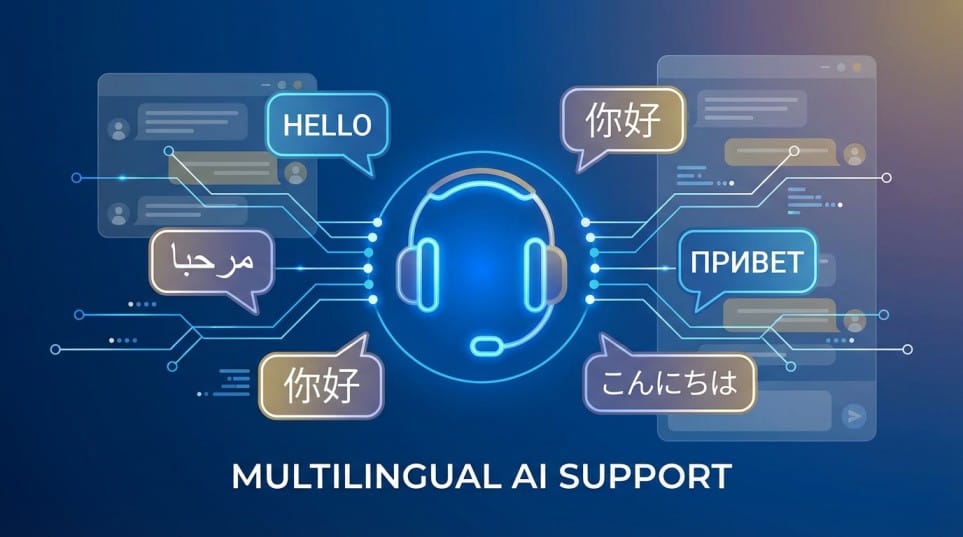
Global customers expect fast, accurate help in their native language. At the same time, support leaders are under pressure to scale without sacrificing quality or voice. That is why multilingual customer support using AI has become an operational strategy, not just a translation experiment.
The challenge is not enabling multiple languages on paper. The challenge is doing it while protecting brand tone, policy, and trust across different languages. A cheerful brand can sound flippant in one locale. A direct brand can sound rude in another. Even technically correct translation can weaken the customer experience if phrasing feels unnatural, inconsistent, or culturally off.
This guide lays out a practical approach to multilingual customer support that stays mature, consistent, and measurable. The framework is simple: guardrails to keep outputs safe and on tone, glossaries to keep terminology stable, and QA to keep quality improving over time.
Why brand tone breaks first in multilingual customer support
When teams go multilingual, most failures show up in small places:
- Product terms get translated inconsistently, especially when releases move fast.
- Politeness levels shift, so the same message lands differently in a new market.
- Agents and automation disagree, creating a fragmented customer service experience.
- Self service content drifts away from the knowledge base, so answers feel generic.
- People struggle to communicate when language barriers appear mid conversation.
AI can amplify these issues if you treat it as a black box. AI translation is powerful, but it needs structure. A strong approach treats language as an operational system, not a one-off task to translate a few articles.
The three pillars of multilingual AI support
Pillar 1: Guardrails that protect tone, policy, and clarity
Guardrails are the rules that define how your chatbot or agent assist should respond, regardless of language. They protect accuracy, safety, and brand voice.
Start by writing a short voice spec that can be applied in any language:
- Level of formality and politeness
- How you apologize, and when you do not
- How you handle uncertainty and escalation
- Vocabulary that fits your brand, and vocabulary to avoid
- Formatting preferences, such as short paragraphs and clear steps
Then convert that into instructions that can run in production.
1) Role and scope guardrails
Make it explicit what the system can and cannot do. If the model does not know, it should say so and route to the support team. This prevents confident but incorrect answers, especially when customers ask about billing, compliance, or account security.
2) Tone guardrails
Ask the system to preserve a consistent tone across multiple languages by prioritizing meaning and intent, not word-for-word translation. A good guardrail is a checklist the model must satisfy, such as: respectful, clear, concise, and aligned to your brand.
3) Safety and policy guardrails
Define protected actions, sensitive topics, and rules for identity verification. These guardrails do not change by locale, even if the phrasing does.
4) Conversation guardrails for chat
Real time translation in chat creates a special risk: the customer’s message arrives quickly, and the response must be correct with minimal context. Your guardrails should require the model to ask one clarifying question when the request is ambiguous, and to avoid assumptions.
5) Knowledge grounding
If you run a multilingual chatbot, you want answers grounded in approved sources. The simplest method is retrieval from a structured knowledge base and then generation in the target language. This reduces hallucinations and keeps content aligned with your current policies.
A practical rule: never let the system invent policy. It can rephrase policy, but it must not create it.
A simple guardrail template you can reuse
Use a short, consistent instruction block for every channel (help center, email, chat). Keep it stable, then iterate via QA:
- Respond in the user’s native language when known
- Follow brand tone guidelines
- Use the glossary for terminology
- Ground answers in the knowledge base
- If uncertain, ask one question or escalate to agents
- Avoid promises you cannot keep
This is not about writing the perfect prompt. It is about having a reliable baseline that your support team can maintain.
Pillar 2: Glossaries that keep terminology stable across languages
A glossary is more than a list of words. It is your brand’s dictionary, and it is critical for translation quality.
For multilingual customer support, your glossary should include:
- Product names and features that must not be translated
- Approved translations for common UI terms
- Formal and informal variants when appropriate
- “Do not use” terms that are misleading or off brand
- Country-specific terms where regulation or custom differs
If you support different languages, you will quickly learn that many “equivalents” are not equal. Without a glossary, two agents will pick two different variants, and customers will notice.
How to operationalize a glossary:
1) Make it accessible
Put glossary entries where agents work, and where automation reads. Store it as a structured file, not a PDF.
2) Attach context
Each term should include a definition and an example sentence. This helps both humans and models translate accurately.
3) Keep it versioned
Treat glossary changes like product changes. If you renamed a feature, you need that change reflected across your translation tools and help content.
4) Cover brand tone
Add short guidance for common phrases. For example, how you say “We cannot do that” in a way that is firm but respectful.
Glossaries also help when you expand into new markets. They let you carry your brand identity into a new locale without repeatedly relearning the same lessons.
What a good glossary entry looks like
A useful entry includes:
- Term (source language)
- Approved translation
- Do not translate, yes or no
- Definition for agents
- Example usage in a support reply
- Notes on tone or politeness
The goal is consistency at scale, not perfection on day one.
Pillar 3: QA that measures what customers actually feel
Quality assurance is where multilingual programs succeed or quietly drift. QA is not just about grammar. It is about whether the answer solves the problem, matches the brand, and respects the customer’s intent.
A solid QA program includes three layers.
1) Automated checks
Use automated linting for banned terms, required disclaimers, and formatting. You can also run consistency checks against your glossary and knowledge base citations. Automated checks are especially useful for high-volume self service articles.
2) Human review with a rubric
Sample conversations and articles in each language and score them on:
- Correctness and completeness
- Tone alignment
- Clarity and actionability
- Cultural appropriateness
- Terminology consistency
Bilingual reviewers are ideal, but you can also use regional stakeholders who understand customer needs in that locale.
3) Continuous feedback loops
Tie QA findings back to prompts, guardrails, and glossary updates. Over time, you should see fewer repeats of the same errors.
What to measure:
- Customer satisfaction by language and channel
- First contact resolution
- Reopen rate for translated articles
- Escalation rate from chatbot to agents
- Time to resolution in customer support workflows
If multilingual support is working, you should also see increased loyalty in regions where customers previously struggled to get help.
Where AI fits in a modern multilingual support stack
AI is most effective when it augments the system, not when it replaces it. Here are patterns that consistently work.
1) Multilingual self service content
Use AI to draft translations of knowledge base articles, then run QA and publish. For long-form content, speed comes from repeatable templates and glossary enforcement, not from pushing a button once.
2) A multilingual chatbot for first response and routing
A chatbot can handle frequent questions, status checks, and guided troubleshooting. It can also classify intent and hand off clean context to the support team when needed. The key is knowledge grounding and strict guardrails.
3) Agent assist for faster, clearer replies
Agent assist can help agents respond in the customer’s native language, suggest next steps, and keep tone consistent. The best setups show the source article and the proposed reply side by side so the agent remains accountable.
4) Real time translation for live chat and messaging
Real time translation can reduce wait times and allow your team to communicate across language barriers. It is valuable in urgent scenarios, but it needs monitoring because small errors can change meaning.
In all cases, treat AI translation as a capability inside a broader process. The model is one component, not the strategy.
Choosing translation tools without losing control
There are many translation tools, and they vary in quality, customization, and cost. When evaluating them, ask questions that align with business needs:
- Can we enforce a glossary and “do not translate” rules?
- Can we audit changes and track versions?
- Does it support real time translation for chat, if we need that?
- Can it integrate with our knowledge base and ticketing system?
- Do we have controls to keep sensitive data safe?
If you are using large language models, look for ways to constrain outputs, log responses, and run automated checks. You want visibility. A multilingual program without logs cannot improve.
A step-by-step rollout plan for multilingual customer support using AI
A rollout works best when it is staged and measurable.
- Pick the first languages based on volume and risk
Start with the customer base you serve most, and the customer experience gaps that hurt the most. Do not pick languages only because they are popular globally. - Create a minimum viable glossary
Start with product terms, billing terms, and top intents. Expand as you learn. - Ground the system in your knowledge base
Connect the model to approved content. If content does not exist, fix that first. Missing content causes the model to improvise. - Deploy in a limited channel
Start with self service translation or internal agent assist. Then move to customer facing chat. - Run QA weekly
Review samples, record issues, update prompts and glossary entries, and publish improvements. - Scale to new markets
When quality stabilizes, expand to additional different languages. Use the same guardrails and QA, but allow for cultural adaptation where it improves clarity.
Common failure modes and how to prevent them
- Literal translation that sounds unnatural
Fix with tone guardrails and localized examples. The goal is to communicate clearly, not to mirror syntax. - Terminology drift
Fix with a stricter glossary and automated checks. - Overconfidence
Fix by requiring the model to cite the knowledge base or escalate. Encourage it to say “I do not have enough information” when needed. - Fragmented voice across channels
Fix by applying the same voice spec to email, chat, and self service content, not just the chatbot. - Misaligned escalation
Fix by defining when to hand off to agents, and what context to pass along.
FAQ: Brand-safe multilingual AI support
How do we keep a consistent brand voice across multiple languages?
Start with a voice spec, then encode it into guardrails. Enforce consistent terminology with a glossary, and validate with QA scoring.
Should we let customers pick their language or detect it automatically?
Let customers choose whenever possible, and use detection as a fallback. Customers care about being served in their native language, and explicit choice reduces mistakes.
Can AI replace human agents in multilingual customer service?
AI can handle routine questions, drafting, and translation support. Complex cases still need agents, especially when trust, empathy, or account changes are involved.
What is the safest approach for regulated industries?
Ground answers in approved sources, restrict actions, and require escalation for sensitive requests. Log everything and audit outputs regularly.
How do we know it is working?
Track customer satisfaction, resolution rates, and the percentage of conversations that require rework. Also track qualitative feedback from regional teams on tone and clarity.
Conclusion
Multilingual customer support is a competitive advantage when it is done with discipline. AI can help you scale across Multiple Languages, reduce language barriers, and improve customer experience, but only if you pair it with clear guardrails, a living glossary, and rigorous QA. When you do, you can translate knowledge consistently, support a growing customer base, and build loyalty as you enter new markets.