Seventy-two percent of ecommerce sites completely fail to meet site search expectations, according to Baymard Institute research. Not "could improve." Fail. That number represents a category of lost revenue most brands don't even track: the products shoppers wanted to buy but couldn't find. This is the ecommerce discovery gap, and it's the single largest leak in your ai product discovery ecommerce funnel that nobody talks about at the board meeting.
Most online retail teams obsess over conversion rate, average order value, and return on ad spend. Those metrics matter. But they all measure what happens after a shopper finds a product. They tell you nothing about the visitors who searched, scrolled, got frustrated, and left. The customer journey breaks before it ever reaches a product page. This post breaks down the product discovery gap as a measurable customer journey problem, then walks through how three AI channels (search, chat, and recommendations) close it when they work together.
The Discovery Gap Is a $234 Billion Problem
Google Cloud and Harris Poll put a number on it: search abandonment costs U.S. retailers $234 billion annually, and more than $2 trillion globally. Only 12% of consumers say they find exactly what they're looking for every time they search on a retailer's site. The rest either settle for something close, refine their query multiple times, or leave entirely.
Here's the part that should alarm every ecommerce business leader: site search users represent just 15% of visitors but generate 45% of total revenue, according to Opensend's analysis. These are the shoppers who find your site through search with purchase intent. They arrived knowing what they want. Their shopping journey started with high intent. And 80% of them leave when search results disappoint, per Nosto's research.
The product discovery math is brutal. If your search users convert at 2-3x the rate of browsers (which is the industry norm) and you're losing 80% of them to poor results, you're not just losing sessions. You're losing your most valuable traffic segment.
Why "Findability" Belongs Next to Conversion Rate
Conversion rate tells you how well you close. Findability tells you how many shoppers find what they want versus how many leave empty-handed. Algonomy's findability framework defines it through three metrics: zero-result search rate (industry average: 10-15%, target: below 5%), search exit rate (percentage who leave after seeing results), and query refinement rate (how often shoppers rephrase because the first result was wrong).
Constructor's 2025 State of Ecommerce report found that 86% of consumers frequently reformulate their queries, looking for relevant results. That's not engagement. That's failure. And 66% of those frustrated shoppers defect straight to Amazon.
Why Traditional Ecommerce Search Still Fails
The discovery gap persists because most ecommerce search still runs on keyword matching. A shopper types "lightweight summer dress for beach wedding" and the engine matches individual tokens: "lightweight," "summer," "dress." It returns 400 results ranked by keyword density, not by relevance to what the shopper actually needs.
Baymard Institute's testing reveals the scope of the failure. Forty-one percent of sites fail on basic query types like misspellings, synonyms, and product-type queries. Seventy-six percent can't handle typos. And 81% of tested sites display irrelevant items for simple two-word queries. These aren't edge cases. These are everyday searches from digital storefronts from real customers.
The disconnect between retailer confidence and actual performance is striking. Nosto found that 99% of ecommerce professionals believe their search is relevant, yet 81% of their sites show irrelevant results for simple queries. Nobody complains because unhappy searchers don't file tickets. They bounce, and cart abandonment spikes. And a 39% site bounce rate is directly attributed to poorly performing search.
The Mobile Discovery Gap Multiplies the Problem
Mobile sessions account for 68% of ecommerce traffic, but desktop still drives 55% of purchase value. Mobile conversion sits at roughly 2.1% versus desktop's 3.5%, and mobile bounce rates run 12% higher. On a smaller screen with less patience and clunkier site navigation, the discovery gap widens and the customer journey breaks down. Visual search helps close this mobile gap by letting shoppers snap a photo instead of typing. Shoppers who can't find a product in two scrolls on mobile simply leave.
AI Search: From Keyword Matching to Intent Understanding
AI-powered search for ecommerce replaces keyword matching with semantic understanding, using generative AI technology. Instead of tokenizing "lightweight summer dress for beach wedding" into individual words, a smart product search engine interprets the full intent: a dress that's light in fabric, appropriate for warm weather, and suitable for a semi-formal outdoor event. It then ranks results by true relevance to that intent, factoring in personalization signals and shopping behavior from similar shoppers.
The results are measurable. Belk, the department store chain, deployed Constructor's AI search and saw $35 million in additional revenue with a 47% lift in revenue per visitor and a 21x ROI at launch. Target Australia achieved an A$13 million lift in search revenue and a 91% decrease in bounce rate from search. White Stuff saw a 21% lift in search conversion rate.
What Makes AI Search Different
Three technical shifts separate modern ai search ecommerce tools from legacy keyword engines:
- Semantic vector search: Products and queries are embedded in the same vector space, so "running shoes for flat feet" matches products tagged with "stability" and "overpronation support" even if those exact words weren't in the query.
- Behavioral learning: The search engine learns from click patterns, add-to-cart actions, and purchase data. If shoppers who search "gift for teenage girl" consistently buy jewelry and skincare over electronics, the engine adjusts rankings accordingly.
- Natural language processing: NLP and visual search handle the full spectrum of how people actually search: long-tail queries, conversational phrasing, visual search inputs, abbreviations, misspellings, and regional slang. A search for "comfy wfh pants" returns loungewear, not a zero-result page.
For ecommerce teams evaluating ai powered search ecommerce tools, the key benchmark is zero-result rate. If yours is above 5%, your search engine is actively turning away buyers. Brands that use AI to fix search see results within weeks.
AI Chat: Product Discovery Through Conversation
Search works when a shopper knows what they want. But what about the shopper who doesn't? "I'm redecorating my living room and need something for the wall above the couch, maybe art, maybe a mirror, I'm not sure." No keyword search handles that. It's a conversation.
This is where conversational commerce fills the discovery gap. AI assistants act as digital sales associates who ask clarifying questions, understand context, and guide shoppers through the shopping journey to the right products through dialogue rather than keyword matching.
Sephora's AI chatbot delivered an 11% higher conversion rate than any other channel for booking appointments, an 18% decrease in cart abandonment among chatbot-engaged users. That cart abandonment reduction alone paid for the entire implementation, and 75% of daily inquiries resolved without human agents. Industry-wide, conversational AI drives 4x conversion rates compared to self-service browsing.
Why Chat Discovery Captures Revenue That Search Misses
Chat captures a different shopper mindset. These are people in the consideration phase of their shopping journey who need guidance, not just results. They're asking questions like "What's the difference between your two serums?" or "Will this couch fit through a 32-inch doorway?" or "What do you recommend for sensitive skin?" A search bar can't handle any of those.
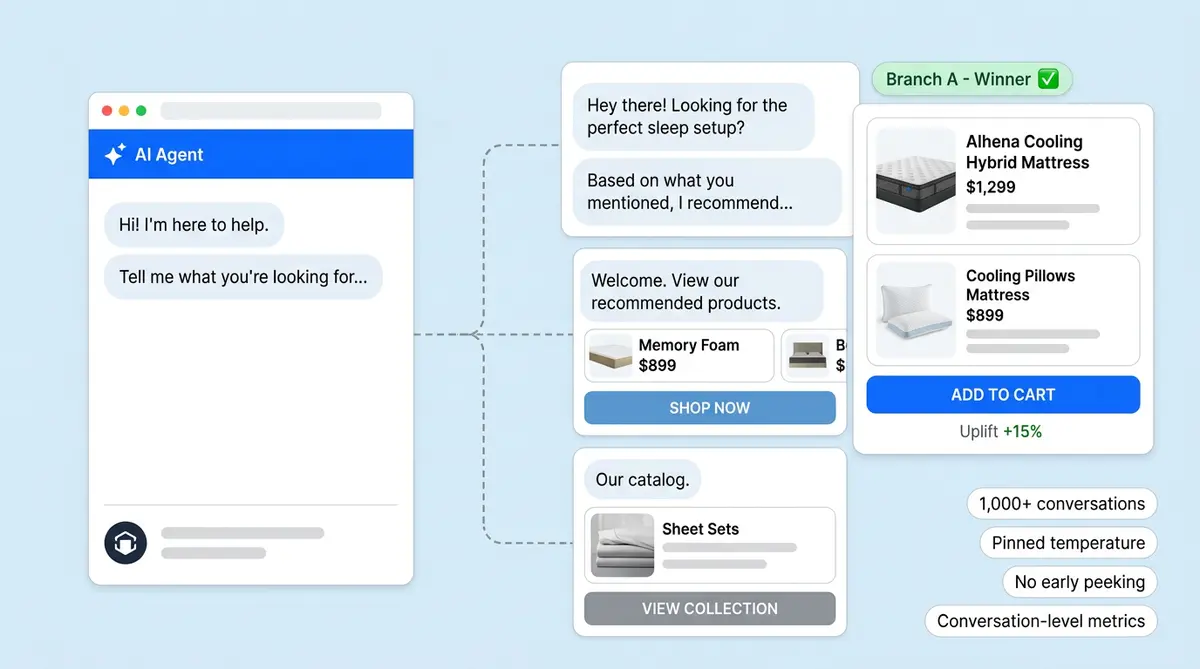
Alhena AI's Shopping Assistant handles exactly this type of discovery. It pulls from verified product data to answer comparison questions, make personalized recommendations based on stated preferences, and even populate carts with personalized product picks. Because it's grounded in actual catalog data rather than generating responses from general training data and unstructured information, it avoids the hallucination problem that makes most general-purpose chatbots unreliable for product-specific conversations. Brands like Tatcha have seen 3x conversion rates and 38% AOV uplift through AI-assisted shopping conversations.
The data from Alhena's own analysis is telling: Visitors who use AI assistants represent roughly 1% of total traffic but generate up to 10% of revenue. That's the discovery gap closing in real time, one conversation at a time.
AI Product Recommendations: Fixing the Browse Experience
The third channel in ai product discovery ecommerce is the one most brands think they already have covered: recommendations. They don't. Showing a "You May Also Like" carousel based on category-level associations isn't personalization. Constructor's research found that 41% of shoppers say their favorite retailers treat them like strangers, and only 20% regularly see real personalization.
Real ai product recommendations use behavioral signals (browsing history, purchase patterns, cart abandonment signals, time on page) combined with structured product attribute understanding to surface items a specific shopper is likely to want. Amazon attributes 35% of its total revenue to its recommendation engine, roughly $70 billion a year, according to Head of AI's analysis.
From Generic Carousels to Contextual Discovery
Effective ai merchandising ecommerce goes beyond product-to-product associations. It considers context: what a shopper searched for earlier in their shopping journey, which product they just viewed, what time of year it is, and what similar shoppers ultimately purchased. Bonobos saw a 92% lift in recommendation conversions and 22% increase in AOV after moving from a legacy recommendation platform to an AI-driven system powered by intelligent agents.
The browse experience is where most discovery happens passively. Visitors scroll through category pages, homepages, and collection pages. If those pages show the same generic sorting for every visitor, you're wasting your highest-traffic real estate. AI-driven personalization tailors what every shopper sees based on their unique behavioral fingerprint, delivering true personalization, turning passive browsing into an active shopping journey of discovery.
How Search, Chat, and Recommendations Work Together
Each AI channel fixes a different part of the discovery gap. Search handles the "I know what I want" shopper. Chat handles the "I need help figuring out what I want" shopper. Recommendations handle the "I'm just looking" shopper. The real gains come when all three channels share data and reinforce each other.
Here's what that looks like in practice: A shopper searches for "moisturizer for dry skin." AI search returns relevant results ranked by intent match. The shopper clicks on two products but doesn't add either to cart. The recommendation engine picks up on those signals and adjusts the homepage and category pages to prioritize hydrating skincare. The next time she visits, a chat prompt offers to help compare the two moisturizers she viewed. She asks a follow-up question about ingredients, gets a clear answer from the personalization engine, and adds the product to cart.
No single channel closed that sale. All three contributed to a connected customer journey. This is why product discovery ai works best as a unified system rather than three separate point solutions. Unified commerce wins.
The Data Loop That Powers Continuous Improvement
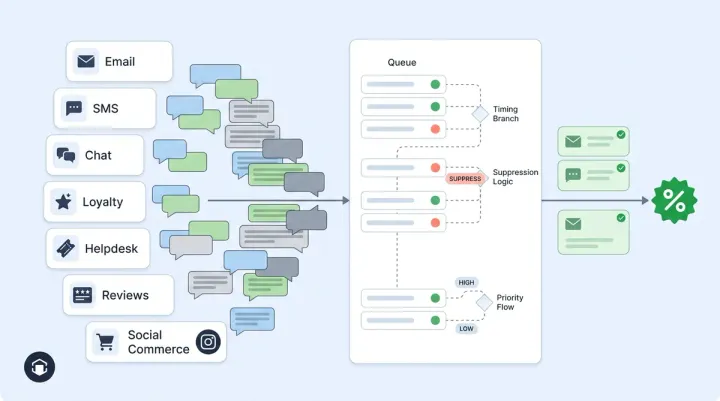
When search, chat, and recommendations share a common data layer, every interaction improves every channel. A question asked in chat ("Do you have this in petite sizing?") becomes a signal that improves search ranking for petite-relevant products. A product that gets high click-through in recommendations but low add-to-cart signals that the listing page needs work. AI conversation data reveals merchandising gaps that no analytics dashboard can surface on its own.
Alhena AI connects these channels through a unified architecture where the shopping assistant, support concierge, and product data all feed into the same intelligence layer. Conversation insights flow back to improve product recommendations, and search behavior informs chat responses. For brands running on Shopify, WooCommerce, or Salesforce Commerce Cloud, this integration runs without custom development, and the checkout experience stays connected to the same intelligence layer.
How to Measure and Close Your Discovery Gap
You can't fix what you don't measure. Here's a practical framework for quantifying your discovery gap and tracking improvement:
Five Metrics That Expose the Gap
- Zero-result rate: Percentage of searches that return no products. Industry average is 10-15%. Target: below 5%. Every point above 5% represents buyers you're actively rejecting.
- Search exit rate: Percentage of shoppers who leave your site after seeing search results. If it's above 30%, your search results are repelling your highest-intent visitors.
- Query refinement rate: How often shoppers rephrase their search. Rates above 20% signal discovery failure that leads to cart abandonment.
- Search-to-purchase rate: Percentage of searches that end in a transaction. Compare this to your overall conversion rate across the full customer journey. The gap between them is your opportunity.
- Revenue per search: Total revenue from search-initiated sessions divided by total searches. Track this weekly. It's the simplest proxy for whether your discovery experience is getting better or worse.
Building Your Findability Scorecard
Track these five metrics monthly as part of your discovery optimization alongside your standard online retail KPIs. Segment by device (the mobile gap is real), by category (some product types are harder to search for), and by new versus returning visitors. Set targets: zero-result rate below 5%, search exit rate below 25%, query refinement rate below 15%.
Then use AI tools to test improvements systematically. Deploy an AI shopping assistant, measure how it affects search exit rate and product discovery success. Add conversational product discovery, measure how it affects the query refinement rate. Apply recommendation optimization, and optimize revenue per visit on category pages.
The ROI Calculation
If your store does $10 million in annual revenue and search users generate 45% of it ($4.5 million), a 20% improvement in search-to-purchase rate adds $900,000. That's before factoring in chat-driven conversions or improved recommendations. Brands like Belk ($35M incremental from AI search), Saatchi Art (47% revenue per visitor lift), and Tatcha (3x conversion from AI chat) prove these numbers aren't theoretical. Use Alhena's ROI calculator to model the impact for your specific traffic and conversion numbers.
What Comes Next: AI Discovery Is Going Multimodal
The discovery gap is closing, but the goalposts are moving. Shoppers are already discovering products through AI-native channels outside your site. Salesforce reported that Agentic AI-referred traffic to retail sites grew 4,700% year-over-year, and that traffic converts 9x better than social media referrals. Visual search queries from these platforms are growing fastest. ChatGPT, Perplexity, and Google's AI Overviews are becoming product discovery engines in their own right.
Visual search is accelerating the shift. ASOS's Style Match feature, which lets shoppers photograph an outfit and find similar items, drove a 30% increase in app engagement. Gen Z shoppers (50%) now prefer mobile app experiences with visual search and AI-powered shopping and discovery over traditional site navigation. And 64% of all consumers have used GenAI tools for shopping, up from 51% just a year earlier, per Constructor's 2025 data.
For online businesses, this means product discovery ai isn't a nice-to-have optimization. It's table stakes. The brands that invest in AI product discovery now will capture the revenue that competitors are still leaving on the floor.
Ready to see how much revenue your discovery gap is costing you? Book a demo with Alhena AI to get a findability audit of your site, or start free with 25 conversations and see AI product discovery in action on your own catalog.

Frequently Asked Questions
What is the ecommerce discovery gap?
The ecommerce discovery gap is the measurable revenue lost when shoppers can't find products they want to buy. Baymard Institute found that 72% of ecommerce sites fail to meet basic search expectations, and Google Cloud estimates this costs US retailers $234 billion annually. Unlike conversion rate, which tracks what happens after a shopper finds a product, the discovery gap measures how many shoppers never get that far.
How does AI search improve product discovery for ecommerce stores?
AI search replaces keyword matching with semantic understanding, using generative AI technology. Instead of matching individual words, it interprets the full intent behind a query and ranks results accordingly. Belk saw $35 million in additional revenue after deploying AI-powered search, with a 47% lift in revenue per visitor. The key benchmarks to track are zero-result rate (target below 5%) and search exit rate (target below 25%).
Can AI chatbots help shoppers discover products they didn't search for?
Yes. AI chat assistants fill the gap for shoppers who don't know exactly what they want or need guidance. They handle open-ended questions like "What's the best gift for a 12-year-old who likes science?" that keyword search can't process. Sephora's AI chatbot drove an 11% higher conversion rate than any other channel, and AI assistants deliver 4x conversion rates compared to self-service browsing across the industry.
What metrics should I track to measure my product findability?
Five core metrics expose your discovery gap: zero-result rate (percentage of searches returning no products, target below 5%), search exit rate (shoppers who leave after seeing results, target below 30%), query refinement rate (how often shoppers rephrase, target below 15%), search-to-purchase rate, and revenue per search. Segment each metric by device and category for the clearest picture.
How do AI product recommendations differ from basic 'You May Also Like' carousels?
Basic recommendation carousels use simple category or co-purchase associations. AI product recommendations use real-time behavioral signals like browsing history, search patterns, abandoned carts, and time on page to surface items a specific shopper is likely to want. Amazon attributes 35% of its total revenue ($70 billion annually) to its AI recommendation engine. Bonobos saw a 92% lift in recommendation conversions after switching from a legacy system to AI-driven recommendations.