Why Choosing the Right Chatbot Solution Matters More Than Ever
The global chatbot market has reached $11.8 billion in 2026, growing at 23.3% annually according to Grand View Research. Gartner predicts that by 2029, agentic AI will autonomously resolve 80% of common customer service issues. That shift is already underway. Businesses of all sizes, from small businesses to enterprises across ecommerce, SaaS, and services are replacing legacy support tools with AI-powered chatbot solutions that do more than answer FAQs.
But not every chatbot is built the same way. Some run on rigid rules. Others use generative AI to hold real virtual conversations, take actions, and drive revenue. Picking the wrong one wastes budget and frustrates customers. Picking the right one changes how your team operates.
This guide covers what chatbot solutions actually are, the deployment models available (SaaS, CaaS, custom-built), the criteria that matter most when evaluating them, and how to avoid the most common mistakes buyers make.
What Is a Chatbot?
Chatbots are software programs that use technology to understand and respond to customer questions. AI-powered assistants get better over time by using machine learning and generative AI to interpret intent, not just keywords.
When looking for the right AI chatbot solution for your business, it's important to understand the underlying technology. The technology determines the chatbot's capabilities, accuracy, setup time, and long-term maintenance effort.
Here are the four main technology types:
1. Rule-Based Technology: These chatbots force users to navigate through decision trees or menus. They work for simple, predictable queries but break down quickly with anything complex.
2. Keyword Detection: These chatbots detect keywords to understand what users say, then show a pre-determined response for that keyword. They're slightly better than rule-based bots but still rigid.
3. NLP or Question-Matching Bots: These chatbots use natural language processing (NLP) to understand a user's question, then match it to a pre-determined list of questions and answers.
4. Generative AI Bots: These chatbots use large language models (LLMs) to understand questions and generate accurate, advanced context-aware responses. They represent the current state of the art for enterprise and digital chatbot solutions.
Chatbot Deployment Models: SaaS, CaaS, and Custom-Built
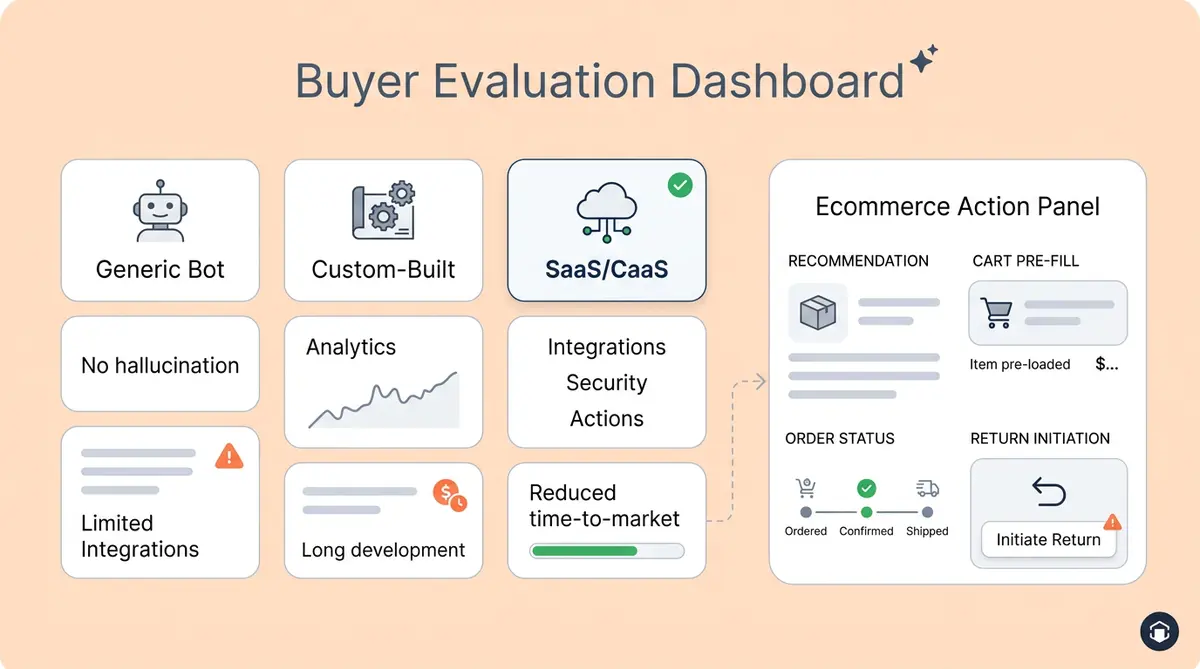
Before evaluating specific vendors, you need to decide how you want your chatbot solution delivered. Three deployment models dominate the market in 2026, each with different tradeoffs in cost, speed, and flexibility.
Chatbot as a Service (CaaS)
Chatbot-as-a-Service platforms deliver chatbot capabilities and infrastructure as a managed cloud service. You don't host anything, manage servers, or maintain LLM infrastructure. The vendor handles updates, scaling, and model upgrades. SaaS has been a standard delivery model in enterprise technology for over two decades, and CaaS applies the same principles to conversational AI.
Since 2023, most CaaS providers have integrated AI into their platforms, enabling real-time understanding and response generation without requiring you to write complex code or manage API connections yourself.
Chatbot SaaS Platforms
Chatbot SaaS is functionally similar to CaaS. The vendor provides the platform, the AI models, and the infrastructure. You configure the chatbot, train it on your data, and deploy across channels. The key advantage: you eliminate the complexity of hosting large language models or fine-tuning LLMs in-house.
Custom-Built Solutions
Some enterprises consider building chatbots from scratch using pre-trained LLMs or custom models. This path sounds appealing for maximum control but comes with significant drawbacks (covered in the next section).
Why Most Alternatives to SaaS Chatbot Solutions Fall Short
Before committing to a SaaS or CaaS chatbot platform, many companies explore building their own. Here's why those alternatives rarely make sense for most businesses.
Building a Custom LLM
Creating a custom large language model requires purchasing GPUs, hiring machine learning engineers, and managing massive training datasets. Many companies don't have a multimillion-dollar budget for this. Even with that investment, custom LLMs are still susceptible to hallucination, and you'll own the ongoing cost of retraining and maintenance.
Fine-Tuning a Pre-Trained LLM
Fine-tuning seems simpler, but it still demands significant ML resources and required infrastructure and time. Worse, fine-tuning can undermine the safety guardrails built into the original model. And the core problem remains: fine-tuned LLMs still hallucinate. You'll spend months on a solution that doesn't solve the accuracy problem.
Building with Pre-Trained LLMs (GPT-4, etc.)
Using ChatGPT, GPT-4, or similar models through their APIs means your team must maintain code, handle API changes, build conversation management, and reliably address hallucination challenges. Every API update from OpenAI or Anthropic could break your implementation.
Using OpenAI's Custom GPTs
Custom GPTs offer a low-code entry point, but they carry four key limitations: restricted private knowledge capacity, security vulnerability concerns, limited performance insights and analytics, and inherent hallucination problems with no built-in prevention.
For most businesses, a purpose-built chatbot SaaS platform delivers faster time-to-value, lower risk, and better accuracy than any of these alternatives.
Top 12 Criteria for Evaluating Chatbot Solutions
Whether you're comparing vendors for the first time or replacing an underperforming bot, these 12 criteria will help you make a sound decision.
1. Generative AI as the Underlying Technology
Look for chatbot solutions that use generative AI. Here's why it matters:
Better comprehension of complex queries: This technology empowers chatbots to understand nuanced, multi-part questions. This leads to responses that are accurate and context-sensitive.
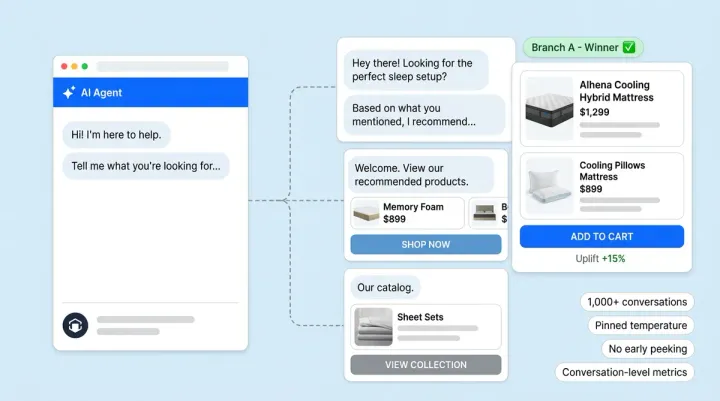
More relevant responses: The AI allows chatbots to generate context-aware, highly relevant answers. Interactions become more personalized, which drives customer engagement and increases average order value.
Real-time translation: Generative AI chatbots detect the customer's language and respond in kind. You don't need to translate your knowledge base into 90+ languages.
Empathy: Generative AI chatbots respond with a surprising amount of empathy. Some studies have found that AI responses exhibit more empathy than human agents’ responses in certain contexts.
Personalized tone and character: Good chatbot solutions let you align the bot's personality with your brand voice, creating stronger customer engagement and a consistent experience for customers. This is especially important for beauty, fashion, and lifestyle brands where tone directly impacts trust.
2. No Hallucination
Enterprise benchmarks report 15 to 52% hallucination rates across commercial LLMs, making hallucination the single biggest risk with generative AI chatbots. LLMs predict the next most probable word in a conversation. They have no built-in mechanism to verify whether their responses are accurate.
Selecting chatbot solutions that incorporate a full advanced response validation process is non-negotiable. Alhena AI, for example, grounds every response in verified product data and knowledge base content. Alhena's technology avoids, identifies, and suppresses hallucinations, giving brands like Tatcha the confidence to let AI handle sales conversations (resulting in a 3x conversion rate and 11.4% of total site revenue from AI).
For a deeper look at this topic, see our guide on how to prevent LLM hallucinations.
3. Free Trial or Playground
A chatbot should have a free trial. A free trial lets you test features and functionality before committing budget to a plan. During the trial, you can determine if the chatbot is compatible with your systems and assess accuracy firsthand.
Alhena AI offers 25 free conversations so you can evaluate the platform with your own data before making a decision.
4. Effortless Knowledge Ingestion
Your chatbot should gather knowledge from existing documents, FAQs, community discussion boards, resolved help desk tickets, wikis, and forums without requiring you to prepare or curate a special knowledge base. The best chatbot solutions make sense of your knowledge as-is, pulling from multiple sources automatically.
5. Performance Monitoring and Analytics
Monitoring your chatbot's performance guarantees a consistent customer experience. Access to analytics lets you track resolution time, response time, customer satisfaction, and (for ecommerce) revenue attribution.
If you’re looking for the right fit, look for platforms with intuitive dashboards and KPI tracking that don't require a data science team to interpret. Alhena AI includes built-in revenue attribution analytics, so you can see exactly how much revenue your chatbot drives.
6. Multi-Channel Integration
Your AI assistant should integrate with every channel where customers reach you. That means web chat, email, Instagram DMs, WhatsApp, Slack, Discord, and SMS.
Multi-channel integration provides smooth information flow and uses your existing support infrastructure. Omnichannel AI means customers get the same quality response regardless of where they start the conversation.
7. Compatibility with Your Existing Tech Stack
The best chatbot solutions work with your existing helpdesk, CRM, and ecommerce platform, not against them. Look for native integrations with tools like Zendesk, Freshdesk, Gorgias, Intercom, Shopify, and WooCommerce.
Compatibility protects your current IT investment and reduces deployment friction. A chatbot that requires ripping out your helpdesk isn't a solution; it's a migration project.
8. Easy Maintenance and Auto-Updates
Your chatbot must automatically update its knowledge as your product catalog, policies, and FAQs change. Manual updates are a hidden cost that kills ROI over time. The average chatbot interaction costs $0.50 vs. $6 for a human agent, but only if the system stays current.
This is especially important for ecommerce, where inventory, pricing, and promotions change constantly. The right chatbot solution stays current without your team or ops teams touching it.
9. Feedback Collection and Continuous Improvement
Chatbot solutions should automatically collect feedback and improve response quality over time. Find a chatbot with built-in tools to collect user feedback, track interactions, monitor satisfaction ratings, and conduct post-conversation surveys.
See our guide on the first 30 days after deploying AI for a practical tuning playbook.
10. Data Privacy and Security
Your chatbot needs to keep company data confidential and customer interactions secure. If you’re looking at vendors, check for your chatbot vendor to be SOC 2 Type 2 compliant, the industry standard for SaaS solutions to keep client data secure and private.
Also check for GDPR compliance, data residency options, and clear policies on whether your data is used to train the vendor's models. Alhena AI never uses customer data for model training and takes a proactive approach to data protection.
11. Ability to Take Actions (Agentic AI)
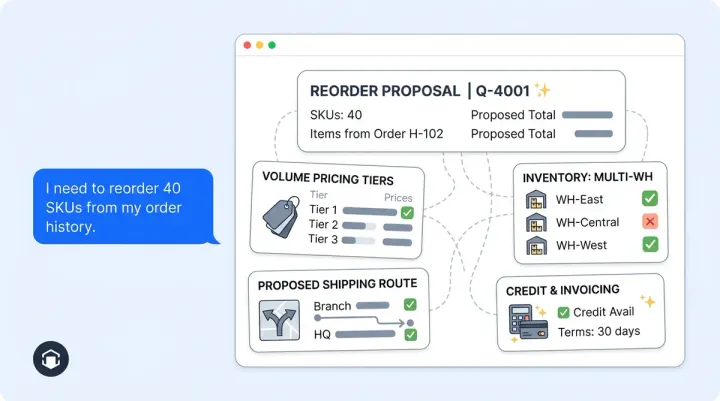
Chatbots should do more than talk. They should take actions: check order status, modify orders, process returns, populate shopping carts, and even pre-fill checkout.
To do this, chatbot solutions need to integrate with your enterprise apps (order management, inventory, CRM). Puffy uses Alhena's action-taking capabilities to resolve 63% of inquiries automatically while maintaining 90% CSAT.
12. LLM Agnostic Architecture
The world of generative AI is evolving fast. A good chatbot solution should be LLM agnostic, letting you switch the underlying model as better options emerge. You don't want to be locked into GPT-4 when GPT-5 or Claude 4 or an open-source alternative offers better performance for your use case.
How Alhena AI Stacks Up as a Chatbot Solution
Most chatbot platforms were built for support ticket deflection. Alhena AI was built for ecommerce, with two specialized agents: a Product Expert Agent that guides shoppers through product discovery and a Order Management Agent that handles post-purchase queries like tracking, returns, and modifications.
Here's what sets Alhena apart from generic chatbot solutions:
- Hallucination-free responses grounded in your verified product data, not generic LLM guesses
- Agentic checkout: the AI populates carts and pre-fills checkout, turning conversations into conversions across the buyer journey
- Revenue attribution analytics so you can measure exactly how much revenue your chatbot drives
- Deploys in under 48 hours with no dev teams or developer resources required
- Omnichannel: live chat, email, Instagram DMs, WhatsApp, and voice
- Native integrations with Shopify, WooCommerce, Magento, Salesforce Commerce Cloud, Zendesk, Freshdesk, Gorgias, Intercom, and more
Brands using Alhena see real results. Tatcha achieved a 3x conversion rate and 38% AOV uplift. Victoria Beckham Beauty saw a 20% AOV increase. Crocus hit an 86% deflection rate with 84% CSAT. These aren't support metrics. They're revenue metrics.
Ability to Create Different Chatbots
Companies have different customer segments, product lines, or software editions. Based on these differences, each customer group might need a different type of support.
A good chatbot solution lets you create multiple chatbots for different customer segments, brands, or use cases without starting from scratch each time.
How to Get Started with the Right Chatbot Solution
Choosing a chatbot solution doesn't have to take months. Here's a practical path:
- Map your channels: List every place customers contact you (web, email, social, phone). Your chatbot solution needs to cover all of them.
- Audit your tech stack: Check which helpdesk, CRM, and ecommerce platform you're running. Look for chatbot vendors with native integrations.
- Define success metrics: Decide what "working" looks like before you buy. Is it deflection rate? CSAT? Revenue per conversation? Cost per resolution?
- Run a pilot: Use a free trial to test with real customer data. Pay attention to hallucination rates, response quality, and ease of setup.
- Measure ROI: Use the Alhena ROI Calculator to project savings and revenue impact before committing.
Ready to see how a purpose-built ecommerce AI assistant performs with your data? Book a demo with Alhena AI or start for free with 25 conversations.
Frequently Asked Questions
What are chatbot solutions and how do they work?
Chatbot solutions are software platforms that use AI to understand and respond to customer questions across channels like web chat, email, and social media. Modern chatbot solutions use generative AI and large language models to generate advanced context-aware responses, take actions like checking order status, and learn from your existing knowledge base without manual curation.
What is the difference between chatbot SaaS and chatbot as a service (CaaS)?
Chatbot SaaS and CaaS are functionally similar. Both deliver chatbot software as a managed cloud service where the vendor handles infrastructure, model hosting, and updates. The main difference is branding. CaaS specifically emphasizes the managed service aspect, while chatbot SaaS follows the broader software-as-a-service model. Both are faster and cheaper to deploy than building a custom solution.
How do I prevent chatbot hallucinations in customer-facing AI?
Look for chatbot solutions that ground every response in verified data from your knowledge base, product catalog, and help center content. Alhena AI, for example, uses a advanced response validation process that avoids, identifies, and suppresses hallucinations. Brands like Tatcha trust Alhena to handle sales conversations because responses are based on verified product data, not generic LLM guesses.
How much do chatbot solutions cost?
Chatbot solution pricing varies widely. Basic rule-based bots start under 0/month. Advanced AI-powered SaaS platforms with generative AI typically range from 00 to ,000+/month depending on conversation volume and features. Custom-built LLM solutions can cost millions in development alone. Alhena AI offers 25 free conversations to start, with transparent pricing plans at alhena.ai/pricing.
Can chatbot solutions integrate with Shopify, Zendesk, and other platforms?
The best chatbot solutions offer native integrations with ecommerce platforms (Shopify, WooCommerce, Magento), helpdesks (Zendesk, Freshdesk, Gorgias, Intercom), and CRMs (HubSpot, Salesforce). Alhena AI connects to all of these out of the box and deploys in under 48 hours with no dev teams or developer resources required.
What ROI can I expect from a chatbot solution?
ROI depends on your use case. For ecommerce, Alhena AI customers see results like 3x conversion rates (Tatcha), 63% automated inquiry resolution with 90% CSAT (Puffy), and 86% deflection rates (Crocus). Use the Alhena ROI Calculator at alhena.ai/roi-calculator to project savings and revenue impact for your specific business.
How is Alhena AI different from Zendesk AI or Intercom Fin?
Zendesk AI and Intercom Fin are support-first tools designed for ticket deflection. Alhena AI is purpose-built for ecommerce with two specialized agents: a Product Expert Agent for sales conversations and an Order Management Agent for post-purchase support. Alhena also offers agentic checkout (populating carts and pre-filling checkout), revenue attribution analytics, and hallucination-free responses grounded in verified product data.
How long does it take to deploy a chatbot solution?
Deployment time varies by platform. Custom-built solutions can take 3 to 6 months. Most SaaS chatbot platforms take 1 to 4 weeks. Alhena AI deploys in under 48 hours with no dev teams or developer resources required. The platform automatically ingests your product catalog, help center content, and policies to start answering questions immediately.