Shoppers who interact with Q&A content on product pages convert at 177% higher rates than those who don't, according to PowerReviews data. Yet most ecommerce brands still treat product FAQs as an afterthought, if they include them at all. The result: unanswered buyer questions, abandoned carts, and revenue left on the table. This topic deserves more attention. Here's why AI-generated, product-specific FAQs on your product detail pages (PDPs) may be the single highest-converting feature you're not using.
Why Static Product FAQs Fail
Most ecommerce sites handle FAQs one of two ways: a single site-wide FAQ page buried in the footer, or a handful of manually written questions on each product page. Both approaches fall short.
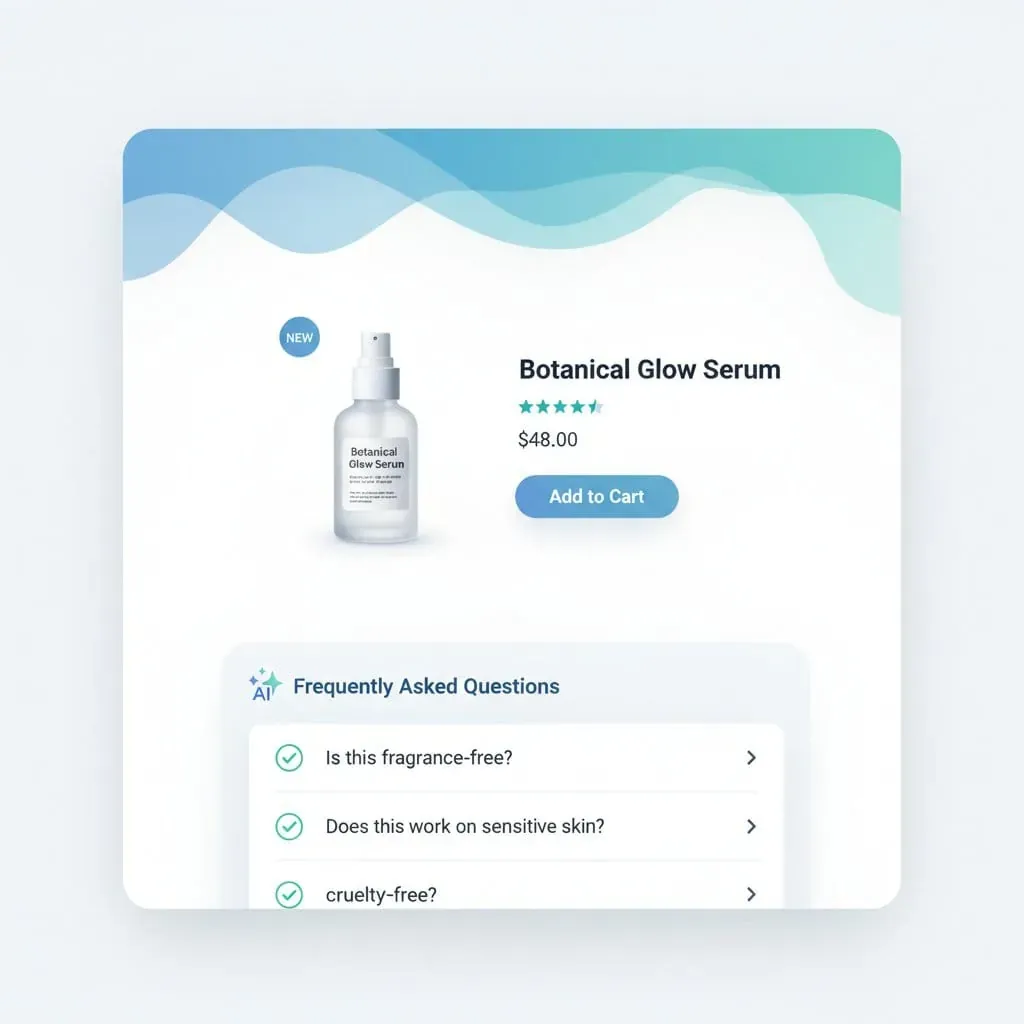
Site-wide FAQs answer generic questions like "What's your return policy?" or "How long does shipping take?" They don't address the specific queries a shopper actually has when they're staring at a specific product: Does this jacket run large? Will this serum work on sensitive skin? Is this compatible with my setup?
Manual per-product FAQs start strong but decay fast. Someone writes five questions at launch, then never updates them. New customer concerns go unanswered. Seasonal questions ("Will this arrive by Christmas?") stay live in March. And for catalogs with hundreds or thousands of SKUs, writing and maintaining per-product FAQs by hand simply isn't feasible.
The data confirms the cost. 35% of mobile shoppers cite lack of product information as a direct barrier to purchasing, per MarketingLTB research. And Baymard Institute pegs the average cart abandonment rate at over 70%, with unanswered questions being a key contributor.
The Bottom-of-Funnel Gap Most Brands Ignore
Here's the thing about product detail pages: the shoppers who reach them are already deep in the funnel. They've searched, browsed, and clicked through to a specific product. They're not researching the category. They're evaluating this product.
At this stage, most purchase decisions hinge on one or two unresolved questions. "Is this moisturizer fragrance-free?" "Will this desk fit in a 48-inch space?" "Can I use this with my existing charger?" Whether it's about sizing, compatibility, or ingredients, these aren't objections. They're micro-hesitations, and they're the last thing standing between a shopper and the Add to Cart button.
Product descriptions and reviews only partially fill this gap. Descriptions are written by the brand and tend to focus on features and benefits, not edge-case questions. Reviews are unstructured and hard to scan for specific answers. Neither is designed to catch the long tail of product-specific questions that real buyers ask.
That's exactly where AI-generated product FAQs fit. They surface the answers to the questions shoppers are most likely to have, right where and when they need them, on the product page itself.
How AI-Generated Product FAQs Actually Work
AI-powered product FAQs aren't templates filled with placeholder text. They're automatically generated for each product based on multiple data sources:
- Product catalog data: specifications, dimensions, materials, ingredients, compatibility info pulled directly from the store's catalog.
- Customer reviews: common themes, praise, complaints, and questions extracted from review content.
- Historical support tickets: real queries previous buyers asked, providing details about this product or similar products.
- Brand policies: shipping instructions, returns, warranties, applied contextually to the specific item.
The underlying technology is Retrieval-Augmented Generation (RAG). Instead of the AI "guessing" answers from its training data, a RAG system first retrieves verified information from these sources, then generates a natural-language answer grounded in that data, matching your brand's tone. If the product weighs 2.3 pounds, the FAQ says 2.3 pounds, not "approximately 2-3 pounds."
Alhena AI's Shopping Assistant takes this further with what it calls Agentic RAG, using intelligent content segmentation that breaks documents down by semantic structure. The system pulls from product catalogs, help centers, and past conversations to generate answers that are specific, accurate, and aligned with the brand's voice. Alhena's Product Review agent also mines review data to surface common questions buyers have already answered for each other.
Avoiding Hallucinations: Why Accuracy Is Non-Negotiable
The biggest risk with AI-generated product content is hallucination: plausible-sounding answers that are factually wrong. A skincare FAQ that invents an ingredient, or a furniture FAQ that states the wrong dimensions, doesn't just fail to convert. It actively increases returns and erodes trust.
This is where most generic AI tools break down. General-purpose chatbots generate answers from pattern recognition, not verified data. They might confidently tell a customer that a product is dishwasher-safe when it isn't.
Purpose-built ecommerce AI systems solve this by grounding every answer in the store's own data. Alhena's approach includes built-in watchdog systems that detect when the AI lacks sufficient data to answer accurately, and either flags the gap or escalates to a human agent. The result is hallucination-free responses that brands can trust to sit on their product pages without manual review of every answer.
Brands like Tatcha have seen 3x conversion rates and 38% AOV uplift using Alhena's AI, with 11.4% of total site revenue attributed to AI-assisted interactions. That kind of performance requires the AI to be right, not just fast.
Where to Place FAQs on the Product Page
Placement optimization matters as much as content quality. Where you position FAQs on the page can ensure they catch shoppers at the right moment. Research and A/B testing point to a few clear best practices:
- Below the primary purchase section, near Add to Cart.
- Accordion (collapsible) format, especially on mobile.
- Top 5 questions visible, rest expandable.
- On checkout pages too.
The Revenue Case: Why This Feature Drives Half the Lift
The conversion math is compelling. Answerbase research shows that up to 75% of answered product questions convert to a sale. Amazon's product Q&A sections contribute to 30%+ higher dwell-time conversion rates, and their overall conversion rate (roughly 13%) runs about 4x the ecommerce average.
Beyond direct conversion, product FAQs deliver compounding benefits:
- Lower return rates. When shoppers get accurate answers before buying, they make better purchase decisions. The NRF reports $849.9 billion in annual returns, with 19.3% of online purchases being sent back.
- Fewer support tickets. Brands using FAQ strategies report up to 56% fewer support tickets, according to Gorgias. Crocus achieved an 86% deflection rate with Alhena's AI.
- SEO value. Product-specific FAQ content drives 17% to 48% of organic traffic to ecommerce sites. Customers arriving through Q&A content show up to 2x higher lifetime value than standard search traffic.
When you combine the direct conversion lift, the reduction in returns and support costs, and the organic traffic gains, it's not hard to see how this single feature can account for half of the total revenue impact from AI on your site.
Getting Started with AI Product FAQs
You don't need a six-month implementation plan. Alhena AI deploys in under 48 hours, connects to your product catalog through native integrations with Shopify, WooCommerce, Salesforce Commerce Cloud, and other major platforms, and starts generating product-specific FAQs immediately, pulling from your existing product documentation and digital catalog.
The system learns from every interaction, adapting to changes in your catalog and surfacing insights from new customer conversations. As shoppers ask new questions, the AI identifies patterns and adds those Q&As to the product's FAQ set. What starts as five auto-generated questions per product grows into a self-optimizing knowledge base that continues to enhance itself, becoming a comprehensive, always-current knowledge base that no manual process could maintain.
If you want to see how much revenue AI product FAQs could add to your store, try the ROI Calculator. Ready to get started? Book a demo with Alhena AI or start for free with 25 conversations.

Frequently Asked Questions
What are AI product FAQs on PDPs?
AI product FAQs are dynamically generated question-and-answer sections placed directly on product detail pages. Instead of static, manually written content, AI uses product catalog data, customer reviews, and historical support tickets to create accurate, product-specific answers that address real buyer questions.
How much do AI-generated product FAQs improve conversion rates?
PowerReviews data shows shoppers who interact with Q&A content on product pages convert at 177% higher rates. Answerbase research indicates that up to 75% of answered product questions convert to a sale. These are bottom-of-funnel shoppers with high purchase intent, so addressing their final questions has an outsized impact on revenue.
Where should I place product FAQs on a product page?
Place them below the primary purchase section, near the Add to Cart button. Use an accordion (collapsible) format, especially on mobile where testing shows a 19% lower bounce rate and 11% higher add-to-cart rate. Surface the top 5 most-asked questions visibly, with additional questions expandable.
How does AI avoid hallucinations in product FAQs?
Purpose-built ecommerce AI systems like Alhena use Retrieval-Augmented Generation (RAG), which grounds every answer in verified product data from your catalog, reviews, and support history. The AI retrieves real data before generating answers, rather than guessing from training data. Watchdog systems flag gaps when the AI lacks sufficient information.
Can AI product FAQs work with my existing ecommerce platform?
Yes. Alhena AI integrates natively with Shopify, WooCommerce, Salesforce Commerce Cloud, and Magento. The system connects to your product catalog and starts generating product-specific FAQs within 48 hours, with no developer resources required for setup.
Do product page FAQs help with SEO?
Product-specific FAQ content drives 17% to 48% of organic traffic to ecommerce sites, according to Answerbase. Customers arriving through Q&A content show up to 2x higher lifetime value than standard search traffic. Structured FAQ content also positions your product pages for AI-powered search and discovery engines.
How do AI product FAQs reduce support tickets?
By answering common product questions proactively on the PDP, AI FAQs prevent those questions from becoming support tickets. Brands using FAQ strategies report up to 56% fewer support tickets. Crocus achieved an 86% deflection rate using Alhena AI, freeing support teams to handle complex issues.