If you are searching for an AI chatbot for customer service in 2026, you will find a crowded market with very different philosophies. Some tools are tightly bundled into a helpdesk or CRM. Others are standalone AI agents designed to automate resolution across channels. Most claim faster responses, fewer wait times, and higher customer satisfaction. In practice, outcomes depend on how well the bot is grounded in your knowledge base, how safely it can resolve issues, and how smoothly it hands off to human agents when it should.
This guide covers seven widely used, reputable AI powered customer support chatbots. The tone here is intentionally level headed: the goal is to help you choose a tool that fits your customer needs, your support maturity, and your risk tolerance.
What “best” means for AI customer service chatbots in 2026
A strong AI customer service chatbot is not just a chat widget that can answer FAQs. The best systems combine:
- Natural language processing and conversational AI that can handle messy, real customer queries and inquiries
- Reliable grounding in your knowledge base (and ideally, ticket history) so it can respond with accurate, brand safe responses
- Workflow actions (refunds, order tracking, subscription changes) so you can truly streamline and automate support
- Clear escalation to agents, with context passed through so humans do not repeat questions
- Reporting that helps you analyze conversations, identify failure modes, and improve automation over time
With that frame, here are the seven.
1) Alhena AI
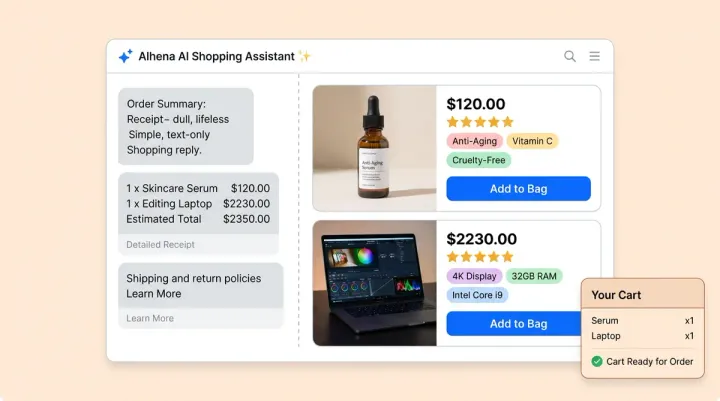
Alhena positions itself as a customer support concierge built around accurate, on-brand automation, with an emphasis on grounding, fast onboarding, and integrating with existing helpdesks and knowledge sources. (Alhena)
A measured way to think about Alhena is as a system optimized for teams who want AI chatbots that do two jobs well: handle support inquiries with high accuracy and enable more personalized customer conversations when the shopper journey overlaps with service. Our product framing emphasizes uploading knowledge, connecting to existing systems, and making the AI behave consistently with brand guidelines.
Where it tends to shine
- Strong emphasis on grounding and brand alignment, which directly impacts whether a bot can safely respond at scale
- Designed for practical support use cases like returns and order tracking, which are common sources of repetitive queries
- Evidence of real world distribution via commerce ecosystems like Shopify, which is often a proxy for usability and deployment patterns in e-commerce support teams
Trade-offs to consider
- If you are primarily a complex enterprise case management shop, you may still prefer a bot tightly embedded in your existing ITSM or CRM platform
- Like any AI customer service agent, long term performance depends on continuous QA, content updates, and monitoring
Best for
Teams that want to automate high volume customer support conversations while keeping a tight handle on tone, accuracy, and the handoff between bot and human agents.
2) Intercom Fin
Intercom’s Fin is one of the most visible “AI agent” offerings for customer service. Intercom emphasizes breadth of channels and fast, accurate answers, with a model where the AI handles routine conversations and escalates the rest to humans. (intercom.com)
Where it tends to shine
- Fast time to value if you already use Intercom for chat, inbox, and help center
- Designed to support a modern conversational experience, with escalation to humans as part of the default workflow
- Strong positioning around handling a meaningful volume of questions without degrading the overall customer experience.
Trade-offs to consider
- Like most AI chatbots, the quality ceiling is set by your knowledge base, policy clarity, and how often edge cases appear
- If your support org is heavily ticket based in another helpdesk, you may face operational duplication
Best for
Support teams that run customer messaging in Intercom and want a production-grade conversational bot that can absorb repetitive inquiries and reduce wait times.
3) Ada
Ada is a long standing player in customer service automation, and in 2026 it leans hard into an “AI agent” narrative: higher automated resolution, omnichannel continuity, and systems to test and optimize bot performance. (Ada)
Where it tends to shine
- A clear emphasis on automated resolution at scale, not just basic chat deflection
- Omnichannel posture, aiming for continuity of identity and context across customer interactions
- A more “operations” mindset, with language around testing and ongoing improvement so teams can analyze performance and iterate.
Trade-offs to consider
- High automation ambitions require real investment in content, governance, and QA
- Enterprise requirements (compliance, complex policy, multiple lines of business) can increase implementation scope
Best for
Organizations that want to use AI to automate a large share of customer support while keeping control over performance and experience quality.
4) Salesforce Service Cloud with Agentforce
Salesforce is a different category because it starts from the CRM and case management layer. Its AI for service focuses on bringing AI into the flow of work, including self-service answers grounded in a knowledge base and autonomous agent experiences via Agentforce. (Salesforce)
Where it tends to shine
- Natural fit if Service Cloud is your backbone for cases, customer data, entitlements, and workflow
- Strong “single system” story: AI that can reference service context, customer history, and knowledge content
- Clear self-service positioning around surfacing answers grounded in your knowledge base in portals and chat.
Trade-offs to consider
- Implementation can be heavier than chat-first tools, especially if your org is not already standardized on Salesforce
- Many teams still need careful scoping to ensure the AI responds safely and escalates correctly on high-risk requests
Best for
Enterprises that want artificial intelligence embedded in their service operations and CRM, especially where context and workflow matter more than just chat deflection.
5) Freshworks (Freshdesk) with Freddy AI
Freshworks targets teams that want practical automation without the weight of a large enterprise suite. Freddy AI is positioned as built in AI for automated customer support, plus agentic workflows and handoff to humans. (Freshworks)
Where it tends to shine
- Faster setup and a more accessible operational model for SMB and mid-market teams
- Practical bot capabilities paired with support workflows, designed to reduce repetitive work for agents
- Explicit focus on security and governance at scale, which matters as you automate more customer service conversations.
Trade-offs to consider
- Deep customization and complex enterprise orchestration may be more limited than top tier enterprise platforms
- As with all AI tools, results depend on how well the knowledge and policies are curated
Best for
Customer support teams that want to streamline resolution, reduce wait times, and add AI powered automation without overhauling their entire stack.
6) ServiceNow Virtual Agent (with Now Assist)
ServiceNow is often chosen when support is deeply tied to enterprise workflows, identity, and internal systems. Virtual Agent is positioned as an enterprise conversational experience to resolve common requests, with Now Assist bringing generative AI into the mix. (ServiceNow)
Where it tends to shine
- Strong fit for enterprises that already live in ServiceNow for workflows and request fulfillment
- A practical path to automate common requests and triage, where the bot is part of a broader automation fabric
- Explicit use of natural language processing to power self-service experiences
Trade-offs to consider
- It can be overkill if your primary need is straightforward customer chat on a marketing site
- The best deployments often require careful design across workflow owners, not just the support team
Best for
Enterprise environments where customer service, IT, and operations workflows intersect, and where the bot must reliably trigger automation beyond simple Q&A.
7) Zendesk AI Agents
Zendesk remains a default choice for teams that already run their helpdesk in Zendesk and want AI that is integrated into existing support operations. In 2026, Zendesk positions its AI agents as capable of resolving a large share of customer and employee interactions across channels, with a focus on deployment speed and tight coupling to the Zendesk environment. (Zendesk)
Where it tends to shine
- Strong fit if Zendesk is already your system of record for tickets, macros, routing, and agent workflow
- Practical automation for common customer service work, plus assistive features that support human agents
- Clear operational framing: treat the bot as part of your service stack, not a side project
Trade-offs to consider
- Best outcomes often depend on disciplined knowledge management and help center hygiene
- Complex workflow automation can require additional configuration and governance
Best for
Teams already committed to Zendesk that want an AI powered path to deflection, faster first response, and more consistent customer support across channels.
A practical way to choose between these AI chatbots
If you want a simple decision lens, start with your system of record:
- Zendesk shop: Zendesk AI Agents are usually the first serious option because they integrate cleanly into existing workflows.
- Intercom shop: Fin is built for chat-first support and can reduce wait times quickly if your help content is strong.
- Salesforce shop: Service Cloud AI makes the most sense when CRM context and workflow actions matter.
- ServiceNow enterprise workflows: Virtual Agent is compelling when automation must reach deeper systems.
- Freshdesk mid-market: Freddy AI is a pragmatic path for teams that want automation and agent assist without heavy lift.
- High automation focus across channels: Ada is built around performance optimization and automated resolution.
- E-commerce concierge model: Alhena is worth a close look when support and shopping conversations blur and brand safe accuracy is the priority.
What to measure after you launch
To keep this grounded, measure outcomes in a way that captures both automation and experience:
- Containment and escalation quality (did the bot resolve, or did it deflect poorly)
- Time to first response and overall wait times
- CSAT or proxy signals for customer satisfaction
- Reopen rates and “handoff friction” for human agents
- Topic gaps in the knowledge base (what the bot could not answer, and why)
The best teams treat AI chatbots as an operating system: you deploy, monitor, analyze, fix knowledge gaps, tune policies, and improve the conversational experience over time.
Closing advice - Here is a useful perspective from an expert in the field on how to get the best from AI chatbots.