The Definitive Guide to AI Shopping Assistants (2026)
Everything you need to know about AI-powered shopping experiences
Contents
What is an AI shopping assistant
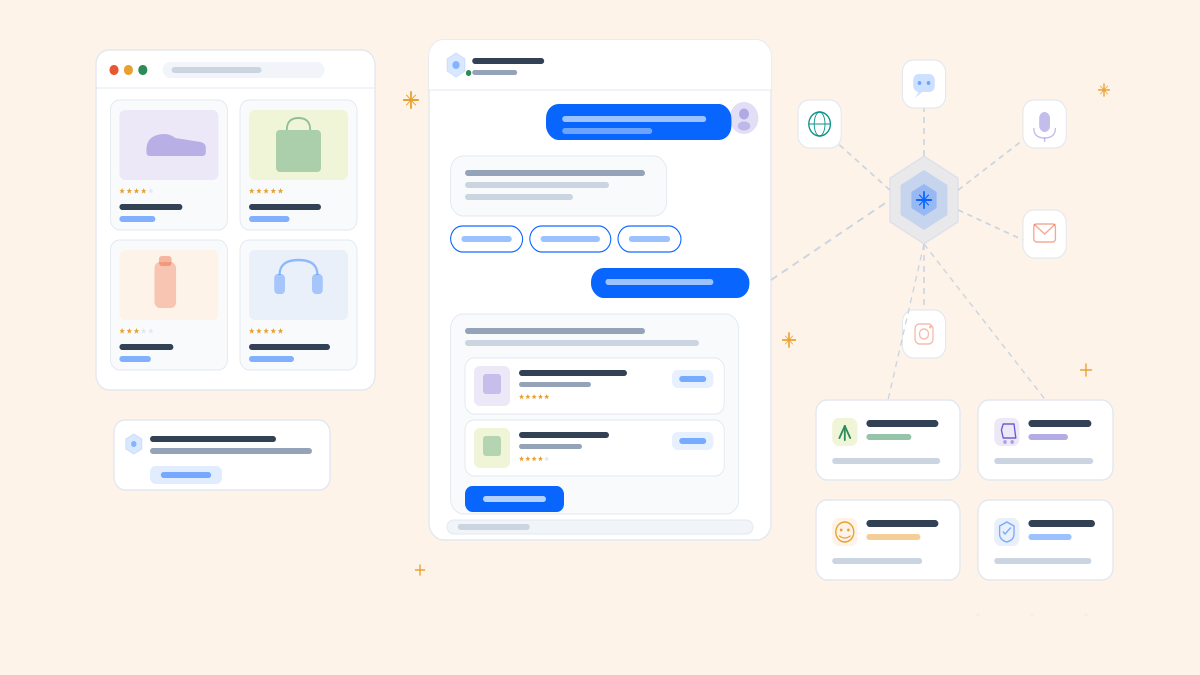
An AI shopping assistant is a digital agent that communicates in natural language, understands intent, and helps shoppers discover, compare, and buy the right products. It lives across all digital channels like website, mobile, email or SMS, social DMs, and voice. It listens, clarifies, grounds its answers in your catalog and policies, and can take real actions that reduce friction at checkout.
For example: A shopper types, "Need a carry-on for a 2-day trip, not too heavy." The assistant interprets "2-day trip" as a small capacity requirement and "not too heavy" as a weight constraint. It shortlists three options that meet airline size rules and explains the tradeoffs in plain language. The shopper adds one to cart without clicking through five filter menus.
A good AI shopping assistant is the digital equivalent of a reliable store associate that reduces effort and enriches the shopping experience for the shopper.
How it works: from words to actions
Under the hood, most assistants follow the same SOP: Interface → Understanding → Grounding → Reasoning → Action → Safeguards → Learning.
- Interface captures text or voice and returns answers quickly enough to feel conversational.
- Understanding maps messy language to structured intent. "Run hot in Austin" becomes breathable fabrics and hot-weather use.
- Grounding pulls facts from your catalog, inventory, policies, and reviews so the model is not guessing.
- Reasoning weighs options with your brand's rules, such as preferring in-stock items with lower return rates.
- Action executes tasks like adding to cart, applying promos, or starting an exchange.
- Safeguards keep tone and claims on-brand and safe.
- Learning closes the loop by tracking outcomes, spotting recurring gaps, and improving prompts and data.
Mini-walkthrough
Let's look at an example of how a user query is processed by the AI assistant.
User: "Is this moisturizer non-comedogenic and safe with tretinoin?"
- Understanding detects "non-comedogenic" and "compatibility with tretinoin."
- Grounding fetches INCI list and internal dermatology guidance.
- Reasoning matches against a non-comedogenic list and contraindications.
- Action offers the best fit and an alternative for sensitive skin.
- Safeguards add a brief caution and invite human help if needed.
- Learning logs which explanation led to add-to-cart.
Top use cases across the journey
Assistants add value from first touch to loyalty. Early in the visit, they translate natural language into precise options. During discovery, they explain tradeoffs in simple terms. Before checkout, they resolve doubts and present a fair path to free shipping without gimmicks. After purchase, they handle exchanges without friction and nudge helpful add-ons at the right time.
First visit engagement
Goal: Turn curiosity into exploration. You could use a tapable ice-breaker prompt to elicit engagement from users.
Example: "Gifts under ₹3,000 for a home chef." The assistant returns a short list with one-line reasons and a link to a comparison.
Ice-breakers are an especially powerful avenue to unlock the performance of an AI shopping assistant. To learn more about it consider reading "Icebreakers: The Emerging Cheatcode to Boost Sales in e-commerce".
Discovery and education
Goal: Map fuzzy language to precise attributes.
Example: "Sheets that stay cool" yields percale or linen choices, GSM guidance, and care notes.
Guided selling and bundles
Goal: Build sensible carts.
Example: "New puppy starter kit" asks two clarifiers, then assembles a swappable bundle.
Confidence and objection handling
Goal: Unblock checkout.
Example: "Is this non-comedogenic with tretinoin?" The assistant checks ingredients and offers a gentler alternative.
Cart and checkout assist
Goal: Finish fairly and fast.
Example: "I am ₹1,000 short of free shipping." It suggests a relevant add-on and shows delivery dates.
Save-the-sale
Goal: Recover intent respectfully.
Example: Cart with size 8 trail shoes triggers a message offering a 30-second fit check or a wide-toe alternative.
Support automation
Goal: Resolve common requests with context.
Example: "Exchange to a gel moisturizer." The assistant initiates the exchange and suggests two gel options.
Loyalty, reviews, and referrals
Goal: Nudge with utility.
Example: After a skillet purchase, suggest a compatible splatter guard timed to likely cooking frequency.
Community and service moments
Goal: Add value beyond the product.
Example: "Beginner trails near me with this daypack?" Provide a short local guide and a checklist.
For more on the top use cases that AI powered shopping assistants can serve, consider reading "AI Shopping Assistant - Top Use cases (2025)".
They can support Voice operation
Voice speeds routine decisions and improves accessibility. Multimodal flows let shoppers speak, see, and communicate naturally. The best assistants can deliver a voice experience that listens continuously to the user during short exchanges, handles background noise, and switches to a visual comparison when screens are useful. It also follows voice-specific guardrails so disclaimers and sensitive topics are handled correctly.
Reliable voice support gives birth to hands-free shopping. Making shopping as easy as speaking to your phone or computer:
- "Find a lightweight rain jacket for a windy city." One clarifier, then a readout of a short list with a visual compare appears.
- "Start a size exchange for the blue shirt." The label is created and emailed without form juggling.
They deliver positive ROI immediately
Plug real numbers into our interactive ROI calculator below and run sensitivity tests on adoption and lift. Start with a pilot on a subset of traffic to validate assumptions before scaling.
[ROI Calculator widget]
Market landscape: types of assistants and where they fit
AI shopping assistants come in several shapes. Choose the shape that matches your bottleneck.
Common categories
- Helpdesk-native assistants focused on ticketing.
- Conversion-focused assistants that specialize in personalization, recovery, and upsells.
- Guided-selling advisors for complex, attribute-heavy catalogs.
- Marketplace-scale search assistants that steer intent in very large catalogs.
- Conversational search and visual discovery tools for style-led categories.
- Platform orchestrators that blend chat with lifecycle messaging.
- Full-funnel, revenue-first platforms that combine search, voice, nudges, and actions across the journey.
How to pick by problem
- If repetitive support eats your budget, start helpdesk-native, then add selling.
- If discovery bounces are high, prioritize guided selling and conversational search.
- If cart recovery is weak, test conversion-focused assistants with bundling logic.
- If you need breadth across channels, consider full-funnel platforms that fit your stack.
For a look at prominent AI shopping assistants available on the market, consider reading "7 Best AI Shopping Assistants for Ecommerce Growth in 2025".
How to choose: selection criteria and due diligence
More AI implementations fail than succeed. Which is mostly down to a rushed implementation process or poor product configuration. In your AI shopping assistant, prioritize grounded answers, real actions, low latency, and fit with your stack. Look for clear data boundaries, a style system that keeps tone consistent, and observability that lets your team review conversations, run A/B tests, and version changes. Avoid deep lock-in by keeping model choice and hosting flexible. Ensure the assistant works across web, app, email or SMS, social DMs, and voice so customers are helped wherever they reach out.
Core capabilities to insist on
- Grounded answers from catalog, inventory, policies, and reviews.
- Agentic actions: add to cart, apply promos, start exchanges, check status.
- Guided selling that asks clarifiers and explains tradeoffs briefly.
- Conversational search for synonyms and constraints.
- Omnichannel coverage across web, app, email or SMS, social DMs, and voice.
Controls and safety
- Brand voice with examples, not vague adjectives.
- Guardrails and refusal rules across sensitive topics.
- Observability with conversation review, analytics, A/B tests, and version control.
- Moderation and escalation to humans when confidence is low.
Performance and operations
- Low latency with streaming and efficient tool calls.
- Model and cloud flexibility to avoid lock-in.
- Security with encryption, access control, and clear retention.
- Multimodal in and out: voice and images.
- Integrations with commerce, payment, shipping, and helpdesk.
- Maintenance that auto-ingests and flags drift.
- Cost transparency and the ability to pilot on a subset of traffic.
Due diligence questions
- What percentage of answers are grounded in our sources during a blind test.
- Action success rate for cart, promo, exchange, and status tasks.
- P95 time to first token and to full reply on a mobile network.
- How conversation review, A/B testing, and version rollbacks work.
- Data usage, retention, and model training boundaries.
- Portability if we change model providers.
- Evidence from similar catalogs and traffic levels.
Benchmarks and stress testing
A credible AI program begins by thoroughly vetting the product up for adoption. We want to measure accuracy, action completion, speed, tone, and deflection quality in real world environments. Here's what to keep in mind while evaluation AI shopping assistants.
What to benchmark
- Accuracy of grounded answers by category.
- Action success rate for cart, promo, exchange, and status.
- P95 latency to first token and final token.
- Deflection quality: solved once without bounce-back.
- Tone safety and correct refusals.
- Revenue influence with holdouts.
Stress-test scenarios
- Low-signal requests: "Sheets that do not pill but stay cool."
- Conflicting constraints: "Under 500 g, 30 L capacity, below ₹3,000."
- Edge cases: Out-of-stock, preorder dates, size exchanges near policy bounds.
- Safety topics: Allergens, medical-adjacent claims, battery travel rules.
- Adversarial prompts: Attempts at prompt injection or tool abuse.
Artifacts to produce
- Golden dataset of 50 to 100 canonical questions per category.
- Evaluation scripts with pass or fail thresholds.
- Change log of prompt and tool updates.
- Weekly memo summarizing accuracy, latency, and what improved.
Want a ready made report on the performance of all prominent AI shopping assistants under stress in the real world? Check out "2025 Field Study: Real-World Stress Test of CX Automation Tools".
Why "no assistant" hurts: UX and business impact
Running a modern storefront on navigation, filters, and static FAQs alone places the cognitive load on the shopper. People arrive with fuzzy intent and natural language. Sites respond with rigid filters and keyword logic. This mismatch creates friction that is invisible in a dashboard but very real in the shopper's mind.
On the experience side, customers bounce when they face filter fatigue or dead ends. A linen-curious shopper who types "sheets that stay cool and do not pill" must translate that into weave, GSM, and fabric blends. If the site does not guide the translation, the shopper either guesses keywords or leaves. On the business side, you see lower conversion on discovery pages, smaller baskets because relevant add-ons are not surfaced.
UX pain that shoppers feel
- Filter fatigue when attribute names are unclear.
- Keyword roulette where "breathable" fails to match "percale."
- Decision paralysis on mobile with no side-by-side "why this vs that."
- Dead ends when questions about fit, compatibility, or delivery require channel switching.
- Accessibility gaps for voice, vision, or keyboard-only users.
Business symptoms you see
- Lower conversion on discovery pages with fuzzy intent.
- Smaller baskets when compatible add-ons are not surfaced.
- Higher abandonment due to unanswered delivery, fit, or promo questions.
- Repetitive tickets (WISMO, promo rules, basic compatibility).
- Weak first-party signals for merchandising and lifecycle marketing.
Quick diagnostic checklist
- Percent of searches with no or low results.
- Exit rate on heavily filtered category pages.
- Time spent on product description pages combined with low add-to-cart rate.
- Share of cart sessions that exit within 30 seconds after a shipping or promo query.
- Mobile sessions with more than 5 filter interactions.
When shopping assistants fail customers and how to avoid it
A poor rollout can be worse than no assistant. The most damaging error is ungrounded answers. If the model responds from memory rather than your data, it may sound confident while being wrong. The fix is strict grounding. Limit answers to your catalog, policies, and approved references. Give the model narrow tools and require evidence internally before a reply is sent.
Another common failure is the explain-but-cannot-do assistant. It recommends a moisturizer but cannot add it to the cart or start an exchange. That breaks the spell. Wire the essentials first: cart operations, promo application, order status, returns and exchanges. Keep latency in check by streaming replies and minimizing serial API calls. Train the assistant to ask one or two smart clarifying questions when intent is ambiguous. Set a clean path to human help whenever confidence is low or the user asks for a person.
Frequent failure modes and practical fixes
Ungrounded answers
Cause: Freeform LLM replies with open-web memory.
Fix: Enforce retrieval from your catalog and policies. Internally require evidence before replies.
Answers without actions
Cause: Recommendations that cannot add to cart or start exchanges.
Fix: Wire cart, promos, order status, returns, and exchanges first.
High latency and verbosity
Cause: Long prompts and serial tool calls.
Fix: Stream early tokens, parallelize safe calls, lead with the answer, and keep text concise.
No clarifying questions
Cause: Intent handling stops at a first guess.
Fix: Train one to two smart clarifiers for ambiguous requests like budget and size.
Inventory or promo drift
Cause: Stale caches or expired rules.
Fix: Scheduled re-ingestion, cache TTLs, out-of-stock aware reasoning, and promo eligibility checks.
Off-brand voice or unsafe tone
Cause: No style system or moderation pass.
Fix: Style guides with examples and a tone checker before send.
No human handoff
Cause: Overconfident thresholds block people from agents.
Fix: Always expose a "talk to a person" path and pass full context.
Set-and-forget operations
Cause: No feedback loop.
Fix: Golden datasets, auto-scored evals, weekly quality review, and staged rollouts.
Operational cadence that works
- Daily: Check error budget, latency, and the five highest volume intents.
- Weekly "Quality Council": Review evals, update prompts and tools, publish what changed.
- Monthly: Expand the golden set, refresh bundles and promos, rotate A/B tests, retire low-value flows.
Acceptance criteria before scaling
- P95 reply latency under your defined target.
- Grounding rate above threshold with auditable references.
- Action success rate for cart, exchange, and status checks above threshold.
- Correct refusals and respectful escalations for low confidence or sensitive topics.
Risks and disadvantages, plus mitigations
AI assistants introduce power and risk together. Treat the following as product requirements, not afterthoughts.
- Privacy and data handling: You will process PII, purchase history, and possibly voice or images. Minimize data, ask for consent for camera or mic, encrypt everywhere, and keep retention short.
- Compliance and policy drift: Claims, shipping promises, and refunds must reflect current policy. Build a pre-send policy check that refuses risky claims and always links back to the source policy.
- Inaccurate or unsafe answers: Strict grounding and sensible refusals protect trust.
- Brand voice misalignment: Codify tone with examples and audit it regularly.
- Over-automation: Always keep a clear route to human help. Customers should never feel trapped.
- Latency and reliability: Slow answers feel like indifference. Stream early tokens and have timeouts and fallbacks.
- Cost sprawl and lock-in: Watch usage, cache results where legal, and keep your architecture portable across models and vendors.
- Accessibility gaps: Follow WCAG (Web Content Accessibility Guidelines) on the widget, provide captions for voice, and support keyboard navigation.
What to expect: business outcomes and KPIs
Teams that implement carefully see improvements that map directly to core metrics. Assisted sessions convert more often because the assistant clarifies needs and removes doubts. Average order value rises as bundles and compatible add-ons are suggested at the right moment. Abandonment falls when delivery dates, inventory, and return policies are answered inside the conversation. Common tickets deflect because WISMO, promos, and compatibility questions are handled instantly. Customer satisfaction improves when tone is consistent and the assistant escalates respectfully.
Measure success with a control group so you attribute fairly. Track assisted conversion against your baseline, AOV uplift on assisted orders, abandonment reduction, ticket deflection with quality checks, time to first response, time to resolution, and CSAT on AI interactions. Tie revenue influence to session-level rules rather than last-touch stories. This gives you a clean view of incrementality rather than wishful attribution.
If your baseline conversion is 2 percent and assisted sessions convert at 2.5 percent with 25 percent of visitors engaging, you will see a measurable lift in orders that should be visible within the first month. Layer in an 8 percent AOV uplift from better bundles and your payback math becomes straightforward.
Implementation plan: from 2-week MVP to scale
Start narrow, measure honestly, and iterate weekly. A disciplined approach ensures sustainable success.
Success Stories from the Alhena community



FAQs
How is an AI shopping assistant different from a rules chatbot?
A rules bot matches keywords to canned replies. An AI assistant understands layered intent, grounds answers in your data, takes actions like add to cart or start an exchange, and learns from outcomes.
How do we prevent hallucinations and off-brand replies?
Restrict answers to approved sources, set refusal rules, and run a tone check before sending. Keep audit logs for review and improvement.
Will this replace human agents?
No. AI shopping assistants handle mostly repetitive tasks so agents focus on complex cases. Handoffs happen with full context when confidence is low or the user asks to speak to a human.
How fast can we launch?
With a clean catalog and ready integrations, an MVP can go live in days. Start with discovery and WISMO. Add exchanges and voice in week two after validation.
What data do we need?
A current catalog with variants and attributes, images, pricing, and stock. Policy documents and FAQs. Reviews or UGC help with social proof. API access enables actions. Voice or vision requires consent and an accessible UI.
Does this work with Shopify, Salesforce, Zendesk, Magento, and others?
Prominent AI shopping assistants should fit your stack easily. Most have well maintained APIs, webhooks or custom built integration with popular e-commerce apps.
Final take and next steps
Choosing to not employ an AI assistant leaves money and goodwill on the table. Choosing an assistant without grounding, actions, and safety risks both. The winning pattern is a disciplined approach: start narrow, measure honestly, and iterate weekly. Use this guide's diagnostics, stress tests, and KPIs to keep the program anchored to outcomes.
Subscribe to the Alhena Newsletter
Get the latest news in generative AI and customer success