The way Customer service teams operate in changing drastically in 2026.
Over the last decade, customer support has gone from being a back-office function to a core part of the customer experience. Today, it is one of the few places where brands still have direct, high-intent interactions with customers after the sale.
At the same time, Artificial Intelligence powered systems have entered customer service at full speed. Generative AI, conversational AI, and AI customer service platforms are now table stakes in most RFPs. Chatbots are no longer a novelty. Automation is expected.
What is far less clear is how all of this actually shows up in the metrics that matter.
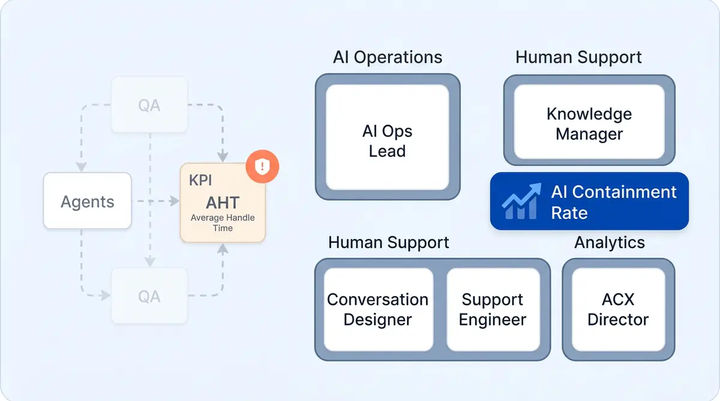
For a framework on building an AI-first CX team, including the five new AI customer service roles and modern KPIs, see our guide to AI-first CX team structure.
This article is written to bring clarity to that question.
Instead of focusing on automation features or tools, we will look at how AI powered customer service changes the most important support KPIs. Average Handle Time. First Contact Resolution. Containment. CSAT. And Time-to-First-Value.
The goal is not to sell AI bots. It is to help you understand how AI behaves in real customer support environments, and how to measure success without fooling yourself.
Why support KPIs change once an AI chatbot enters customer service
Most customer service KPIs were designed for a world dominated by human agents.
Tickets came in through email or phone. Agents worked queues in real time. Performance was measured by speed, volume, and resolution. This model held up reasonably well for years.
Generative AI changes the shape of this system.
AI customer service tools intercept customer interactions before they become tickets. Conversational AI resolves some issues instantly. Others are partially resolved and resurface later. Some issues become more complex because the simple ones never reach human agents.
This is why teams often feel disoriented after rolling out chatbots or other AI tools. Metrics move, but not always in the direction expected. One KPI improves dramatically. Another quietly deteriorates.
Understanding how each KPI is affected by AI use is important to deploy AI powered customer support responsibly.
Average Handle Time and why AI does not always reduce it immediately
Average Handle Time (sometimes calles response time), or AHT, is usually the first KPI leadership looks at. It is often treated as a proxy for efficiency and cost.
AI powered customer service does reduce AHT over time, but rarely in a straight line.
In the early stages of automation, AHT often increases. This surprises teams and sometimes causes panic. The reason is simple. Conversational AI and chatbots absorb the easiest customer interactions first. Password resets. Order status. Basic FAQs.
What remains for human agents are the harder cases. These take longer by definition.
As AI tools mature, AHT begins to fall. Agents receive better context. Generative AI assists with drafting responses. After-contact work is automated. Information retrieval becomes instant.
The mistake many teams make is optimizing AHT too aggressively too early. When speed becomes the primary goal, resolution quality suffers. Customers come back. FCR drops. CSAT follows.
AHT should be treated as a lagging indicator in AI customer service, not a primary one.
First Contact Resolution is the KPI AI exposes most clearly
First Contact Resolution tells you whether customer needs were actually met.
In an AI powered customer service environment, FCR becomes even more important because it reveals whether automation is truly effective or just fast.
Conversational AI improves FCR when it completes full workflows, not just answers questions. This includes returns, exchanges, order changes, subscription updates, and account actions. These are not single responses. They are sequences of interactions.
Where AI customer service systems struggle, FCR declines quietly. Chatbots provide confident answers that do not fully resolve the issue. Customers disengage and return later. From the system’s point of view, nothing went wrong. From the customer’s point of view, trust eroded.
The best teams measure FCR across AI and human agents together. They treat resolution as an end-to-end outcome, not an interaction-level metric.
Containment is useful, but only when framed correctly
Containment, often referred to as deflection, measures how many customer support interactions are resolved without human agents.
AI powered systems can drive significant containment. This is one of the clearest cost benefits of customer service automation.
The problem is that containment is frequently misunderstood.
High containment does not automatically mean good customer experience. If using AI prevents escalation when escalation is appropriate, customers feel blocked. If chatbots resolve issues partially, tickets come back later and inflate volume.
Healthy containment grows gradually. It is bounded. It is designed with explicit escape hatches to human agents.
The most mature AI customer service teams do not celebrate containment in isolation. They look at containment alongside FCR and CSAT to ensure automation is not creating future demand.
CSAT remains the most fragile metric in AI customer service
Customer Satisfaction is still the fastest way to understand whether your AI powered customer service is helping or hurting the customer experience.
Generative AI can improve CSAT by reducing effort. Customers get answers faster. They do not wait in queues. They do not repeat themselves.
It can also damage CSAT quickly when tone, accuracy, or transparency slip.
Customers are generally comfortable interacting with chatbots. What they dislike is being misled. Overconfident answers. Hallucinated information. Or conversational AI that refuses to hand off to a human agent when needed.
The strongest AI customer service experiences are calm and honest. They set expectations clearly. They escalate smoothly. They respect customer needs rather than forcing automation.
Time-to-First-Value is the KPI leadership actually cares about
Time-to-First-Value is rarely discussed in marketing content, but it is one of the most important metrics internally.
Executives want to know when AI powered customer support will show real impact. Not pilots. Not demos. Measurable change.
In practice, Time-to-First-Value is reached when one of three things happens. Ticket volume decreases. Cost per interaction decreases. Or customer experience metrics stabilize or improve.
AI customer service initiatives often fail not because the technology is weak, but because value arrives too late. Long implementation cycles. Heavy customization. Complex training requirements.
Fast value comes from focus. High-volume intents. Existing data. AI tools that work out of the box and improve over time.
Realistic KPI benchmarks for AI powered customer support
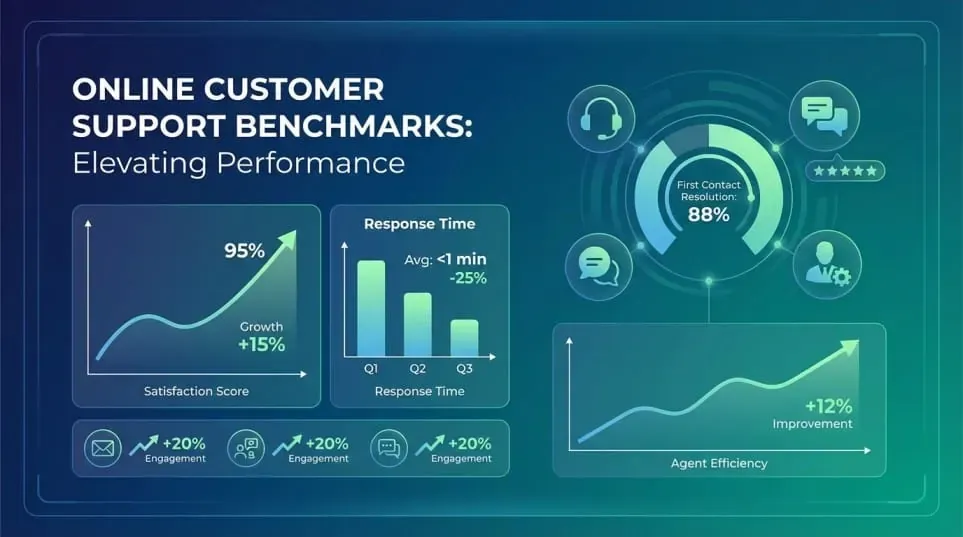
Below are realistic ranges observed across mature digital customer service teams using AI responsibly. These are not best-case scenarios. They are sustainable outcomes.
| KPI | Typical Pre-AI | Healthy Post-AI |
|---|---|---|
| Average Handle Time | 6 to 10 minutes | 4 to 7 minutes |
| First Contact Resolution | 60 to 75 percent | 70 to 85 percent |
| Containment | 0 to 10 percent | 25 to 50 percent |
| CSAT | 70 to 80 percent | 78 to 88 percent |
| Time-to-First-Value | 3 to 6 months | 2 to 6 weeks |
These benchmarks vary by industry and ticket mix, but they provide a grounded reference point.
How this plays out in retail customer service
Retail customer support is dominated by order-related inquiries. Shipping. Returns. Exchanges. Inventory questions. These are well suited for conversational AI.
AI powered retail customer service often sees faster containment gains than other industries. At the same time, partial resolution is a common failure mode. An order status update without the ability to act is not resolution.
Healthy retail benchmarks tend to look like this.
| KPI | Retail Pre-AI | Retail Post-AI |
|---|---|---|
| AHT | 7 to 11 minutes | 5 to 8 minutes |
| FCR | 58 to 72 percent | 70 to 82 percent |
| Containment | 5 to 15 percent | 30 to 55 percent |
| CSAT | 72 to 82 percent | 80 to 88 percent |
| Time-to-First-Value | 3 to 5 months | 3 to 5 weeks |
Retail teams should watch FCR closely as containment increases. Resolution quality matters more than volume reduction.
How beauty and skincare customer service differs
Beauty customer service has a different texture.
Customer queries are more nuanced. Ingredient questions matter. Tone and reassurance matter. Customers often seek personalized guidance rather than transactional answers.
AI customer service can perform well here, but only when accuracy and brand voice are tightly controlled. Generative AI that hallucinates or sounds generic damages trust quickly.
Healthy benchmarks in beauty tend to be slightly more conservative on containment, with higher emphasis on CSAT.
| KPI | Beauty Pre-AI | Beauty Post-AI |
|---|---|---|
| AHT | 8 to 12 minutes | 6 to 9 minutes |
| FCR | 62 to 78 percent | 72 to 85 percent |
| Containment | 0 to 8 percent | 20 to 45 percent |
| CSAT | 75 to 85 percent | 82 to 90 percent |
| Time-to-First-Value | 4 to 6 months | 4 to 6 weeks |
In beauty, customer satisfaction is the leading indicator. If CSAT slips, something is wrong.
How experienced teams realize benefits of AI bots
Customer service KPIs move together.
When FCR improves, CSAT usually follows. When containment rises too quickly, repeat inquiries increase. When AHT drops without resolution, customer frustration builds silently.
AI powered customer service amplifies these dynamics. It makes strong systems stronger and weak systems visible.
Support teams that succeed do not chase vanity metrics. They measure carefully. They involve human agents early. They treat AI as part of the support system, not a shortcut around it.
A final thought
AI does not automatically improve customer service.
It reshapes how customer needs enter the system. It changes how interactions unfold. It exposes gaps in data, process, and tone.
When used thoughtfully, AI powered customer support improves efficiency and customer experience at the same time. When used carelessly, it creates hidden friction.
KPIs are how you tell the difference. Used well, they keep AI honest.