> For the complete documentation index, see [llms.txt](https://alhena.gitbook.io/docs/llms.txt). Markdown versions of documentation pages are available by appending `.md` to page URLs; this page is available as [Markdown](https://alhena.gitbook.io/docs/dashboard/analytics/trending-topics.md).

# Trending Topics

Analyze conversation patterns by topic to understand what customers are asking about.

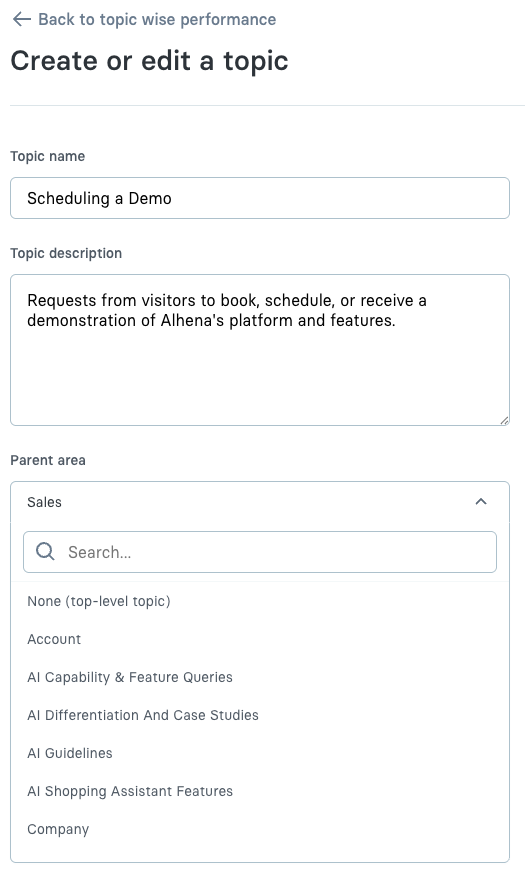
<figure><img src="https://2864633804-files.gitbook.io/~/files/v0/b/gitbook-x-prod.appspot.com/o/spaces%2FKZ3bWFAIdLAqpW2uafZ4%2Fuploads%2Fgit-blob-cbb9e9f0b5301f437ab2cb18fe34ab2b3a3820c6%2Ftrending-topics-dashboard.png?alt=media" alt="Trending topics tab with the Sales parent area expanded and its Scheduling a Demo topic selected" width="563"><figcaption><p><em>The Trending topics tab, with a parent area expanded and one of its topics selected.</em></p></figcaption></figure>

#### 1. Where to find it

1. **Open the Alhena Dashboard.**
2. In the **left-hand navigation**, click **Analytics**.
3. Across the top of the Analytics workspace, choose the **Trending topics** tab

***

#### 2. What you see at a glance

The Trending Topics view is split into two panels:

**Left panel - Topics list**

| Element                | What it shows                                                                |
| ---------------------- | ---------------------------------------------------------------------------- |
| **Topic name**         | The name of each conversation topic                                          |
| **Conversation count** | Badge showing total conversations tagged with this topic                     |
| **AI-generated icon**  | Indicates topics that were automatically created by the AI                   |
| **Expand arrow**       | Shown on a parent area; click it to show or hide the topics grouped under it |
| **Create new**         | Button to add a new custom topic                                             |

Topics are organised in two levels. A **parent area** (for example, "Orders & Shipping") groups related topics (for example, "Where is my order" and "Change delivery address"). In the screenshot above, the **Sales** area is expanded to show its two topics. Each conversation is assigned to one topic. Topics that don't belong to an area appear at the top level on their own. Conversations that don't fit any topic go to **Other**.

Topics are sorted by conversation volume (highest first).

{% hint style="info" %}
Alhena assigns a topic to each conversation shortly after it finishes, so the most recent conversations may take a little while to show up in the counts.
{% endhint %}

**Right panel - Topic details**

| Element                             | What it shows                                                                                                                                                       |
| ----------------------------------- | ------------------------------------------------------------------------------------------------------------------------------------------------------------------- |
| **Topic name and description**      | Details about the selected topic. For a topic inside a parent area, the area's name appears above the topic name                                                    |
| **Line chart**                      | Visualization of conversations over time with two metrics                                                                                                           |
| **Number of conversations**         | Total conversations tagged with this topic (blue line)                                                                                                              |
| **Human-transferred conversations** | Conversations that were escalated to human agents (pink line). Hidden when the **Filter conversations** control is set to anything other than **All conversations** |

***

#### 3. Global filters

| Control                                                  | Why it matters                                                                                                                                                                                                       |
| -------------------------------------------------------- | -------------------------------------------------------------------------------------------------------------------------------------------------------------------------------------------------------------------- |
| **Integration source** (default **All sources**)         | Filter by channel (Chat widget, Web voice, Email, Slack, Discord, Embed, etc.) to see topics by integration.                                                                                                         |
| **AI Profile filter** (default **All AI profiles**)      | View topics across all profiles or focus on a specific one.                                                                                                                                                          |
| **Filter conversations** (default **All conversations**) | Choose **Human-transferred** to see only conversations that were handed to a human agent, or **Not human-transferred** to see only the ones your AI resolved on its own. Topic counts and the chart update to match. |
| **Date range** (default **Last 30 days**)                | Adjust the time period to analyze topic trends.                                                                                                                                                                      |

***

#### 4. Managing topics

| Action                 | How to do it                                                                                                                                                                                                                     |
| ---------------------- | -------------------------------------------------------------------------------------------------------------------------------------------------------------------------------------------------------------------------------- |
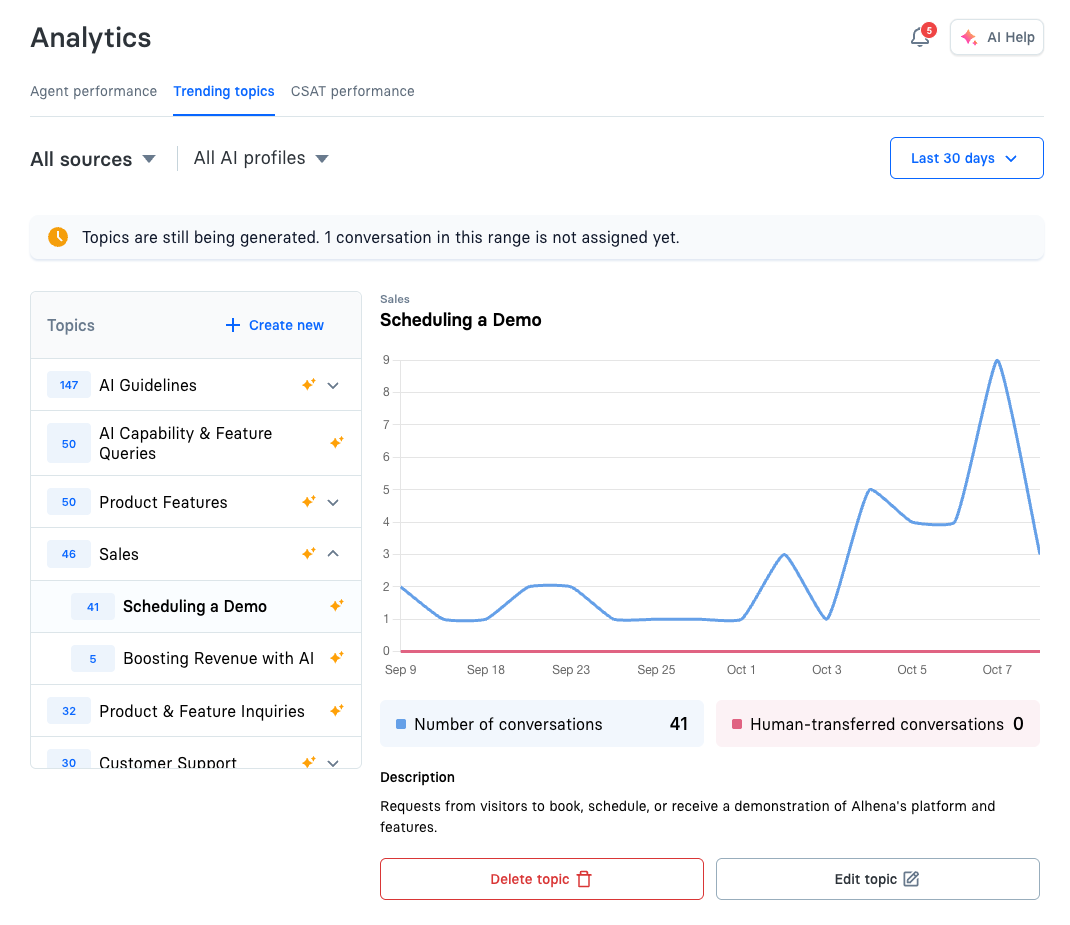
| **Create a topic**     | Click "Create new" and enter a name and description. To group it under a parent area, save it, then edit it and pick a **Parent area**.                                                                                          |
| **Edit a topic**       | Select a topic and click "Edit topic" to update the name, description, or **Parent area**. Pick **None (top-level topic)** to take it out of its area. The Parent area field isn't shown when the topic is itself a parent area. |
| **Delete a topic**     | Select a topic and click "Delete topic" to remove it. Deleting is permanent and can't be undone. Deleting a parent area keeps its topics and moves them to the top level.                                                        |
| **View conversations** | Click "View conversations" to drill down into the actual conversations tagged with this topic.                                                                                                                                   |

<figure><img src="https://2864633804-files.gitbook.io/~/files/v0/b/gitbook-x-prod.appspot.com/o/spaces%2FKZ3bWFAIdLAqpW2uafZ4%2Fuploads%2Fgit-blob-4ac9d898125e5d186584d6a7593bdbfc4f8646c5%2Ftrending-topics-parent-area.png?alt=media" alt="Edit form for the Scheduling a Demo topic with the Parent area dropdown open and Sales selected" width="563"><figcaption><p><em>Editing a topic: the <strong>Parent area</strong> dropdown lists every area, plus <strong>None (top-level topic)</strong>.</em></p></figcaption></figure>

***

#### 5. Practical use-cases

| Goal                                   | How to use Trending Topics                                                                                                                                                |
| -------------------------------------- | ------------------------------------------------------------------------------------------------------------------------------------------------------------------------- |
| **Identify common customer inquiries** | Sort topics by conversation count to see what customers ask about most frequently.                                                                                        |
| **Spot gaps in AI training**           | Set **Filter conversations** to **Human-transferred** to see which topics most often end up with a human agent. These may be areas where the AI needs more training data. |
| **Track seasonal trends**              | Compare topic volumes across different date ranges to identify seasonal patterns.                                                                                         |
| **Measure impact of product changes**  | Monitor if specific topics spike after product updates or releases.                                                                                                       |
| **Organize conversations**             | Create custom topics to categorize conversations in ways that match your business needs.                                                                                  |

***

#### 6. FAQs

**What are AI-generated topics?**\
Topics the AI creates when it notices a recurring theme among conversations in **Other**. Once enough similar conversations build up, Alhena gives them their own topic, placed in a matching parent area. It also merges AI-generated topics that turn out to cover the same thing.

**Why can't I edit or delete "Other"?**\
**Other** collects conversations that don't fit any existing topic, so it's always there. It can't be edited, deleted, or used as a parent area.

**Can I rename an AI-generated topic?**\
Yes, you can edit any topic including AI-generated ones.

**What happens when I delete a topic?**\
The topic is permanently deleted and can't be recovered. If you delete a parent area, the topics inside it move to the top level instead of being deleted.

**Why can't I click "View conversations"?**\
This option requires selecting a specific AI profile (not "All AI profiles").

***

**Trending Topics helps you understand what customers are asking about—enabling you to improve AI training, identify knowledge gaps, and track how conversation patterns change over time.**

***

#### See also

* [Agent Performance](/docs/dashboard/analytics/agent-performance.md) - Track conversation volume, AI vs. human handled interactions, and credit usage
* [Revenue Impact](/docs/dashboard/analytics/revenue-impact.md) - Measure the revenue contribution of your AI agent with cart and GMV analytics
* [CSAT Collection](/docs/dashboard/analytics/csat-collection.md) - Set up customer satisfaction feedback collection after AI interactions